
HOSA Nutrition Assessment Practice Test
$69.00
- Buy to unlock unlimited access to all Quiz questions and Answers in this Quiz.
- After purchase you can print a PDF of the whole quiz at any point. The PDF will contain the questions and the correct answers.
About this Exam
The HOSA Nutrition Assessment examination is a prestigious competitive event designed for dedicated members of HOSA–Future Health Professionals who are aiming for careers in healthcare, particularly in dietetics and nutritional science. This competition challenges students to master the critical role that nutrition plays in patient wellness, disease prevention, and treatment protocols. By utilizing this dedicated practice exam, students preparing for regional, state, or international leadership conferences can test their knowledge against standard HOSA benchmarks. This study tool is specifically crafted for high school and collegiate students looking to validate their understanding of dietary guidelines, nutritional calculations, and the assessment of patient health data.
Ready to test your knowledge?
Buy Now to Access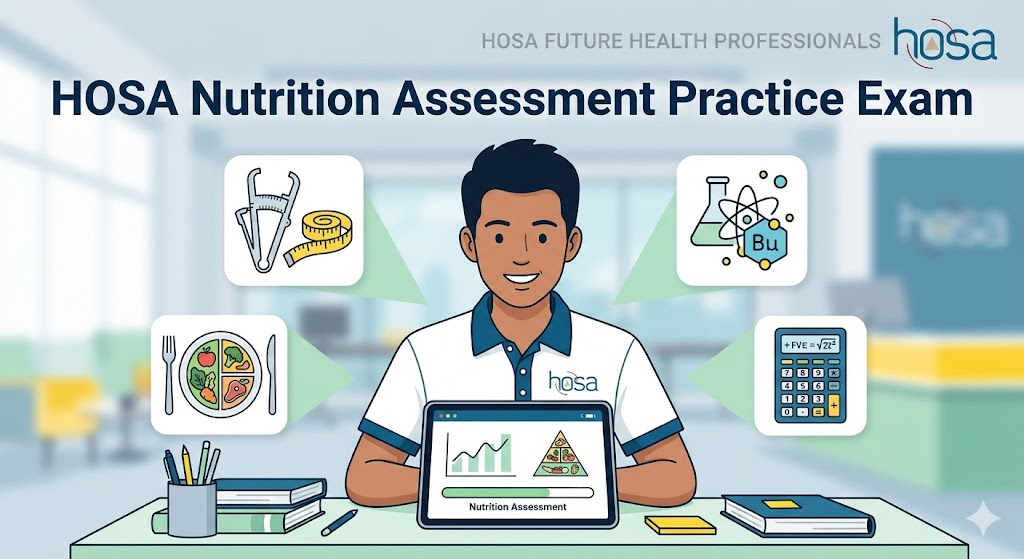
Additional Information
What the Course Entails and Exam Details
This examination requires a deep understanding of comprehensive nutritional care and the scientific principles behind it. The content is modeled after current healthcare standards and foundational concepts in nutrition and dietetics. The practice exam covers several core domains essential for clinical success. These key areas include understanding macronutrients and micronutrients, calculating and interpreting body mass index (BMI) and other anthropometric data, and analyzing biochemical assessments relevant to nutritional status. Students must also be proficient in recognizing clinical signs of malnutrition or deficiency. The examination tests knowledge of therapeutic diets used in clinical settings, such as those for managing diabetes, renal disease, and hypertension. Furthermore, the exam evaluates competency in food safety and dietary guidelines appropriate across the lifespan.
What to Expect in the Final Exam
When competing at a HOSA conference, the written test is typically administered in a focused, timed environment. The format consists of multiple-choice questions designed to measure both recall and critical application of nutritional knowledge. The test typically contains between 50 and 100 questions. Candidates generally have a time limit of approximately 60 to 90 minutes to complete the exam. While a passing score threshold may vary depending on the level of competition (Regional, State, or ILC), aiming for a score above 70% is generally expected to be competitive. Strict rules apply, including prohibitions on external aids, textbooks, and electronic devices, ensuring a fair testing environment. To maximize points, students must accurately perform nutritional calculations without relying on pre-programmed devices.
How to Study and Exam Centers
Preparation for this competitive exam demands a structured study plan and utilization of recognized educational materials. Focus studies on the official HOSA event guidelines and the recommended textbooks, such as "Williams' Basic Nutrition and Diet Therapy" or "Krause’s Food & the Nutrition Care Process." Utilize this practice test repeatedly to identify knowledge gaps. Make it a priority to memorize diagnostic criteria for various nutritional assessments and practice complex calculations, such as energy expenditure and fluid balance. Candidates do not take the final competition exam at standard public testing centers like Pearson VUE. Instead, testing is administered through authorized HOSA advisors at regional or state-level conferences, or via specific secure online portals authorized by National HOSA during designated testing windows. For practice exams, students typically access them through educational platforms recommended by their local HOSA chapter advisor.
Job Opportunities from the Course
A strong performance on the HOSA Nutrition Assessment exam, and the mastery of the subject matter it represents, creates a direct pathway to advanced education and numerous career opportunities within the healthcare and wellness sectors. This competition provides a robust foundation for specializing in dietary health and medical nutrition therapy.
Potential career paths and job roles unlocked by pursuing this specialization include:
Registered Dietitian Nutritionist (RDN)
Dietetic Technician, Registered (DTR)
Clinical Nutritionist
Public Health Nutritionist
Corporate Wellness Consultant
Sports Nutritionist
Food Service Director in Healthcare Facilities
Certified Diabetes Care and Education Specialist
WIC (Women, Infants, and Children) Nutritionist
Frequently Asked Questions
Reviews
5.0
Based on 0 reviews
Leave a Review
No reviews yet. Be the first to review!