
HOSA Parliamentary Procedure Assessment Practice Test
$69.00
- Buy to unlock unlimited access to all Quiz questions and Answers in this Quiz.
- After purchase you can print a PDF of the whole quiz at any point. The PDF will contain the questions and the correct answers.
About this Exam
The HOSA Parliamentary Procedure Assessment, part of the HOSA - Future Health Professionals competitive events, is an essential competition designed for HOSA members at various levels (secondary and postsecondary/collegiate). This rigorous assessment evaluates a team’s understanding and proficiency in conducting formal business meetings using the structured and democratic process known as parliamentary procedure. It’s perfect for aspiring health professionals who recognize that strong leadership, teamwork, and efficient meeting skills are critical in any collaborative professional environment. The entire competitive event is structured to prepare future leaders to manage discussions effectively, respect minority opinions, and make decisions in an orderly and fair manner.
Ready to test your knowledge?
Buy Now to Access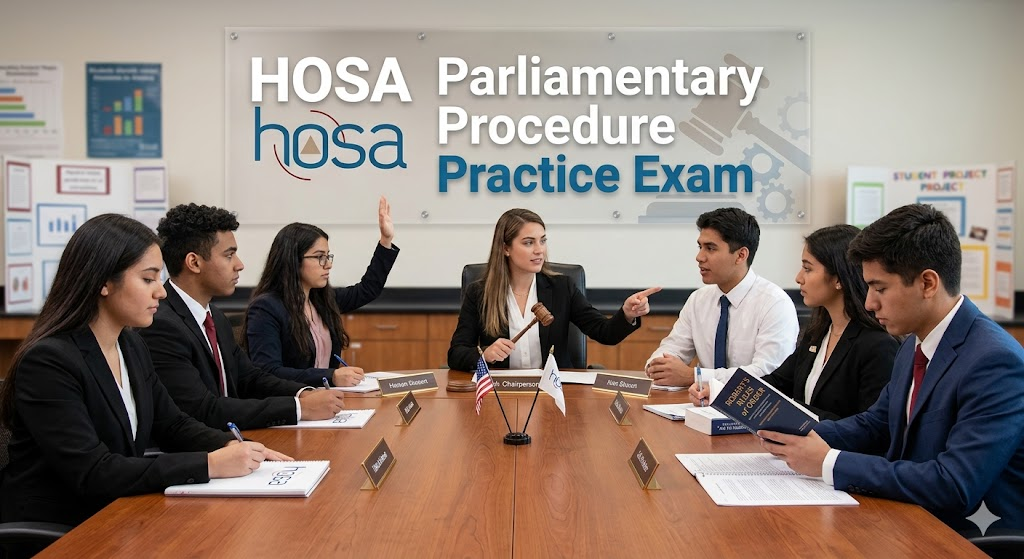
Additional Information
What the Course Entails and Exam Details
This guide focuses specifically on the knowledge and skills required for the Round One written test part of the event. The foundational resource for the entire event and test is Robert’s Rules of Order, Newly Revised. To succeed, you and your team must delve deep into this essential guide to formal procedures. Key areas of study include:
The fundamental principles and importance of rules in a meeting.
Properly handling motions, including their different classes (main, subsidiary, privileged, incidental, and motions that bring a question again before the assembly).
The correct procedures and rules for conducting debate.
Making, debating, and voting on amendments.
The specifics of postponing decisions, referring matters to committees, and other procedural actions.
Procedures for the group to reconsider previous decisions or "change its mind".
Understanding different methods of voting and conducting elections.
The purpose and structure of bylaws and other organizational rules.
Preparing and approving meeting minutes, treasurer’s reports, and committee reports.
The HOSA Parliamentary Procedure event is a team-based competition, and all members (typically 5 to 8) must be active, registered HOSA members in good standing. Dress code is strictly enforced and often involves the HOSA uniform or proper business attire for both rounds.
What to Expect in the Final Exam
While the full competition involves a practical demonstration meeting in Round Two, Round One consists entirely of a written assessment which this guide focuses on. Here’s what you can expect on test day for this critical first component:
Exam Format: The assessment is a written test, typically composed entirely of multiple-choice questions designed to measure your recall, understanding, and application of parliamentary procedure knowledge.
Content: Questions are derived directly from Robert's Rules of Order and cover the various topics outlined above. Expect to be tested on specific motion rankings, voting requirements (e.g., majority vs. two-thirds), and correct procedural phrases.
Time Limit: There is a defined maximum time (often 30 or 60 minutes, depending on the specific year/division rules) to complete the entire test. Your ability to think clearly and answer accurately within this time is crucial.
Scoring: Each team member takes the test, and individual scores are combined. However, the final result for Round One is determined by the team average. The highest-scoring teams in this written round qualify to advance to the final demonstration part of the event. While there isn't a single passing score for this competition component like a professional certification, special recognition from the National Association of Parliamentarians is often given to HOSA members who achieve a score of 70% or higher.
How to Study and Exam Centers
Preparation is paramount for the HOSA Parliamentary Procedure test. It is not a test you can just cram for; understanding the application of the rules is essential.
Actionable Study Strategies:
Master Robert's Rules of Order: This is your bible for this competition. Study the latest Newly Revised edition thoroughly. Focus on the core principles and especially the specific mechanics of different motions.
Take Practice Tests: Actively search for and take official HOSA practice materials or reputable parliamentary procedure quizzes. Practice with your team and review all answers, understanding the correct procedures and why. Look for practice questions specifically derived from NAP/Robert's Rules material.
Conduct Mock Meetings: The best way to learn parliamentary procedure is by using it. Conduct regular mock meetings with your team. Assign roles (Chair, Secretary, Members, etc.), use the required motions, and navigate complex scenarios.
Use Flashcards: Create flashcards for key terms, definitions, motion rankings (which motion takes precedence over which), and specific voting requirements for various motions.
Review Guidelines & Past Events: Stay updated with the official HOSA competition guidelines for the current year, noting any updates or specific requirements. Look at sample agendas or past "secret topics" for hints on Round Two preparation, as this knowledge reinforces Round One understanding.
Exam Centers:
The written test for HOSA Parliamentary Procedure (Round One) is not taken at external centers like Pearson VUE. Instead, it is typically administered as part of official HOSA conferences and events, from the local/chapter level up to regional, state, and the International Leadership Conference (ILC). Registered teams will be notified of the specific date, time, and location (within the conference venue) for the test by their HOSA advisors and conference officials. HOSA competitive events are managed internally through the HOSA network.
Job Opportunities from the Course
While this assessment is part of a high school and collegiate competition, the skills you develop through rigorous preparation for the HOSA Parliamentary Procedure event are highly valuable and directly applicable to various career paths, both in the healthcare sector and beyond. Mastery of leadership, team coordination, meeting management, and clear, structured communication can set you apart in any professional role.
Specific potential job paths and career areas include:
Healthcare Administration and Leadership: Positions requiring managing committees, boards, or departments.
Non-Profit Leadership and Management: Roles where effective meeting conduct is essential for diverse boards and members.
Corporate Leadership: Management and executive positions where structured meetings and decision-making are critical.
Government and Public Service: Legislative aides, committee members, or elected officials.
Organizational Parliamentarians: Specialists who advise organizations, associations, and government bodies on correct procedural use.
Association Management: Careers in running and leading professional associations and membership organizations.
Management Consulting: Roles where strong leadership, meeting efficiency, and problem-solving skills are valued.
Education and Leadership Training: Developing leadership skills in others.
Any position where leading effectively, coordinating teams, and conducting efficient, fair meetings is crucial for success.
Preparation for this HOSA event doesn't just prepare you for a test – it helps build the foundational leadership and teamwork skills essential for your future career, whether it’s in a bustling hospital, a corporate boardroom, or leading a community organization.
Frequently Asked Questions
Reviews
5.0
Based on 0 reviews
Leave a Review
No reviews yet. Be the first to review!