
HOSA Pathophysiology Assessment Practice Test
$69.00
- Buy to unlock unlimited access to all Quiz questions and Answers in this Quiz.
- After purchase you can print a PDF of the whole quiz at any point. The PDF will contain the questions and the correct answers.
About this Exam
Welcome, Future Health Professionals! The HOSA Pathophysiology Assessment is not just a test; it's your opportunity to prove your deep understanding of human health at its most fundamental level. This rigorous assessment, designed for members of HOSA - Future Health Professionals, tests your knowledge of disease processes, bodily malfunctions, and the intricate ways our bodies respond to illness. Succeeding here demonstrates you are well-prepared for the demanding world of medical education and professional healthcare practice. The HOSA Pathophysiology Assessment Practice Exam is your essential tool, meticulously designed to mirror the challenges and structure of the actual competition, helping you identify your strengths, clarify tricky concepts, and build the confidence needed to excel. Consider this practice exam your personal tutor, guiding you through the complexities of human biology in its atypical state.
Ready to test your knowledge?
Buy Now to Access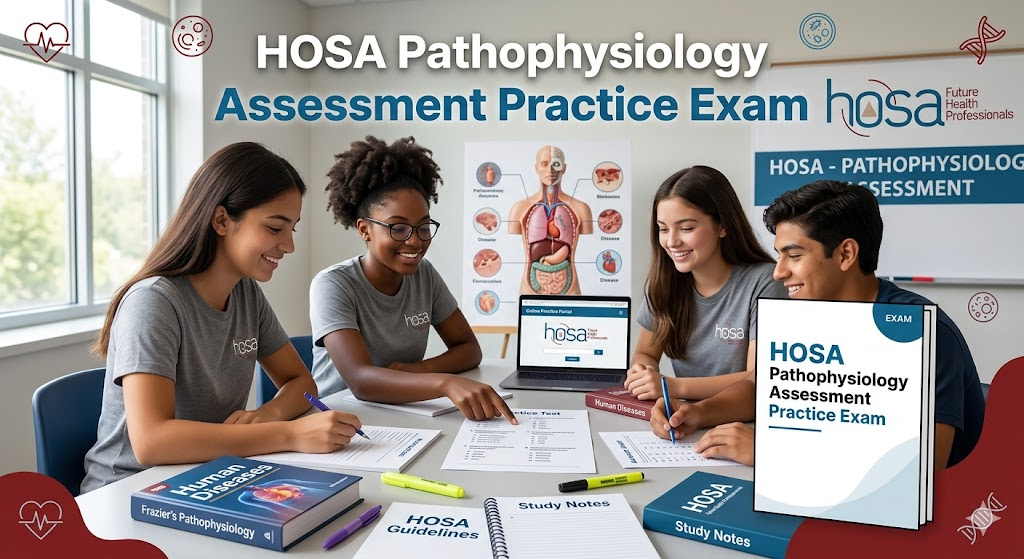
Additional Information
What the Course Entails and Exam Details
While there isn't a single, required "course" for this HOSA event, your preparation must encompass a vast and detailed knowledge base of pathophysiology. The HOSA Pathophysiology Assessment content areas generally align with standard, advanced anatomy and physiology concepts, but with a sharp focus on the underlying causes and symptoms of various conditions. Common topics covered in both your study and the actual assessment, and therefore prioritized in this practice exam, typically include:
Disease Processes and Terminology (approx. 10-15% of actual test): Foundations, key terms, etiology, pathogenesis, and general cellular mechanisms of disease.
Body Systems (approx. 70-80%): You will encounter substantial questions across all major body systems, including but not limited to:
Integumentary System: Disorders of the skin, hair, and nails.
Musculoskeletal System: Conditions affecting bones, joints, and muscles.
Circulatory & Lymphatic Systems: Diseases of the heart, blood vessels, and immune network.
Respiratory System: Issues with the lungs and airways.
Digestive System: Conditions affecting digestion and nutrient absorption.
Endocrine System: Glandular malfunctions and hormonal imbalances.
Nervous System & Senses: Pathologies of the brain, nerves, and sensory organs.
Reproductive System: Disorders related to male and female reproduction.
Urinary System: Kidney and bladder function abnormalities.
Other Potential Areas: Specific percentages can vary slightly by competition year and level, but aspects of immunology, infectious disease, and mental health might also be included.
The HOSA Pathophysiology Assessment Practice Exam is crafted to give you representative practice across all these crucial areas, ensuring you are well-versed in the terminology and pathological mechanisms for each key topic.
What to Expect in the Final Exam
Prepare yourself for a comprehensive and focused assessment. The actual HOSA Pathophysiology Assessment is typically a written, multiple-choice examination. While specific formats can differ slightly by competitive level (regional vs. state vs. international) and year, you should generally expect:
Format: A large number of detailed multiple-choice questions, ranging from foundational concepts to advanced application-based scenarios. Common structure is often around 100 questions at high-level competitions, though preliminary rounds might be smaller.
Time Limit: You will be under strict time pressure, typically given approximately 60 to 90 minutes to complete the test.
Scoring and Passing: This is a competitive event rather than a pass/fail test. Your score will be directly compared to other competitors. However, achieving a competitive score generally indicates proficiency and deep understanding, often linked with ranking. Practice is key to maximizing speed and accuracy to achieve a high rank.
Tie-Breaker: In many levels, a tie-breaker essay or additional scenario-based question will be included with the test. This means writing skills can be a critical advantage!
Professional Conduct: Competitors must strictly adhere to the HOSA General Rules and Regulations and the specific event guidelines for the current year. Official HOSA uniforms or proper business attire are typically required.
How to Study and Exam Centers
Preparation for the HOSA Pathophysiology Assessment requires dedication, strategic study, and consistent practice. Your journey towards success involves:
Actionable Study Strategies:
Review Recommended Textbooks: Utilize official HOSA-approved reference lists, including textbooks like "Essentials of Human Diseases and Conditions" (Frazier) or "Human Diseases: A Systemic Approach" (Zelman) to understand core concepts deeply.
Create Structured Notes & Flashcards: Condense your reading into organized notes, and use digital or physical flashcards for definitions, disease processes, and symptoms for rapid recall.
Utilize the Practice Exam Thoroughly: Take the HOSA Pathophysiology Assessment Practice Exam under simulated test conditions (timed, quiet space, official dress code practice optional but helpful for mind-set). Treat each question as a learning opportunity; for every question you miss, understand exactly why and revisit the relevant material.
Study in Groups: Collaborating with other HOSA members can help you understand different perspectives and explain complex topics to each other, which reinforces learning.
Practice with Real-World Scenarios: Apply knowledge of diseases to realistic patient scenarios, thinking about cause and effect.
Exam Centers: This HOSA event takes place as part of HOSA competitive conferences and events at various levels:
State Leadership Conferences (SLCs): Preliminary and potentially advanced rounds often occur at your state-level HOSA conference. Your state HOSA advisor and school chapter advisor will provide specific information on registration, dates, and locations.
International Leadership Conference (ILC): Top competitors from SLCs may qualify for the prestigious ILC, which serves as the national/international final for HOSA competitive events. This conference, usually held in a major U.S. city, is where the best in the world compete in Pathophysiology and other events.
Proctored Local/Area Testing: For preliminary rounds in some areas, or for certain state structures, tests might be proctored locally at your school, a nearby community college, or a central regional testing site, often following specific online portal guidelines. Again, clear communication with your HOSA leadership is key.
Job Opportunities from the Course
A strong understanding of pathophysiology, demonstrated by preparation for and success in the HOSA Pathophysiology Assessment, is a significant stepping stone toward unlocking countless rewarding career paths in the vast healthcare field. This foundational knowledge provides a powerful advantage and demonstrates commitment to any future medical role. Participating in HOSA and excelling in this event is highly regarded by educational institutions and future employers. This deep understanding prepares you for and helps unlock potential careers including, but certainly not limited to:
Physician (MD or DO)
Physician Assistant (PA)
Registered Nurse (RN)
Nurse Practitioner (NP)
Pathologist
Medical Laboratory Scientist / Technician
Surgical Technologist
Cardiovascular Technologist
Respiratory Therapist
Physical Therapist
Occupational Therapist
Pharmacist / Pharmacy Technician
Public Health Professional
Medical Researcher
Epidemiologist
Health Educator
Biomedical Engineer
Medical Dosimetrist
Radiologic Technologist
SEO Disclaimer: This article provides a comprehensive study guide structured for the "HOSA Pathophysiology Assessment Practice Exam," incorporating essential event details, study methods, and related career paths to aid in optimized search visibility. HOSA event details can evolve, so always consult the most current official HOSA guidelines. The HOSA Pathophysiology Assessment Practice Exam is a powerful tool to build that foundational knowledge and test-taking confidence necessary for achieving high competitive success and propelling you toward these incredible career pathways! Good luck on your journey to becoming a future health professional!
Frequently Asked Questions
Reviews
5.0
Based on 0 reviews
Leave a Review
No reviews yet. Be the first to review!