
HOSA Pathophysiology Endocrine Practice Test
$69.00
- Buy to unlock unlimited access to all Quiz questions and Answers in this Quiz.
- After purchase you can print a PDF of the whole quiz at any point. The PDF will contain the questions and the correct answers.
About this Exam
Welcome to your guide for the HOSA Pathophysiology Endocrine Practice Test! This practice exam is not an official certification, but rather a valuable study tool designed specifically for HOSA (Future Health Professionals) members preparing for the Pathophysiology competitive event. If you are a student passionate about understanding the intricate workings of the human body and aspire to a career in healthcare, this event is perfect for you. The Endocrine system is a fundamental component of the broader Pathophysiology competition, and this targeted practice test focuses solely on its complexities. By taking this practice test, you will gain experience with the types of questions and topics covered in the actual competition, helping you to build confidence, identify areas of strength and weakness, and enhance your final performance. It's a fantastic way for motivated healthcare students to refine their knowledge of hormonal systems and common endocrine disorders in a controlled, educational environment.
Ready to test your knowledge?
Buy Now to Access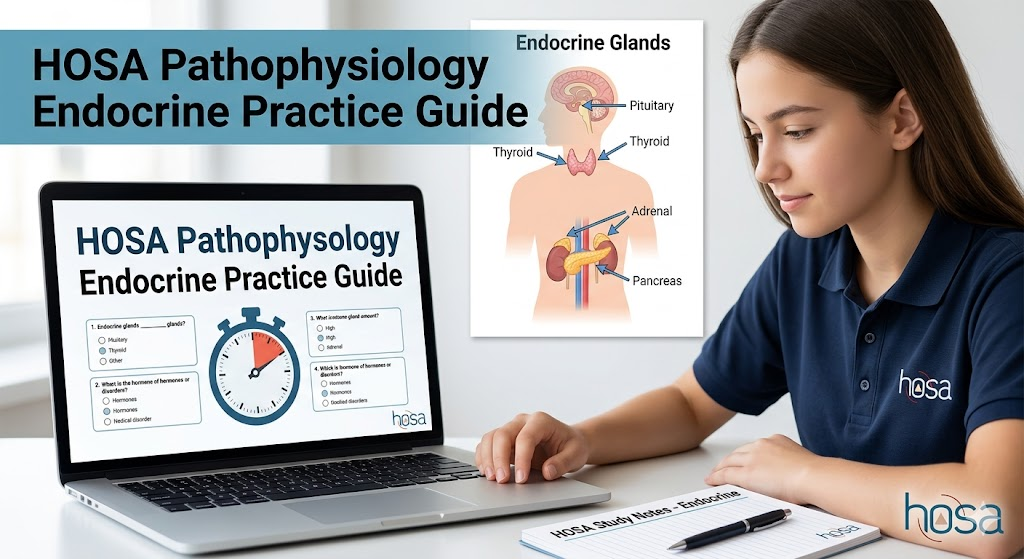
Additional Information
What the Course Entails and Exam Details
While this is a practice test, the content it covers reflects a critical section of the HOSA Pathophysiology competitive event, which delves into the 'why' behind diseases and disorders. The "course" in this context is your independent study and textbook learning, structured around the HOSA curriculum, and this practice exam is a key assessment within that. The core topics specifically covered within the Endocrine section and likely to be reflected in the practice test include:
Detailed knowledge of all major endocrine glands (e.g., hypothalamus, pituitary, thyroid, parathyroid, adrenal, pancreas, ovaries, testes).
Understanding the function of key hormones produced by each gland.
Mechanisms of hormonal control, including negative feedback loops.
Common endocrine pathologies, such as:
Thyroid disorders (hyperthyroidism/hypothyroidism, Graves' disease, Hashimoto's).
Pancreatic disorders (diabetes mellitus - Type 1 and Type 2, hypoglycemia).
Pituitary gland disorders (gigantism, acromegaly, dwarfism, diabetes insipidus).
Adrenal gland disorders (Addison’s disease, Cushing’s syndrome).
Symptoms, causes, potential treatments, and diagnostic methods (to a limited degree) associated with these conditions.
Recognizing the systemic impact and interconnectedness of different endocrine functions.
The practice test itself will likely consist of a defined number of questions (e.g., 50-100) presented primarily in a multiple-choice format, mimicking the typical structure of the first round of the HOSA competition. Keep in mind that as a practice tool, the specific question breakdown, total points, or strict adherence to a particular year's rules might vary, but the content focus will always be the Endocrine system's pathophysiology.
What to Expect in the Final Exam
It's crucial to distinguish between this practice test and the actual HOSA competitive event testing.
For this Practice Test:
Format: Typically an online assessment or a downloaded question set with a separate answer key. Expect mostly multiple-choice questions, which is the standard format for testing knowledge in HOSA. There might be some multiple-response or matching questions, but they are less common for practice modules.
Passing Score: There is no official "passing score" for this practice test that progresses you in a competition. You should aim for a high self-determined score (e.g., 80% or higher) as a marker of solid readiness and a target for your actual competition performance. Use the results to guide further study, not as a pass/fail outcome.
Time Limits: While some practice modules might have a self-timer function or suggest completing it within a specific duration (e.g., 60-90 minutes) to simulate competitive conditions, it is generally flexible and self-paced.
Rules: There are no formal external proctors or strict rules for this practice exam. The honesty policy is your own – avoid using study aids during the test to get an accurate self-assessment, and review your answers afterward with the key. It’s for your learning.
For the actual HOSA Pathophysiology Competitive Event (for context): The actual competition often involves a preliminary written test (often computer-based, timed, multiple-choice) and sometimes a subsequent practical or complex case study analysis in higher levels of competition. Passing that preliminary test and your rank determines if you move on. The competition environment is strict, proctored, and has definitive time limits. The rules are much more formal. This practice test is purely to prepare you for that actual competition experience.
How to Study and Exam Centers
Preparation is key to success! Here are actionable strategies for your studies:
How to Study for the Endocrine Practice Test and the broader Pathophysiology event:
Use Recommended Textbooks: Utilize high-quality high school or introductory college level anatomy, physiology, and specifically pathophysiology textbooks recommended by HOSA guidelines or your advisor.
HOSA Resources: Review the official HOSA competitive event guidelines for Pathophysiology. Seek out past exams or sample questions if available (though these are often not public). Utilize specific HOSA study guides provided by your advisor.
Create Structured Notes & Flashcards: Focus on identifying glands, the hormones they produce, their target organs/functions, and detailed information (causes, symptoms, mechanisms, typical treatments) for every major disorder. Flashcards are excellent for memorizing names and connections.
Conceptual Understanding: Don't just memorize terms. Grasp the physiological mechanisms – why does excess growth hormone cause acromegaly after growth plates have closed, but gigantism before? Understanding the feedback loops is essential.
Practice with this Test and Others: Take this practice test under exam-like conditions (timed, without notes). Review every question you got right or wrong, ensuring you understand the rationale. Seek out other reliable practice questions online or in study books.
Connect Concepts: Link the Endocrine system to other body systems you are studying for the broader Pathophysiology competition (e.g., how might chronic stress affecting the adrenal glands influence immune function or blood sugar?).
Form Study Groups: Working with other HOSA students can be very effective. Quiz each other, explain concepts, and discuss complex conditions.
Exam Centers and Accessing this Practice Test:
This Practice Test: This is not taken at a commercial exam center like Pearson VUE or a testing facility. It is generally a localized or internal tool. Access to this specific practice test is typically provided through your HOSA chapter advisor. They might administer it as an online module through a school platform, a dedicated HOSA educational resource site, or even as a shared electronic document/printout. Check with your HOSA advisor to learn how to access it.
Actual HOSA Competition Testing: The real HOSA competitive events, including testing for Pathophysiology, occur at designated HOSA conferences: local/district, state, and international. These competitions are administered in group settings, often with computer-based testing, within convention centers or specific school locations, with strict proctoring by HOSA officials. You must qualify at previous levels to compete in state and international events.
Job Opportunities from the Course
While completing this practice test doesn't directly confer job qualifications or specific positions, the knowledge and experience you gain are invaluable stepping stones towards numerous rewarding healthcare careers. HOSA involvement is highly regarded by educational institutions and employers. The deep understanding of pathophysiology, especially the endocrine system, is directly relevant to these and many other professions:
Physician (MD or DO): Specifically relevant for those aspiring to practice in internal medicine, endocrinology, or other specialties.
Physician Assistant (PA): PAs are crucial in diagnosing and managing a wide range of conditions, including those of the endocrine system.
Registered Nurse (RN) / Nurse Practitioner (NP): Nurses at all levels require strong physiological knowledge; NP specializations in chronic disease management are highly relevant.
Pharmacist: Understanding hormone interactions and medication management is key for pharmacists.
Clinical Laboratory Scientist: Relevant for understanding and performing diagnostic tests related to hormone levels and metabolic markers.
Medical Assistant: While often a clinical role, this knowledge provides beneficial context.
Endocrinology Researcher: Conducting vital research into the mechanisms and treatments of endocrine disorders requires fundamental knowledge.
Veterinary Medicine: While a different species, understanding endocrine systems is fundamental in veterinary care.
Healthcare Education: For those who want to teach future healthcare professionals.
Healthcare Administration: Understanding clinical concepts can enhance decision-making and leadership in healthcare settings.
Preparing for this test demonstrates dedication, a strong foundation in medical science, and commitment to your future, making your path into these professions clearer and your applications more competitive. Good luck with your study and your practice test!
Frequently Asked Questions
Reviews
5.0
Based on 0 reviews
Leave a Review
No reviews yet. Be the first to review!