
HOSA Public Service Announcement (PSA) Guidelines Practice Exam 2026
$69.00
- Buy to unlock unlimited access to all Quiz questions and Answers in this Quiz.
- After purchase you can print a PDF of the whole quiz at any point. The PDF will contain the questions and the correct answers.
About this Exam
Welcome to your essential roadmap for the HOSA Public Service Announcement (PSA) competitive event. While not a conventional seated certification exam, this event is a dynamic competition designed for future health professionals to harness their creativity, technological skills, and passion for public health.
It challenges teams of 2 to 6 HOSA members to research a relevant health issue, produce a broadcast-quality 30-second video, and present their creative process to a panel of judges.
This event is perfectly suited for students who are passionate about health advocacy, graphic design, cinematography, scriptwriting, and communication, allowing them to educate their community while building vital teamwork and leadership skills.
Ready to test your knowledge?
Buy Now to Access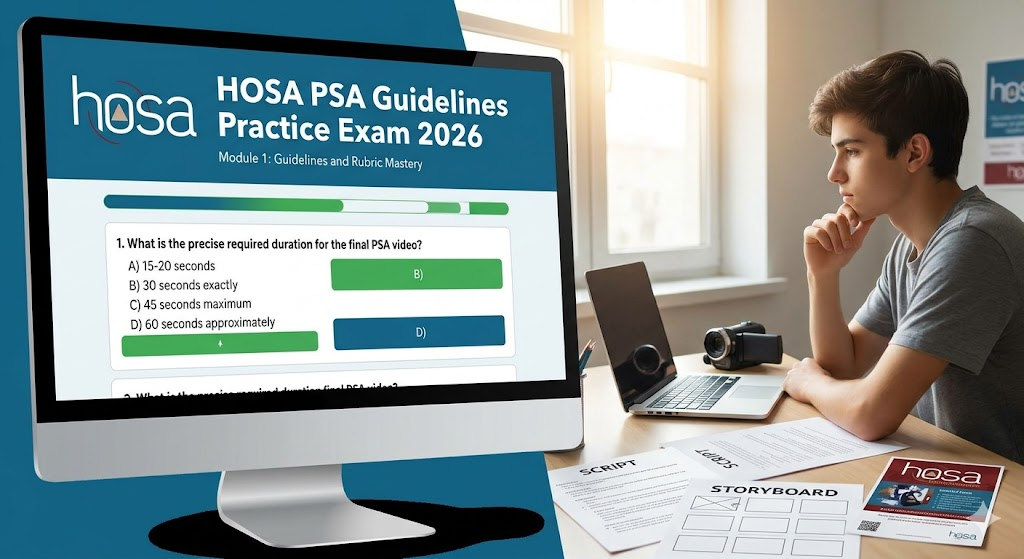
Additional Information
What the Course Entails and Exam Details
This event is unique because the "course" is the process of creating a real-world media product. The core skills and topics covered focus on both the health science underlying the annual topic and the technical art of media production.
Competitors must master the official HOSA event guidelines, the specific annual health topic (e.g., “Brain Health is Public Health” for 2025-2026), and a variety of creative disciplines.
Your preparation must entail:
In-depth research using credible, well-documented medical and public health sources to support your PSA’s message.
Creative development, including brainstorming, genre selection (drama, comedy, musical, etc.), storyboard creation, and scriptwriting.
Technical production mastery, encompassing filming, editing, sound design, graphic design, and lighting.
Ethical content creation, ensuring all visual and audio elements comply with copyright laws and HOSA's fair use policies.
Public speaking and presentation skills for the digital upload components and the in-person judges’ panel interaction.
For the 2026 competition cycle, all team members are also required to complete specified foundational health courses (such as HFCUniverse Brain Health 101 and 201) and submit certificates of completion.
What to Expect in the Final Exam
The "final exam" for the HOSA PSA event is the summation of your pre-judged work and your live presentation at the leadership conference. There is no traditional written test for this event.
The competition typically consists of one rigorous round divided into two main components: Pre-judged Digital Uploads and the In-Person Presentation.
Component 1: Digital Uploads (Pre-judged) Before the conference, teams must submit several crucial items through the HOSA digital upload portal by the established deadline. These generally include:
A hyperlink to the final 30-second PSA video production.
A completed documentation form verifying the PSA’s airdate or public showing.
A copyright documentation form.
The required course completion certificates for all team members.
Your video is pre-judged by a panel using the official rubric, focusing on the clarity of your message, technical quality, creativity, and adherence to time limits (exactly 30 seconds).
Component 2: In-Person Presentation At the conference, your team will meet with judges to present your project. This presentation lasts a total of 10 minutes:
Set-up (3 minutes): Teams have 3 minutes to set up any allowed equipment or visual aids.
Presentation (7 minutes): Teams present their PSA, discuss their research and creative process, explain how they targeted their audience, and show their final video to the judges.
Following the presentation, judges may ask questions to further evaluate the team's understanding of the topic and their production process. The official rubric emphasizes visual impact, content organization, technical aspects, and overall professionalism.
How to Study and Exam Centers
Studying for this event means practicing the creation process. There is no official center to take a test; instead, you take the "exam" through your HOSA chapter at Regional, State, and International Leadership Conferences.
Study Strategies:
Master the Guidelines: Treat the official 2026 HOSA PSA Guidelines as your textbook. Know every rubric point and penalty deduction.
Deep Topic Research: Immediately research the annual health topic from reputable sources like the CDC, NIH, or major health organizations. Your PSA must be factually accurate.
Analyze Award-Winning PSAs: Watch winning PSAs from previous HOSA conferences and from professional health organizations to understand what makes a message impactful in 30 seconds.
Use Practice Exams: While there is no written test, use practice exams of this nature—mock presentation sessions. Present your PSA process to your advisor, teachers, or other chapters and ask for feedback based on the official rubric.
Master Your Software: Do not wait until the last minute. Practice filming and editing on the software you plan to use (e.g., Adobe Premiere, Final Cut Pro, DaVinci Resolve).
Event Locations (Centers): You do not register at a testing center like Pearson VUE. Instead, you register for HOSA conferences through your local school’s HOSA advisor.
Regional/State Leadership Conferences (SLC): Initial competition levels, typically held in schools, hotels, or convention centers within your state during late winter or early spring.
International Leadership Conference (ILC): Where the top qualifiers from each state compete. This is the final event of the HOSA year, held in a major U.S. city in June.
Job Opportunities from the Course
Mastering the HOSA PSA event provides a diverse skill set that bridges healthcare and media, opening doors to careers in public health communication, media production, and healthcare administration.
This competitive event helps build a portfolio and experience applicable to the following career paths:
Public Health Educator
Health Communications Specialist
Medical Illustrator
Public Relations Coordinator (Healthcare Sector)
Medical Journalist / Health Editor
Social Media Manager for Health Organizations
Video Producer / Editor (Healthcare Content)
Marketing Director for Health Services
Health Advocacy Coordinator
Patient Education Specialist
Documentary Filmmaker (Health Focus)
Multimedia Content Creator for Medical Technology Companies
Frequently Asked Questions
Reviews
5.0
Based on 0 reviews
Leave a Review
No reviews yet. Be the first to review!