
HOSA Sports Medicine Assessment Practice Test
$69.00
- Buy to unlock unlimited access to all Quiz questions and Answers in this Quiz.
- After purchase you can print a PDF of the whole quiz at any point. The PDF will contain the questions and the correct answers.
About this Exam
The HOSA Sports Medicine Assessment is a dynamic competitive event designed for current members of HOSA - Future Health Professionals who are interested in pursuing careers in sports medicine, athletic training, and associated healthcare fields.
This assessment is not just a test; it is an integrated part of a student's preparation, challenging them to apply their knowledge to realistic scenarios and practical skills.
The primary aim of this competitive event is to inspire and recognize students who demonstrate exceptional understanding of sports injury prevention, emergency care, therapeutic intervention, and the overall administrative aspects of working with athletes.
It serves as a powerful stepping stone and validation of knowledge for students across high school and post-secondary levels who aspire to become vital parts of a medical team supporting active individuals.
Ready to test your knowledge?
Buy Now to Access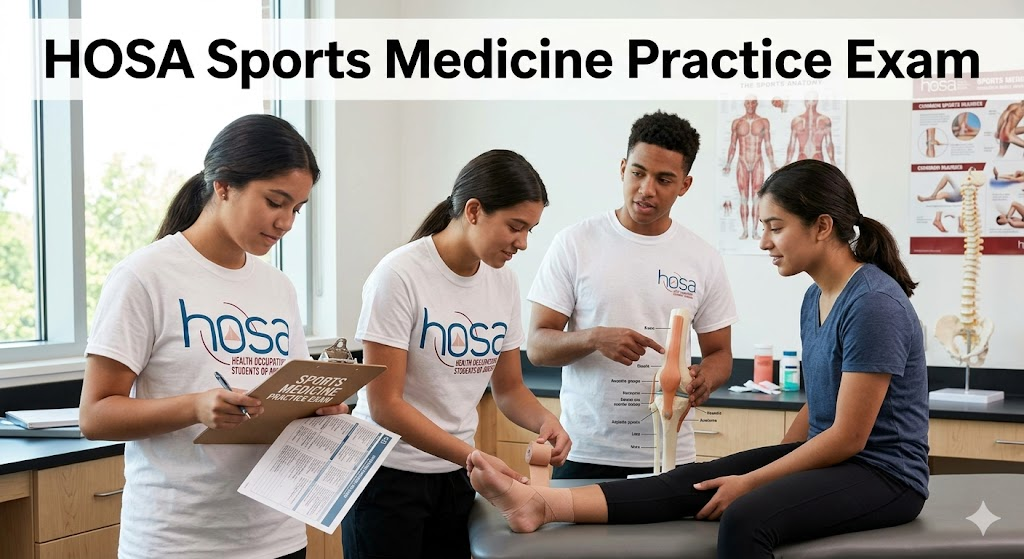
Additional Information
What the Course Entails and Exam Details
While the exact structure of a "practice test" product can vary, the official HOSA Sports Medicine event is comprehensive and tests a deep level of subject matter.
The core curriculum and the assessment focus areas typically cover:
Human Anatomy & Physiology: An intricate understanding of the musculoskeletal system (bones, muscles, ligaments, tendons), nervous system, and cardiovascular systems as they relate to human movement and athletic activity.
Injury / Illness Prevention and Wellness Promotion: Knowledge of strategies to reduce injury risk, including equipment fitting, taping, strapping, nutrition, and environmental considerations (heat and cold issues). This makes up a significant portion of the written component.
Examination, Evaluation, and Assessment: Mastering the standard protocols for evaluating athletic injuries (observation, palpation, and understanding of standard movement tests).
Immediate and Emergency Care: Protocols for managing acute injuries and conditions, including basic life support, first aid, and standard operating procedures for emergencies on and off the field.
Therapeutic Intervention: Introduction to rehabilitation techniques, therapeutic modalities, and exercise protocols to return an athlete to safe participation.
Healthcare Administration and Professional Responsibilities: Understanding the legalities, ethics, record-keeping, and the team structure typical in sports medicine settings.
The actual HOSA competition is an integrated event.
Competitors must be HOSA members and good standing to participate.
The details of the practice test, as a reflection of the actual exam, should prepare you for both the multiple-choice knowledge-based assessment and the practical application required in later competitive stages.
What to Expect in the Final Exam
The full HOSA Sports Medicine assessment is structured into two rounds of competition.
A practice test is most likely to focus heavily on the written component of Round One.
Round One: Written Test
Format: This section is a written, multiple-choice examination.
Content: Expect approximately 50 multiple-choice questions that assess knowledge across all the core topics listed in the syllabus section.
Time Limit: Competitors typically have a maximum of 60 minutes to complete this round. There are usually verbal time remaining announcements to keep you on track.
Scoring: This test measures your depth of knowledge and analytical skills. The written test score is used not only for placement but also often to determine who advances to the next round. A higher score here is crucial.
Round Two: Skills Assessment
Should you excel in the written test, you will advance to the second round, which is a practical skills assessment.
Format: Performance of selected skills identified from official HOSA competitive event guidelines. This requires not just knowledge, but correct, timed execution in front of judges. A written scenario is typically provided at the start of the round and will require applying critical thinking skills to a realistic case.
Skills: The skills tested in Round Two can include:
Anatomical Landmark Identification (a live patient is often used, with small adhesive labels for you to place correctly)
Joint Action and Maximum Range of Motion Identification
Taping/Wrapping of various areas (e.g., Ankle, Achilles Tendon, Shoulder Spica, Wrist/Hand)
Time Limit: Each skill has its own set time limit, typically ranging from 4 to 15 minutes, with additional time rules depending on the specific skill task.
Passing Score for Recognition: A critical point is that competitors must earn a combined score of 70% or higher on the combined skill(s) of the event (excluding the written test score) to be recognized as an award winner at the International Leadership Conference (ILC).
Final Scoring: The final rank is determined by adding the score from the Round One written test to the total score from the Round Two skill performance. In case of a tie, the highest written test score is used.
You must be prepared with your own supplies for Round Two, including #2 pencils, a watch, appropriate tape, elastic wrap, and specialized scissors. A photo ID is required for check-in at both rounds.
How to Study and Exam Centers
Effective preparation requires a multi-faceted approach, balancing theoretical knowledge with practical skills practice.
Official HOSA Resources: The absolute best place to start is the official HOSA website. Download the current year's Sports Medicine Competitive Event Guidelines. These guidelines detail the test plan, specific knowledge percentages, official textbook references, and the detailed performance criteria (rubrics) for every potential skill you might be tested on. The official references are crucial, as test questions are sourced directly from these materials.
Textbook Study: Obtain the listed official textbooks. Use these books to master the anatomy, principles, protocols, and standard care procedures that are the core of the exam.
Create or Find a Study Guide: Transform the key concepts from the official resources into your own study guides, ensuring you cover every point in the official guidelines. Practice tests like the one you are aiming to complete should be treated as diagnostic tools to highlight your strong and weak areas.
Active Learning & Flashcards: Use flashcards for anatomical landmarks, terminology, injury types, and treatment steps. Practice identifying landmarks on yourself and willing volunteers.
Practice tests: Engage in numerous multiple-choice practice tests to build your knowledge, familiarity with question styles, and to improve your time management. Analyze both your correct and incorrect answers.
Group Study: Collaborate with other HOSA members. Quiz each other on both the written and practical components. You can take turns acting as the athlete, competitor, and judge to practice the Round Two skills.
Hands-on Skills Practice: The written knowledge is only half the battle. You must practice the taping, landmark identification, and joint evaluation skills consistently. Seek guidance from athletic trainers, physical therapists, or your HOSA advisor to ensure your technique is correct and up to professional standards. Time yourself while performing skills to mirror exam conditions.
Exam Centers: The actual HOSA Sports Medicine Assessment is conducted during HOSA State and International Leadership Conferences. These are significant events that require registration and travel. Practice tests may be available through specific educational platforms or resources, which are typically accessible online or through specific logins from your school or program. Check with your HOSA advisor or your chapter leadership to understand the registration process and locations for your specific state's HOSA competition.
Job Opportunities from the Course
Engaging deeply with this competitive event, whether in preparation or as an active participant, enhances your knowledge and skills, making you a stronger candidate for a variety of future healthcare and sports-related professions.
This assessment directly prepares students for roles such as:
Athletic Trainer: The core career associated with sports medicine, providing immediate care, injury prevention, and rehabilitation.
Physical Therapist: Deep knowledge of human movement and injury recovery.
Physical Therapist Assistant: Direct support in rehabilitation and exercise prescription.
Occupational Therapist: Addressing physical challenges in daily living.
Sports Nutritionist: Guiding athletes on fueling their bodies optimally.
Exercise Physiologist: Analyzing and optimizing exercise and movement for health and performance.
Kinesiotherapist: Developing and implementing corrective exercise programs.
Coach (Various Levels): Enhancing knowledge of injury risk and safety protocols.
Physician (MD/DO) (Sports Medicine Specialty): The ultimate diagnostic and treatment role within the field.
Physician Assistant (with a sports medicine focus): Crucial diagnostic and care functions within a medical team.
Orthotist/Prosthetist: Creating and fitting braces and artificial limbs.
Chiropractor: Focusing on musculoskeletal and spinal health.
Wellness/Health Coach: Promoting overall health and active lifestyles.
The knowledge gained from this assessment also serves as a strong foundation for many other roles across the healthcare spectrum, from paramedics and medical assistants to clinical researchers. The skills in critical thinking, scenario analysis, and professional care are invaluable in any health environment. By utilizing a practice exam, you can gain a significant advantage and build the confidence necessary to excel in the competitive HOSA environment and your future medical career.
Frequently Asked Questions
Reviews
5.0
Based on 0 reviews
Leave a Review
No reviews yet. Be the first to review!