
Hospital Corpsman Basic (HCB) Test 1 Practice
$69.00
- Buy to unlock unlimited access to all Quiz questions and Answers in this Quiz.
- After purchase you can print a PDF of the whole quiz at any point. The PDF will contain the questions and the correct answers.
About this Exam
The Hospital Corpsman Basic (HCB) curriculum is the foundational training program for enlisted medical personnel in the United States Navy. This intensive course is designed to transform motivated Sailors into skilled healthcare professionals capable of serving in diverse environments, from state-of-the-art hospitals to forward-deployed Marine Corps units. HCB Test 1 is the critical first academic milestone in this journey. It is specifically designed for Navy recruits and Sailors currently enrolled in "A" School at the Medical Education and Training Campus (METC). This exam assesses a candidate's grasp of introductory medical concepts and Navy medicine fundamentals, ensuring they are prepared to progress to more advanced clinical training. Succeeding on Test 1 is the essential first step toward earning the coveted caduceus rating emblem.
Ready to test your knowledge?
Buy Now to Access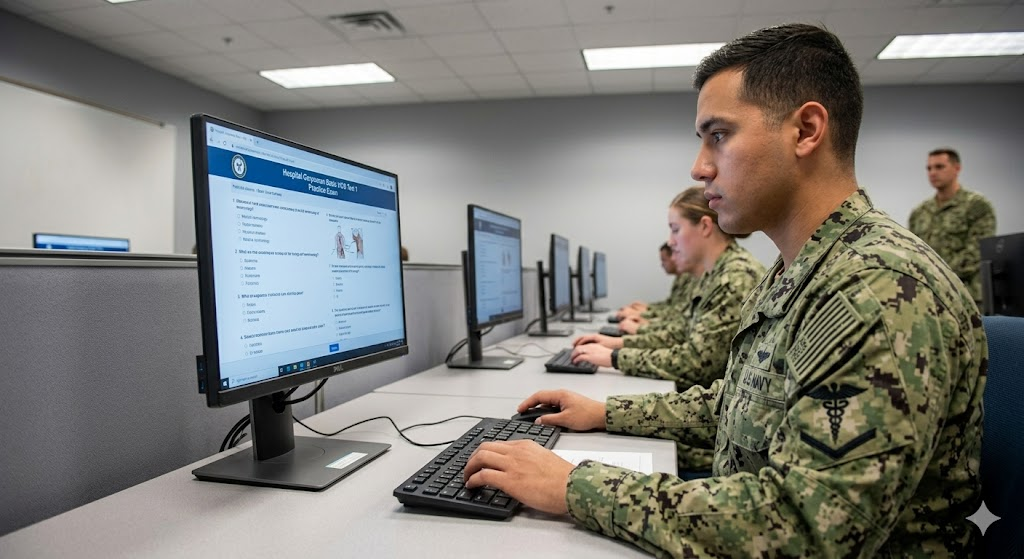
Additional Information
What the Course Entails and Exam Details
The comprehensive HCB course provides students with a blend of theoretical medical knowledge and practical, hands-on skills. The initial phase of training focuses heavily on the core building blocks necessary for all medical providers. HCB Test 1 specifically evaluates mastery of these foundational topics.
The core syllabus and key skills covered in preparation for this exam include:
Medical Terminology: Mastering the root words, prefixes, and suffixes that form the basis of medical communication.
Anatomy and Physiology: An introduction to the structure and function of the major human body systems, with a focus on musculoskeletal, respiratory, and circulatory basics.
Fundamental Patient Care: Understanding basic nursing skills, including patient hygiene, bedmaking, and safe patient transfer techniques.
Infection Control: Strict adherence to standard precautions, aseptic techniques, and procedures for maintaining a sterile environment to prevent the spread of pathogens.
Vital Signs: Accurately measuring and interpreting temperature, pulse, respiration, and blood pressure.
Navy Medical History and Heritage: Familiarization with the rich history of the Hospital Corps and the Navy Medical Department.
Ethics and Law in Medicine: Introduction to patient rights, HIPAA compliance, and the ethical responsibilities of a military medical provider.
What to Expect in the Final Exam
When sitting for the HCB Test 1, candidates should expect a standardized, rigorous evaluation. While Navy training curricula can be updated, the general structure of the exam follows a consistent model to assess baseline competency.
The final exam typically features the following format:
Format: The exam consists primarily of multiple-choice questions designed to test knowledge recall and application of basic concepts. Some tests may include drag-and-drop or true/false formats regarding specific protocols.
Content Distribution: Questions are weighted heavily toward medical terminology, fundamental anatomy, and infection control procedures.
Time Limit: Students are generally allotted a strict time limit, typically around 60 to 90 minutes, to complete the exam. Efficient time management is crucial.
Passing Score: The Navy requires a high standard of academic achievement. While specific percentages may vary slightly by training command policies, students generally must achieve a score of 75% or higher to pass and avoid academic remediation.
Testing Rules: The exam is closed-book and highly proctored. No outside reference materials or personal electronic devices are permitted in the testing area.
How to Study and Exam Centers
Effective preparation is key to succeeding on HCB Test 1. Because of the sheer volume of new terminology and foundational knowledge, passive reading is rarely enough. Actionable study strategies and practice methods are essential.
Candidates are encouraged to utilize the following methods:
Spaced Repetition Flashcards: Utilize tools like Anki or Quizlet to master medical terminology. Create digital or physical flashcards for definitions, anatomical structures, and normal vital sign ranges. Reviewing these daily is critical for retention.
Active Recall via Study Groups: Form small study groups within your class. Take turns teaching concepts to each other. Explaining a process like circulation or the steps of aseptic technique from memory is one of the best ways to solidify understanding.
Utilize Official Navy Curriculum Materials: Focus heavily on the provided trainee guides, powerpoint presentations, and relevant chapters in the Hospital Corpsman Manual (NAVEDTRA 14295B).
Practice with Purpose: Seek out available practice tests or review questions provided by instructors. Treat these practice sessions like the real exam by timing yourself and reviewing every answer you got wrong.
Hands-On Review: For vital signs and patient movement techniques, physically practice these skills on classmates during designated lab times until they become second nature.
Regarding testing centers, the HCB Test 1 is not taken at civilian centers like Pearson VUE. It is administered exclusively in-house by authorized Navy military instructors (NMTIs) at the designated training facility. Currently, this primary training location is the Medical Education and Training Campus (METC) located at Joint Base San Antonio-Fort Sam Houston, Texas. Students must be officially enrolled in the Hospital Corpsman "A" School curriculum to sit for this exam.
Job Opportunities from the Course
Successfully navigating HCB Test 1 and ultimately completing the entire course opens the door to one of the most diverse and rewarding ratings in the U.S. Navy. Graduates enter the Fleet as rated Hospital Corpsmen (HM), ready to serve in any environment where Sailors and Marines operate.
A small sampling of the specific job opportunities and career paths this certification unlocks includes:
Hospital Corpsman 0000 (General Duty): Providing direct patient care in Navy hospitals (Blueside), clinics, or on ships and submarines.
Fleet Marine Force (FMF) Corpsman (Greenside): Serving as the primary medical provider embedded with Marine Corps infantry or support units.
Search and Rescue (SAR) Medical Technician: Providing advanced emergency medical care during aerial and maritime rescue operations.
Dive Medical Technician: Specialized medical support for Navy Deep Sea Divers and SEAL teams.
Independent Duty Corpsman (IDC): Serving as the sole medical provider on smaller surface ships or at isolated shore commands.
Medical Department Head/Leading Chief Petty Officer: Leadership and administrative roles managing medical readiness for entire commands.
Specialized NEC Pathways: Eligibility to apply for advanced "C" Schools for roles like X-Ray Technician, Surgical Technologist, Preventive Medicine Technician, or Pharmacy Technician.
Frequently Asked Questions
Reviews
5.0
Based on 0 reviews
Leave a Review
No reviews yet. Be the first to review!