
Hospital Corpsman First Class (HM1) Advancement Practice Exam
$69.00
- Buy to unlock unlimited access to all Quiz questions and Answers in this Quiz.
- After purchase you can print a PDF of the whole quiz at any point. The PDF will contain the questions and the correct answers.
About this Exam
The Hospital Corpsman First Class (HM1) Advancement Exam is a critical step in the career path of a U.S. Navy Hospital Corpsman. This examination is designed for ambitious HM2 Petty Officers who are ready to demonstrate the advanced knowledge, leadership, and technical expertise required to lead at the Next level. It measures proficiency in both medical skills and professional military leadership, identifying those ready for the increased responsibilities of an E-6 Petty Officer.
Ready to test your knowledge?
Buy Now to Access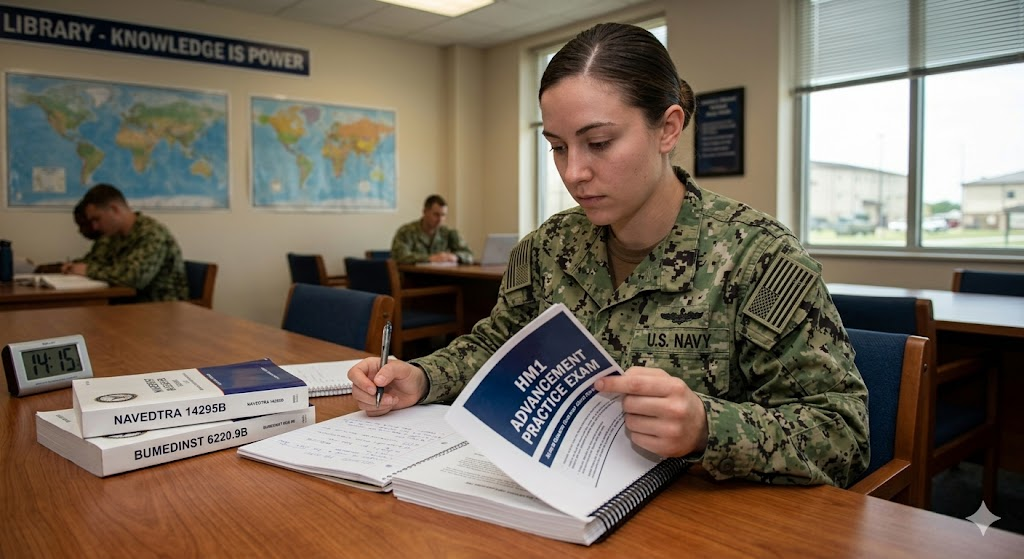
Additional Information
What the Course Entails and Exam Details
As an applicant for HM1, the course of study is extensive and demanding. The examination does not cover a single course, but rather is a comprehensive evaluation of the knowledge, skills, and abilities an individual has accumulated throughout their career in the Hospital Corps. The exam content is primarily derived from the current Naval Advancement Bibs (Bibliographies), which are updated regularly. These Bibs list the specific references, manuals, and instructions you must master.
You will need to demonstrate depth of knowledge across multiple distinct areas. The core topics generally include Advanced Medical-Surgical Nursing. You will be expected to understand complex patient care for diverse medical conditions and surgical procedures. The examination also focuses heavily on Operational Medicine. This involves proficiency in Fleet Marine Force (FMF) medical protocols, Combat Casualty Care, and triage in high-stress environments.
Furthermore, a significant portion of the test evaluates Clinical Administration. You must show mastery of Medical Department organization, medical logistics, supply chain management, and the nuances of the Theater Medical Information Program (TMIP). You will be tested on Preventive Medicine and Occupational Health protocols, including sanitation standards and health surveillance.
Lastly, and crucially for this paygrade, the exam measures Leadership and Professional Military Knowledge (PMK). This section evaluates your understanding of leadership principles, Navy regulations, counseling procedures, training program management, and operational security. Mastery of these topics is not optional; it is fundamental to the role of an HM1.
What to Expect in the Final Exam
The Hospital Corpsman First Class (HM1) Advancement Exam is a rigorous, standardized test. It generally consists of 175 questions designed to test both factual knowledge and its application in practical scenarios. Of these, 150 questions typically cover your rating (medical) knowledge, while the remaining 25 focus on Professional Military Knowledge (PMK).
This is a multiple-choice examination. You will be given a set period of time, typically three hours, to complete the entire test. Time management is crucial for success.
A passing score on the HM1 exam is a critical component of your final multiple, which determines your advancement. There is no singular "passing" numerical score that guarantees promotion. Instead, your Final Multiple Score (FMS), which combines your exam performance with other factors such as performance evaluations, awards, and time-in-service, determines your ranking against your peers.
Only the top candidates with the highest total FMS scores are advanced based on the vacancies available (the "quota") in the Navy at that time. Therefore, achieving a high score on this exam is your best path to ensuring you are above the cutoff line for advancement. The examination is strictly proctored, and all official Navy advancement regulations apply throughout the testing period.
How to Study and Exam Centers
Effective preparation for the HM1 exam requires a dedicated and systematic approach. The foundation of your study must be the specific Bibliographies (Bibs) published for your exam cycle. Do not rely on generic information; you must study the exact manuals and references listed.
Create a long-term study plan and break the topics down into manageable sections. Utilize the active recall method by generating flashcards for critical information. Actively taking HM1-specific practice exams is one of the single most effective study methods. This helps you become familiar with the question phrasing, identifies your knowledge gaps, and improves your time-management skills.
Participate in study groups with other HM2s who are preparing for the exam. Explaining complex concepts to others often strengthens your own understanding. Review your performance evaluations and seek feedback from HM1s and Chiefs to identify areas where your practical knowledge may be lacking.
Unlike civilian certifications, this exam is not taken at a commercial testing center. You will typically sit for the official advancement exam in a controlled setting at your command or a designated military installation. These physical testing centers are often large common areas like gymnasiums or dining facilities, repurposed for the exam to accommodate all candidates simultaneously. Your command’s Educational Services Officer (ESO) will coordinate your eligibility and provide exact details on the time and location. For practice exams and digital study resources, many Sailors utilize official Navy portals (like MyNavy Portal) and authorized third-party online platforms.
Job Opportunities from the Course
Successfully passing the HM1 Advancement Exam and achieving promotion to Petty Officer First Class dramatically changes your career trajectory. This milestone shifts your focus from hands-on clinical tasks to advanced leadership and supervisory roles within the Hospital Corps. Achieving the rank of HM1 unlocks the following leadership roles and career paths:
Leading Petty Officer (LPO) of a clinic, ward, or department.
Independent Duty Corpsman (IDC) - HM1 is often a prerequisite for application to this critical operational role.
Medical Department Representative (MDR) for a small unit or detachment.
Classroom Instructor at "A" School, "C" Schools, or operational training commands.
Advanced operational leadership positions within Fleet Marine Force (FMF) units.
Specialized clinical management roles in biomedical, laboratory, or dental facilities.
Naval Recruiter or Recruit Division Commander (RDC).
Pathway to the rank of Chief Petty Officer (E-7).
Eligibility for various Navy commissioning programs (e.g., MECP, STA-21) to become a commissioned officer.
By achieving the rank of HM1, you solidify your standing as a leader within the Navy medical community and open doors to assignments with increased authority, responsibility, and influence.
Frequently Asked Questions
Reviews
5.0
Based on 0 reviews
Leave a Review
No reviews yet. Be the first to review!