
Houston Fire Department (HFD) Phase 1 Practice Test
$69.00
- Buy to unlock unlimited access to all Quiz questions and Answers in this Quiz.
- After purchase you can print a PDF of the whole quiz at any point. The PDF will contain the questions and the correct answers.
About this Exam
The Houston Fire Department (HFD) Phase 1 Practice Test is the essential first step on your journey to becoming a firefighter in one of the largest and most prestigious fire departments in the United States. Designed for aspiring firefighter candidates, this written assessment is a critical hurdle that evaluates the fundamental cognitive abilities, behavioral traits, and job-related skills required for success in the fire service. Passing Phase 1 is not just about showing what you know; it is about demonstrating that you possess the core aptitudes to excel through the subsequent, rigorous phases of the HFD hiring process and throughout your career. This practice exam is engineered to help you identify your strengths and weaknesses, build confidence, and ensure you are fully prepared to conquer the actual written test.
Ready to test your knowledge?
Buy Now to Access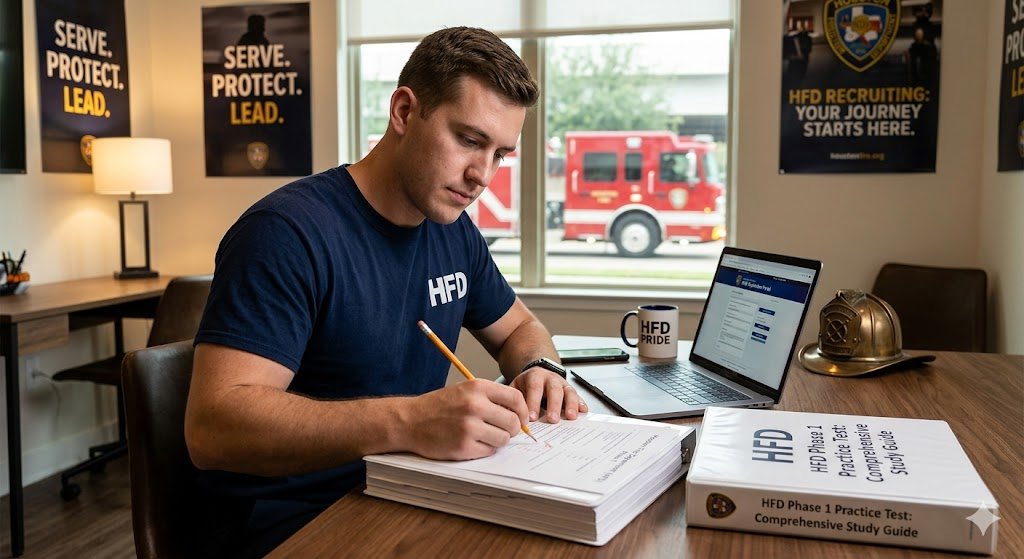
Additional Information
What the Course Entails and Exam Details
The official Houston Fire Department entry-level written exam typically utilizes a comprehensive assessment tool like the Firefighter Selection Tool (FST). This test is split into two primary sections: Cognitive Abilities and Non-Cognitive Traits.
Cognitive Abilities: This section is a multiple-choice exam that measures your intellectual aptitude across several key domains. You can expect questions to assess your proficiency in:
Mathematical Reasoning: Solving problems involving basic arithmetic, decimals, fractions, percentages, and algebraic operations, often presented as word problems related to fire service scenarios.
Written Comprehension & Expression: Evaluating your ability to read and understand complex written materials, such as policies and training manuals, and to express ideas clearly and correctly in writing.
Deductive & Inductive Reasoning: Your ability to apply general rules to specific problems to reach logical conclusions, as well as finding a rule or principle that explains how a set of items are related.
Information Ordering: The ability to correctly follow a rule or set of rules to arrange things or actions in a certain order.
Spatial Orientation & Visualization: Assessing your ability to navigate and understand your surroundings and to imagine how an object would look after being moved or rearranged.
Non-Cognitive Traits: This part of the assessment often includes two sub-sections:
Work Styles/Personality: Measuring your behavioral dispositions, such as conscientiousness, teamwork, and emotional stability, to determine how well your personality aligns with the demands of a firefighter's role.
Biographical Data: A questionnaire about your personal history and experiences, which helps build a complete picture of your suitability for the fire service.
What to Expect in the Final Exam
The actual HFD Phase 1 written exam is a high-stakes, proctored assessment. While specific formats can vary slightly from one hiring cycle to another, you should anticipate a challenging experience.
Format: The core of the exam is a multiple-choice test, typically administered on a Scantron bubble sheet or a computer. There may be close to 100 or more questions in the cognitive section.
Time Limit: Candidates are usually afforded a fixed time limit, often around two hours, to complete the cognitive section. It is crucial to manage your time effectively, as many find the test to be a race against the clock.
Passing Score: A minimum score of 70% is generally required to pass the written examination before additional points, such as those for qualified veterans, are considered. Scoring well is essential for advancing to the physical ability test and personal interview.
Non-Cognitive Assessment: The biographical and personality questionnaires may be integrated into the main exam session or administered separately.
How to Study and Exam Centers
Preparation is the key to conquering the HFD Phase 1 written exam. Follow these actionable strategies to optimize your study plan:
Engage with Official Resources: Start with any official study guides, orientation materials, or preparatory information provided directly by the City of Houston and the Houston Fire Department.
Practice Under Realistic Conditions: Utilize high-quality practice tests, such as this one, and time yourself strictly. This will help you build stamina, improve speed, and manage testing anxiety.
Focus on Foundational Skills: Dedicate time to reviewing and practicing basic mathematical concepts, such as long division, fractions, and percentages. Work on your reading speed and comprehension by practicing with technical or operational texts.
Review Sample Personality Questions: Familiarize yourself with the types of non-cognitive questions. Answer honestly, but understand that the department is looking for traits like safety-consciousness, resilience, and a strong work ethic.
Identify and Address Weaknesses: Use your results from practice tests to pinpoint specific areas where you need improvement. Focus your studying efforts on those topics.
Take the Real Exam: The actual HFD written test is a formal event. It is not available on demand through online portals like Pearson VUE. Candidates must register for and take the exam at a designated physical location in Houston, TX, as part of the department's structured hiring process. All specific details, including the exact center, date, and time, will be provided directly to eligible applicants.
Job Opportunities from the Course
Passing the HFD Phase 1 Practice Test and subsequently the actual written exam is your gateway to a rewarding career in the fire and emergency services. This certification unlocks a clear career path with numerous opportunities for growth within the Houston Fire Department.
Upon successful completion of the entire hiring process, you will begin your career as a:
Firefighter Trainee: A crucial role where you will receive comprehensive academy training in fire suppression, emergency medical services, and specialized rescue techniques.
After completing training, you will advance to:
Firefighter: Serving the Houston community on the front lines, responding to a diverse range of emergencies, and protecting lives and property.
Firefighter/EMT: A vital position that combines firefighter duties with emergency medical expertise, providing life-saving care on medical calls.
With experience and further certification, you can pursue advanced and specialized roles, such as:
Engineer/Operator: Responsible for driving and operating fire apparatus, including engines, ladders, and specialized vehicles.
Paramedic: Providing advanced life support and critical medical care on complex emergency scenes.
Captain/Chief Officer: Leadership positions where you command fire stations, oversee crews, and manage large-scale emergency incidents.
Specialized Rescue (HazMat, Technical Rescue): Serving on elite teams that handle hazardous materials incidents, technical rope rescues, or swift water emergencies.
Arson Investigator: Conducting detailed investigations to determine the cause and origin of fires.
Your journey to a meaningful career in the Houston Fire Department begins with conquering the Phase 1 assessment. Take that first step with confidence!
Frequently Asked Questions
Reviews
5.0
Based on 0 reviews
Leave a Review
No reviews yet. Be the first to review!