
How to Conduct a Command Climate Assessment and Administer the Defense Organizational Climate Survey Practice Test
$69.00
- Buy to unlock unlimited access to all Quiz questions and Answers in this Quiz.
- After purchase you can print a PDF of the whole quiz at any point. The PDF will contain the questions and the correct answers.
About this Exam
Welcome to your comprehensive study guide and preparation resource for understanding and excelling in the Command Climate Assessment (CCA) process and the administration of the Defense Organizational Climate Survey (DEOCS).
This crucial area of military leadership is not just about passing a test; it is about mastering the essential tools used across the Department of Defense (DoD) to evaluate and improve unit health, inclusivity, and overall effectiveness.
By deeply understanding how to conduct effective assessments and leverage survey data, you empower yourself and your leadership to create positive, proactive, and mission-ready environments.
This guide, and the associated practice exams, is specifically designed for military leaders at all levels, Equal Opportunity (EO) advisors and specialists, human resources personnel within the defense sector, and any unit member designated to support or lead climate assessment teams.
Whether you are preparing for formal certification, looking to refresh your knowledge, or simply aiming to be a more effective leader, this resource is your starting point for success.
Our goal is to provide you with the knowledge and confidence not only to perform well on any associated assessments but, more importantly, to apply these critical skills effectively in your unit.
Ready to test your knowledge?
Buy Now to Access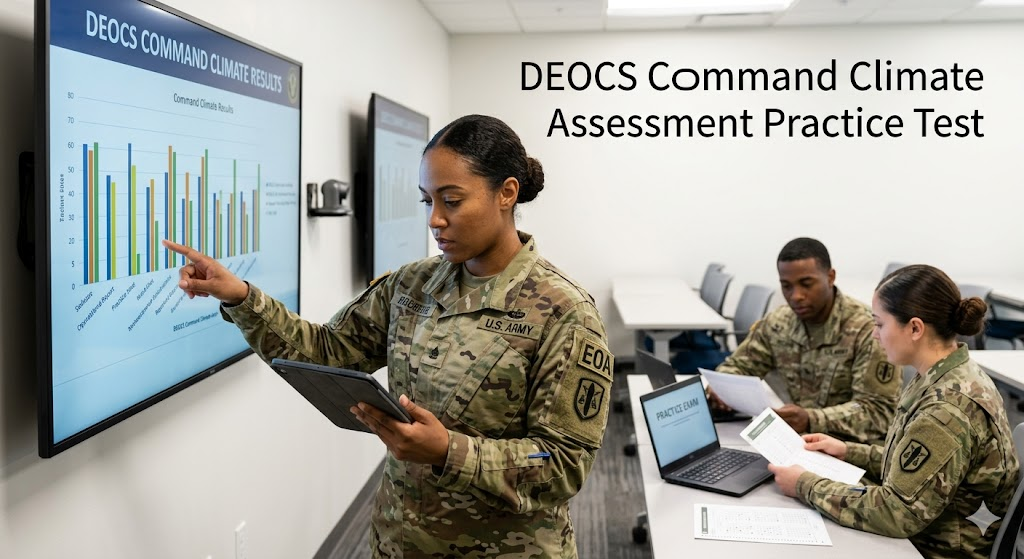
Additional Information
What the Course Entails and Exam Details
Preparing for a Command Climate Assessment and understanding the DEOCS involves delving into several key interconnected areas.
A comprehensive course or study plan will typically cover:
Foundations of Command Climate: Understanding what constitutes a positive and negative command climate, its impact on readiness and morale, and the leader's responsibility in shaping it.
Legislative and Regulatory Requirements: Deep dives into relevant DoD Instructions (DoDI), service-specific policies, and legal frameworks governing climate assessments, inclusion, and the prevention of harassment and discrimination.
The Defense Organizational Climate Survey (DEOCS) Deep Dive:
Purpose and Scope: Understanding exactly what the DEOCS measures, including key factors like proactive leadership, reactive leadership, peer cohesion, inclusion, and prevalence of various negative behaviors.
Administration Process: Mastering the step-by-step procedure for requesting, registering, and administering the survey through official online portals. This includes understanding participant eligibility and confidentiality protocols.
Methodology: Grasping the survey design principles, data collection methods, and reporting structures.
Data Interpretation and Analysis: Learning how to read and interpret DEOCS reports, identifying trends, strengths, and areas of concern. This involves understanding statistical significance and comparing unit data against benchmarks.
Conducting Qualitative Assessments: Mastering methods beyond surveys, such as focus groups and individual interviews, to gain deeper insights and context. Learning effective questioning and facilitation techniques.
Developing Actionable Improvement Plans: Translating assessment findings into concrete, measurable, and effective action plans to address identified issues and reinforce positive aspects of the climate.
Communication Strategies: Effective methods for briefing leadership, communicating results to the unit, and fostering transparency and trust throughout the process.
The specific "final exam" or practice test you are preparing for will test your mastery across these domains through a series of rigorous questions.
It aims to ensure you have not just memorized facts but can apply policies, analyze data, and make sound recommendations in realistic scenarios.
What to Expect in the Final Exam
While the exact format and details can vary by specific program, command, or platform offering the assessment, you can generally expect the following:
Exam Format: The test will predominantly feature multiple-choice questions designed to assess both factual knowledge and application skills. You may also encounter scenario-based questions where you are presented with a hypothetical unit situation or DEOCS data and must select the best course of action or interpretation. Some assessments might include true/false statements or short-answer questions related to specific policy details.
Passing Score Requirements: A high standard is typically set, often requiring a minimum passing score of 80% or higher. This ensures a strong level of competency given the sensitive nature and critical impact of climate assessments. Always verify the specific passing score for your particular program.
Time Limits: Expect a defined time limit for completing the exam, for example, 90 to 120 minutes. This requires you to manage your time effectively and have a solid understanding of the material to answer questions efficiently.
Specific Rules: Most official assessments will be closed-book, meaning you cannot use any study materials, policies, or outside resources. You will likely need to take the exam through a specific, secure online portal, potentially requiring you to be monitored or proctored. Ensure you have the necessary system requirements and identification readily available. Collaboration is strictly prohibited.
By practicing with representative tests, you can get a feel for the specific question styles, difficulty levels, and time pressures you will face.
How to Study and Exam Centers
Effective preparation is key to success. Here are actionable strategies to help you study:
Master the Core Documents: Thoroughly review all relevant DoD and service-specific instructions and policies related to command climate, harassment prevention, and the DEOCS program. Understand the why behind each policy.
Deeply Understand the DEOCS Guide: Study official DEOCS administration guides and portal documentation. Familiarize yourself with all the survey factors, the reporting structure, and the entire survey lifecycle.
Practice Data Interpretation: Seek out sample DEOCS reports (if available for training) or construct hypothetical scenarios with sample data. Practice identifying key strengths, weaknesses, and potential red flags. Compare your analysis with established benchmarks.
Review Sample Improvement Plans: Study examples of effective climate improvement plans to understand how to turn findings into actionable steps. Practice drafting your own plans based on real or hypothetical assessment data.
Engage with Official Training Materials: Utilize any training modules, webinars, or resources provided by your service’s EO office, leadership schools, or the DEOCS help desk. These are often the most accurate and up-to-date sources.
Form Study Groups: Collaborate with colleagues or fellow students to discuss complex topics, share insights, and test each other’s knowledge. Discussing different perspectives on scenarios can be highly beneficial.
Take Multiple Practice Exams: This is crucial. Take representative practice tests, like the one this guide supports, repeatedly. Treat them as real exams – time yourself, close all materials, and identify your weak areas after each attempt.
Where to Take the Exam:
For official DEOCS administrator certification or related assessments within a military context, you will typically access and take the exam through:
Authorized Military Online Portals: Specific service portals (e.g., Army Training Requirements and Resources System (ATRRS), Navy e-Learning, Air Force myLearning, Marine Corps Training and Education Command (TECOM) portals) or dedicated DEOCS administration websites. You will need authorized access to these systems.
Military Learning Centers: Formal courses at military leadership schools, Equal Opportunity schools, or professional development centers may include a final, in-person proctored exam.
Unit EO Offices: Some lower-level or localized assessments might be administered or facilitated directly by your unit’s Equal Opportunity office or higher headquarters.
It is critical to note that these are generally not taken at public testing centers like Pearson VUE. They are controlled, internal assessments specific to the defense community and its systems. Always check with your specific command, EO advisor, or course coordinator for precise instructions on how and where to register for and take your official exam.
Job Opportunities from the Course
While "Command Climate Assessment" isn't typically a standalone job title, mastering this skill set is invaluable and often required or highly desirable for numerous critical roles within the military and defense sectors, unlocking significant career paths:
Equal Opportunity (EO) Advisor / Specialist: A core responsibility, where you will directly advise commanders on climate issues, administer DEOCS, analyze data, and help develop improvement strategies. This is a primary career path for deep specialization.
Command Team Member (Commander, Sergeant Major, Senior Enlisted Advisor): Vital for every leader to understand, as you are ultimately responsible for the unit’s climate. This knowledge makes you a more effective and proactive leader, enhancing your promotion potential and overall effectiveness.
Human Resources Specialist (Military/Civilian): Essential for understanding organizational health, retention factors, and employee satisfaction within defense organizations, leading to various HR leadership roles.
Climate Assessment Team Member / Leader: Specialized roles within larger commands or organizations dedicated specifically to monitoring and improving organizational climate.
Inspector General (IG) Personnel: Understanding climate assessment methodologies helps IG teams effectively investigate systemic issues and complaints related to unit environments.
Instructional Designer / Trainer: Roles involving developing and delivering training on leadership, ethics, and organizational climate.
Defense Consultant (Organizational Development): Civilian or contract roles advising defense agencies on optimizing organizational health and culture.
By becoming an expert in command climate assessments and DEOCS administration, you significantly enhance your value to any military organization and open doors to diverse, impactful leadership and specialist positions across the defense landscape. Good luck with your studies!
Frequently Asked Questions
Reviews
5.0
Based on 0 reviews
Leave a Review
No reviews yet. Be the first to review!