
HSC-3 Plane Captain Practice Test
$69.00
- Buy to unlock unlimited access to all Quiz questions and Answers in this Quiz.
- After purchase you can print a PDF of the whole quiz at any point. The PDF will contain the questions and the correct answers.
About this Exam
The HSC-3 Plane Captain Practice Test is a critical preparation tool for US Navy personnel striving to earn their Plane Captain qualification.
This rigorous qualification process is designed for sailors assigned to Helicopter Sea Combat Squadron Three (HSC-3), primarily operating the MH-60S Seahawk helicopter.
Passing this exam is the foundational step in proving you are ready for the immense responsibility of launching and recovering these aircraft safely.
It confirms that you possess the necessary technical knowledge and attention to detail required to supervise flight deck ground operations and ensure aircraft readiness.
Ready to test your knowledge?
Buy Now to Access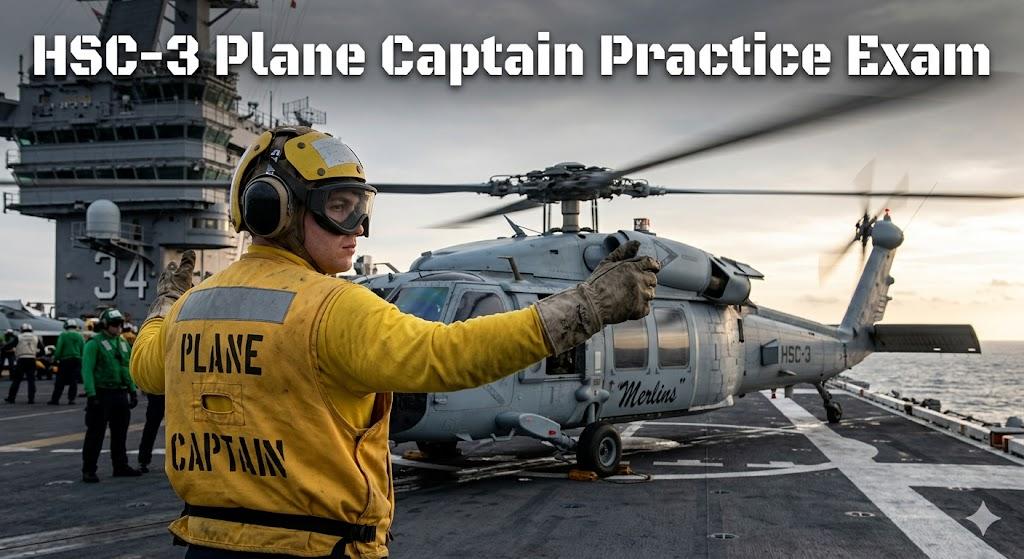
Additional Information
What the Course Entails and Exam Details
The qualification syllabus covers a broad spectrum of critical naval aviation knowledge, specifically focused on the MH-60S aircraft and squadron procedures.
Key areas include comprehensive Naval Air Training and Operating Procedures Standardization (NATOPS) general flight and operating instructions.
Candidates must master aircraft ground handling, including towing procedures, visual hand signals for communication, and flight deck safety protocols.
The coursework also entails in-depth training on daily and pre-flight/post-flight inspection criteria, refueling operations, and basic helicopter systems (such as hydraulics, engines, and electrical components).
Furthermore, there is a heavy emphasis on Emergency Action Plans (EAPs) and fire fighting procedures specific to the aircraft and the hangar bay/flight deck environment.
What to Expect in the Final Exam
The actual HSC-3 Plane Captain qualification is a comprehensive assessment that usually involves two main phases: a formal written exam and a practical application review, often known as a "Board."
The written portion generally consists of multiple-choice, true/false, and short-answer questions derived directly from NATOPS manuals and squadron instructions.
This is not a simple test; a minimum passing score is typically very high (often 90% or higher), reflecting the zero-tolerance policy for safety errors in naval aviation.
Upon passing the written test, you will face an oral board and practical evaluation, where senior squadron leaders will test your knowledge in real-time and observe your ability to conduct inspections.
You are expected to demonstrate absolute confidence and accuracy when performing pre-flight checks or guiding the aircraft.
How to Study and Exam Centers
Effective preparation for the HSC-3 Plane Captain Practice Test requires a multi-faceted approach.
First, treat the practice test as your primary diagnostic tool; take it several times to identify areas where your NATOPS and SOP (Standard Operating Procedures) knowledge is weak.
Dedicate significant time to studying the MH-60S NATOPS manual (A1-H60SA-NFM-000) and your squadron’s local instructions, which are the absolute authorities on the subject.
Supplement your reading with practical application; shadow qualified Plane Captains during their inspections, learn the aircraft's physical layout, and practice hand signals daily.
The written exam and practice tests are typically administered through secure naval training portals or within the HSC-3 squadron training department located at NAS North Island, San Diego, California.
Job Opportunities from the Course
Earning your Plane Captain qualification within HSC-3 is a significant achievement and a prerequisite for advancement in several aviation ratings.
It unlocks critical career paths, both within the Navy and later in the civilian sector, because it demonstrates proven leadership and high-stakes technical competence.
This certification directly enables you to function in key roles:
HSC-3 MH-60S Plane Captain
Flight Deck Leading Petty Officer
Aviation Structural Mechanic (AM)
Aviation Machinist's Mate (AD)
Aviation Electrician's Mate (AE)
Collateral Duty Inspector (CDI) (Advanced qualification requiring the PC background)
(Civilian) FAA Airframe and Powerplant (A&P) Mechanic (Hours logged as PC contribute toward eligibility)
( Civilain) Aviation Ground Handling Specialist
Frequently Asked Questions
Reviews
5.0
Based on 0 reviews
Leave a Review
No reviews yet. Be the first to review!