
HSC Community and Family Studies (CAFS) Practice Exam
$69.00
- Buy to unlock unlimited access to all Quiz questions and Answers in this Quiz.
- After purchase you can print a PDF of the whole quiz at any point. The PDF will contain the questions and the correct answers.
About this Exam
The HSC Community and Family Studies (CAFS) Practice Exam is an essential tool designed for Year 12 students in New South Wales (NSW), Australia, preparing for their Higher School Certificate. This unique, interdisciplinary subject combines elements of sociology, developmental psychology, and family studies. It is designed for students passionate about understanding the intricate dynamics of contemporary Australian society, focusing on resource management, the wellbeing of individuals and groups, and the critical role families play within the broader community. This practice exam allows students to gauge their understanding of these complex social issues and refine their research and analytical skills before the final state-wide assessment.
Ready to test your knowledge?
Buy Now to Access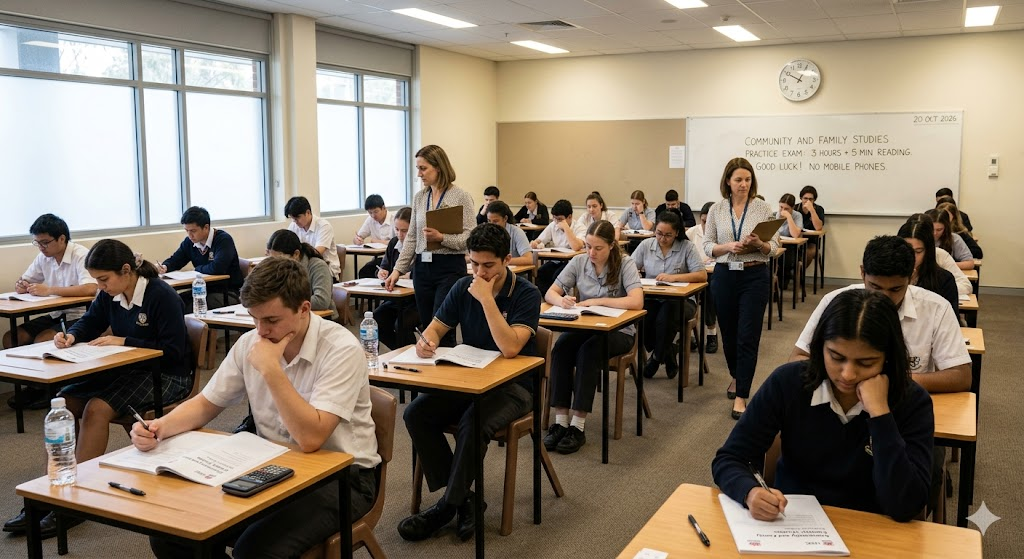
Additional Information
What the Course Entails and Exam Details
The CAFS course provides a fascinating exploration of the diverse nature and interdependence of individuals, families, and communities. Throughout the Year 12 course, students dive deep into critical human issues.
The core syllabus topics cover:
Research Methodology: A vital module developing skills in planning, collecting, recording, interpreting, analysing, and presenting research. A requirement of the course is the completion of an Independent Research Project (IRP).
Groups in Context: An investigation into the specific needs and inequities experienced by various community groups, such as people with a disability, the homeless, youth, and aged people.
Parenting and Caring: An analysis of the diverse roles and factors that influence the quality of parenting and caring, and their subsequent impact on wellbeing.
In addition to the core topics, students study one of the following option modules, which represents 25 percent of the course time:
Family and Relationships
Social Impact of Technology
Individuals and Work
The final state examination is a comprehensive three-hour written paper, plus five minutes of reading time, worth a total of 100 marks. The exam tests students' knowledge, understanding, and application of syllabus content through various response types.
What to Expect in the Final Exam
The final CAFS HSC exam is structured to test both broad knowledge and deep understanding. The written examination has a total working time of 3 hours. It is divided into two distinct sections:
Section I (Core Modules): This section is worth 75 marks and is based on the compulsory core content. It consists of Part A (20 Multiple Choice Questions) and Part B (Short Answer Questions of varying lengths, often requiring students to draw on specific examples and critical analysis).
Section II (Options): This section is worth 25 marks and focuses on the single option topic your school has studied. Students must answer one question from this section, which may include short-answer and extended-response components, requiring a logical, cohesive argument.
While there is no single "passing score" for the HSC, students aim to achieve the highest possible mark to secure a place in their desired band (1-6), with Band 6 representing the highest level of achievement. It is a closed-book exam. You must bring black or blue pens, and a non-programmable calculator is often recommended for interpreting statistical data in question stimuli.
How to Study and Exam Centers
Preparation for the CAFS exam requires a blend of consistent content review, skill development, and targeted exam practice.
Practice with Past Papers: Access the New South Wales Education Standards Authority (NESA) website to complete past HSC examination papers. This is the single most effective way to understand the exam format and the language of NESA key words.
Refine Your IRP Skills: Revisit the methodologies and ethical practices you used for your Independent Research Project. The exam will likely test your ability to apply these concepts to hypothetical scenarios.
Use Current Examples: In short and extended responses, top-tier students don't just state theory; they apply it to real-world Australian contemporary examples. Keep up to date with community news, social issues, and relevant statistics.
Study the Rubric: Pay close attention to the NESA marking guidelines and glossary of key words to ensure your answers directly address what the question is asking.
Create Structured Notes: Organize your notes around syllabus dot points. For the Option topic, ensure you have multiple detailed case studies and examples prepared.
The official HSC Community and Family Studies exam is taken in registered secondary schools across New South Wales. Students take the exam at their own school or a designated examination center approved by NESA.
Job Opportunities from the Course
Studying CAFS equips students with highly valued, transferable skills that are a fundamental requirement for careers focused on people, community, and social wellbeing. The depth of understanding regarding human development, resource management, and research makes graduates attractive in various professional sectors.
The course unlocks numerous career paths, including:
Child Care Worker
Social Worker
Counsellor (Family, School, or Community)
Registered Nurse or Aged Care Worker
Teacher (specifically in PDHPE, Community Services, or related fields)
Human Resource Management Specialist
Disability Support Worker
Community Development Officer
Youth Advocate
Case Manager
Nonprofit Program Director
This qualification provides a robust foundation for vocational training and tertiary studies in social sciences, health, and education.
HSC Community and Family Studies Practice Exam
Description
The HSC Community and Family Studies (CAFS) Practice Exam is an essential tool designed for Year 12 students in New South Wales (NSW), Australia, preparing for their Higher School Certificate. This unique, interdisciplinary subject combines elements of sociology, developmental psychology, and family studies. It is designed for students passionate about understanding the intricate dynamics of contemporary Australian society, focusing on resource management, the wellbeing of individuals and groups, and the critical role families play within the broader community. This practice exam allows students to gauge their understanding of these complex social issues and refine their research and analytical skills before the final state-wide assessment.
What the Course Entails and Exam Details
The CAFS course provides a fascinating exploration of the diverse nature and interdependence of individuals, families, and communities. Throughout the Year 12 course, students dive deep into critical human issues.
The core syllabus topics cover:
Research Methodology: A vital module developing skills in planning, collecting, recording, interpreting, analysing, and presenting research. A requirement of the course is the completion of an Independent Research Project (IRP).
Groups in Context: An investigation into the specific needs and inequities experienced by various community groups, such as people with a disability, the homeless, youth, and aged people.
Parenting and Caring: An analysis of the diverse roles and factors that influence the quality of parenting and caring, and their subsequent impact on wellbeing.
In addition to the core topics, students study one of the following option modules, which represents 25 percent of the course time:
Family and Relationships
Social Impact of Technology
Individuals and Work
The final state examination is a comprehensive three-hour written paper, plus five minutes of reading time, worth a total of 100 marks. The exam tests students' knowledge, understanding, and application of syllabus content through various response types.
What to Expect in the Final Exam
The final CAFS HSC exam is structured to test both broad knowledge and deep understanding. The written examination has a total working time of 3 hours. It is divided into two distinct sections:
Section I (Core Modules): This section is worth 75 marks and is based on the compulsory core content. It consists of Part A (20 Multiple Choice Questions) and Part B (Short Answer Questions of varying lengths, often requiring students to draw on specific examples and critical analysis).
Section II (Options): This section is worth 25 marks and focuses on the single option topic your school has studied. Students must answer one question from this section, which may include short-answer and extended-response components, requiring a logical, cohesive argument.
While there is no single "passing score" for the HSC, students aim to achieve the highest possible mark to secure a place in their desired band (1-6), with Band 6 representing the highest level of achievement. It is a closed-book exam. You must bring black or blue pens, and a non-programmable calculator is often recommended for interpreting statistical data in question stimuli.
How to Study and Exam Centers
Preparation for the CAFS exam requires a blend of consistent content review, skill development, and targeted exam practice.
Practice with Past Papers: Access the New South Wales Education Standards Authority (NESA) website to complete past HSC examination papers. This is the single most effective way to understand the exam format and the language of NESA key words.
Refine Your IRP Skills: Revisit the methodologies and ethical practices you used for your Independent Research Project. The exam will likely test your ability to apply these concepts to hypothetical scenarios.
Use Current Examples: In short and extended responses, top-tier students don't just state theory; they apply it to real-world Australian contemporary examples. Keep up to date with community news, social issues, and relevant statistics.
Study the Rubric: Pay close attention to the NESA marking guidelines and glossary of key words to ensure your answers directly address what the question is asking.
Create Structured Notes: Organize your notes around syllabus dot points. For the Option topic, ensure you have multiple detailed case studies and examples prepared.
The official HSC Community and Family Studies exam is taken in registered secondary schools across New South Wales. Students take the exam at their own school or a designated examination center approved by NESA.
Job Opportunities from the Course
Studying CAFS equips students with highly valued, transferable skills that are a fundamental requirement for careers focused on people, community, and social wellbeing. The depth of understanding regarding human development, resource management, and research makes graduates attractive in various professional sectors.
The course unlocks numerous career paths, including:
Child Care Worker
Social Worker
Counsellor (Family, School, or Community)
Registered Nurse or Aged Care Worker
Teacher (specifically in PDHPE, Community Services, or related fields)
Human Resource Management Specialist
Disability Support Worker
Community Development Officer
Youth Advocate
Case Manager
Nonprofit Program Director
This qualification provides a robust foundation for vocational training and tertiary studies in social sciences, health, and education.
Frequently Asked Questions
Reviews
5.0
Based on 0 reviews
Leave a Review
No reviews yet. Be the first to review!