
HSC Design & Technology Practice Exam
$69.00
- Buy to unlock unlimited access to all Quiz questions and Answers in this Quiz.
- After purchase you can print a PDF of the whole quiz at any point. The PDF will contain the questions and the correct answers.
About this Exam
The Higher School Certificate (HSC) Design and Technology course is a dynamic subject designed for students in New South Wales, Australia, who possess a creative, curious, and innovative mindset. This course provides an engaging pathway for students to develop a rich understanding of the multifaceted nature of design. It is specifically designed for individuals who have a passion for problem-solving, enjoy practical "hands-on" creation, and are interested in exploring how products, systems, and environments are conceived, developed, and evaluated.
This certification is a major component of the HSC, testing a student's ability to integrate theoretical knowledge of design principles with the practical skills required to manage a project from an original concept through to a realized, high-quality solution.
Ready to test your knowledge?
Buy Now to Access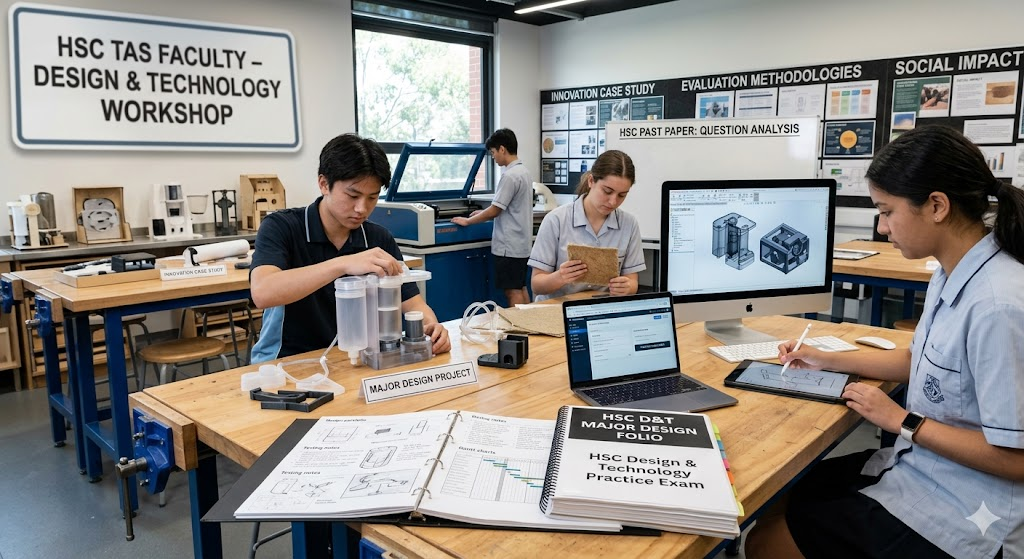
Additional Information
What the Course Entails and Exam Details
The HSC Design and Technology course is an integrated program that explores the core areas of design, technology, and society. The course content is structured around several key themes, ensuring students gain both breadth and depth in their understanding. Students are required to delve into the study of innovation and emerging technologies, completing a detailed case study of a specific innovation to understand its historical, cultural, and environmental impacts.
The central pillar of the course is the Major Design Project (MDP), which allows students to apply the knowledge and understanding gained throughout the preliminary and HSC courses. Through the MDP, students are expected to identify a need or opportunity and, with creativity and resourcefulness, research, test, and evaluate to develop a detailed, practical design solution.
Core Topics Covered:
Design Theory and Practice
Design Processes (Identification, Exploration, Realisation)
Innovation and Emerging Technologies (including Case Studies)
The Manipulation of Materials, Tools, and Techniques
Environmental and Social Issues in Design
Project Management and Folio Documentation
Testing and Evaluation in Design
Communication of Design Ideas
The overall HSC assessment for Design and Technology is structured as follows:
External Examination (100%): A multi-faceted exam administered by the NSW Education Standards Authority (NESA), contributing to the final ATAR mark.
What to Expect in the Final Exam
The final HSC Design and Technology examination is a comprehensive evaluation divided into two distinct, high-stakes components, which assess a student’s knowledge, skills, and the outcome of their Year 12 project work.
Component 1: The Written Examination Paper (40 Marks)
Format: This is a standard written examination, usually lasting 1.5 to 2 hours, taken at the student's authorized school.
Structure: It consists of multiple-choice questions, short-answer questions, and extended response questions.
Assessment: This part tests the student's comprehensive understanding of all aspects of the core syllabus content, including design principles, technologies, evaluation methods, and the innovation case study. Students are required to apply their knowledge to hypothetical scenarios and analyze the impacts of design.
Component 2: The Major Design Project (MDP) (60 Marks)
Format: A unique practical and folio submission.
Structure: Students must submit:
A realized Product, System, or Environment (PSE): The tangible outcome of their year-long work.
A Supporting Design Folio: A comprehensive document (no more than 80 written A4 pages or 40 written A3 pages, or equivalent digital/multimedia of no more than 6 minutes) detailing the entire design process.
Assessment: The marking is "holistic," evaluating the quality and detail of the final practical outcome and the degree to which the folio documents the project’s proposal, development, production, and critical evaluation. Mark penalties apply for exceeding specified page and time limits and for font sizes smaller than 12-point. The project must reflect creativity, innovation, technical skill, and an application of appropriate design, production, and evaluation skills.
Passing Score and Specific Rules: There isn't a specific "passing score" in the standard sense for the HSC exam itself; rather, students are awarded a mark and placed into performance bands (Bands 1–6, with 6 being the highest). The overall result is a combination of school-based assessment and this final exam.
How to Study and Exam Centers
Preparation for the HSC Design and Technology exam is a marathon, not a sprint. Success demands a balanced approach that combines rigorous theoretical review with diligent management of the Major Design Project.
Study Strategies and Practice Methods:
Master the MDP Folio: Understand that 60% of your mark resides in your project. Ensure your folio addresses all the criteria holistically. Follow the formatting rules precisely, including the 12-point font size for all text. The folio is your tool to 'show' the markers not just what you made, but why and how you made it, highlighting your research, testing, and continuous evaluation.
Practice Past Written Papers: Access previous HSC papers and marking guidelines from the NESA website. These are invaluable for understanding question formats, common topics, and the level of analysis required for Band 6 responses. Practice under timed conditions to improve speed and accuracy.
Case Study Depth: Go deep into your chosen innovation case study. You must be able to discuss its genesis, impact, and the technologies involved from multiple perspectives (social, environmental, economic, ethical).
Create a Timeline: Develop a clear project management plan (e.g., Gantt chart) for your MDP at the start of Year 12 and stick to it. This prevents a last-minute rush and ensures your production and evaluation are well-documented.
Focus on Evaluation: The most successful students show evidence of testing and experimentation throughout the design process, using evaluations to guide their next steps, rather than just as a final step.
Where to Take the Exam: The HSC Design and Technology exam is not a digital-only certification or a multi-center professional test like Pearson VUE. It is part of the Higher School Certificate, which is administered in authorized secondary schools across NSW.
Written Exam: This component is sat at the student's regular high school during the October/November HSC examination period.
Major Design Project (MDP): The product and folio are finalized and submitted to markers at the school by a set NESA deadline.
Job Opportunities from the Course
A strong result in the HSC Design and Technology course is a testament to a student’s high-level creative, technical, and project management abilities. It opens doors to a vast range of design-focused tertiary degrees (such as Bachelor of Design, Industrial Design, Architecture, and Engineering) and unlocks varied, high-demand career paths across creative, technical, and manufacturing sectors.
Potential Career Paths and Job Titles:
Industrial Designer
Interior Designer
Graphic Designer
Civil Engineer
Aerospace Engineer
Architect
Architectural Draftsperson
Product Designer
UX/UI Designer
Video Game Designer
Web Developer
Animator / Digital Artist
Fashion Designer / Pattern Cutter
Set / Costume Designer for Theater and Film
Furniture Designer
Exhibition / Display Designer
Art Director
Sound Engineer
CAD/CAM Technician
Carpenter / Artisan Craftsperson
Frequently Asked Questions
Reviews
5.0
Based on 0 reviews
Leave a Review
No reviews yet. Be the first to review!