
HSC Economics Practice Exam
$69.00
- Buy to unlock unlimited access to all Quiz questions and Answers in this Quiz.
- After purchase you can print a PDF of the whole quiz at any point. The PDF will contain the questions and the correct answers.
About this Exam
The HSC Economics course provides students with a deep understanding of economic concepts, principles, and models, focusing on the Australian and global economies. The practice exam is an invaluable tool designed for Year 12 students in New South Wales, Australia, who are preparing for their final Higher School Certificate (HSC) exams. This simulated test mirrors the structure, difficulty, and content of the actual HSC Economics examination.
By attempting this practice exam, students can assess their knowledge, identify critical areas for improvement, and become familiar with the format and time constraints of the final test. The goal is to build confidence and refine exam techniques to maximize performance.
Ready to test your knowledge?
Buy Now to Access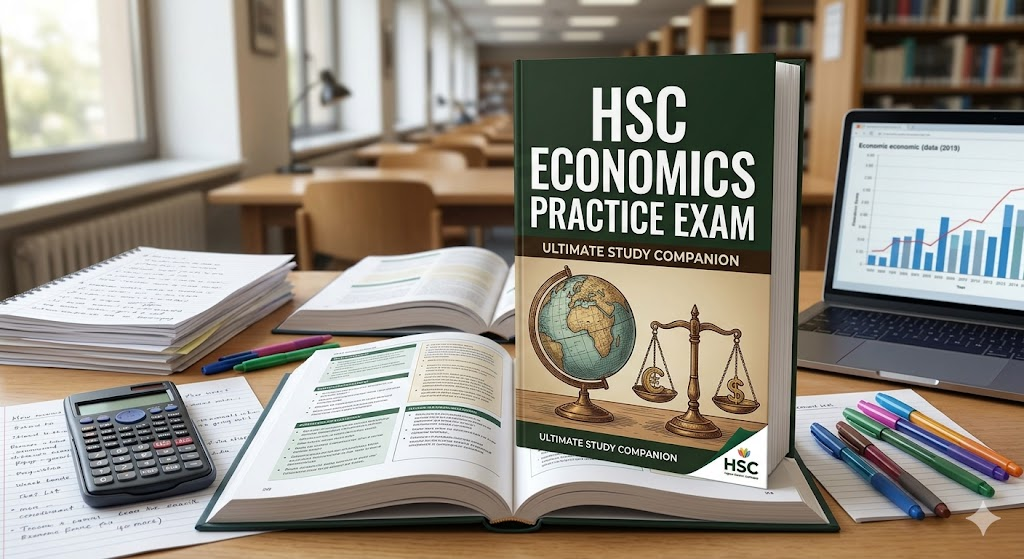
Additional Information
What the Course Entails and Exam Details
The HSC Economics course explores four main topics, all of which are covered in the practice exam:
The Global Economy: This topic investigates the integration of national economies through trade, investment, and financial flows. It includes an analysis of global economic conditions, trade agreements, and the role of international organizations.
Australia’s Place in the Global Economy: Students analyze Australia’s external stability, including the balance of payments, exchange rates, and the impact of global events on the domestic economy.
Economic Issues: This section covers key economic problems facing Australia, such as economic growth, unemployment, inflation, wealth distribution, and environmental sustainability.
Economic Policies and Management: Students learn about the various policy tools available to the Australian government to manage the economy, including fiscal policy, monetary policy, microeconomic reform, and labor market policies. The practice exam assesses a student’s ability to analyze and evaluate these policies' effectiveness.
The practice exam typically mirrors the final HSC exam length, lasting three hours plus a 5-minute reading time. It is a pencil-and-paper test that tests a student's ability to apply economic knowledge to both known and hypothetical situations.
What to Expect in the Final Exam
The final HSC Economics exam is a single three-hour paper. It consists of multiple sections designed to test different skills and levels of understanding:
Section I: Multiple Choice (20 marks)
This section consists of 20 multiple-choice questions that cover all four core topics. It requires a solid understanding of key economic terms, concepts, and relationships.
Section II: Short Answers (40 marks)
This section contains several short-answer questions. These questions often involve economic calculations, interpreting data from graphs and tables, and providing brief explanations of economic concepts and policies.
Section III: Stimulus-Based Essay (20 marks)
In this section, students are presented with stimulus material, such as articles, data tables, or graphs. They must use this information, along with their economic knowledge, to write an extended essay analyzing a specific economic issue or policy.
Section IV: Free-Response Essay (20 marks)
This final section requires students to write an extended, structured essay in response to a choice of two questions. This is an opportunity to demonstrate a deep understanding of a complex economic issue and to provide a well-structured, logical economic argument.
There is no "passing" score for the HSC; instead, students are ranked relative to their peers. However, a score above 50 is required for a student’s result to be recorded on their Record of Achievement.
How to Study and Exam Centers
Preparation is key to succeeding in the HSC Economics exam. Here are some actionable study strategies:
Start Early and Be Consistent: Don't wait until the last minute. Establish a regular study routine early in Year 12, focusing on one topic at a time.
Master the Syllabus: The HSC Economics syllabus is your most important document. Ensure you are familiar with all content points for each of the four core topics.
Review Past Papers: Practicing with actual past HSC exam papers is the single best way to prepare. This helps you understand the types of questions asked and the expected depth of analysis.
Create Structured Notes: Write concise, organized notes for each syllabus dot point. Use headings, bullet points, and diagrams (e.g., supply and demand curves) to make them easy to review.
Analyze Economic Data: Keep up to date with current economic news in Australia and globally. Analyze key statistics like economic growth, unemployment, inflation, and interest rates.
Practice Essay Writing: The extended-response sections are worth 40 marks, so write practice essays regularly. Structure your arguments logically and back them up with economic theory and relevant data.
Exam Centers: The final HSC exams are administered by the NSW Education Standards Authority (NESA). They are not held at external testing centers like Pearson VUE. Students typically take their HSC exams in a supervised setting, such as a school hall or a dedicated exam room, at their own high school or an authorized school nearby.
Job Opportunities from the Course
A strong result in HSC Economics is a valuable qualification that opens doors to further education and various exciting career paths. It provides an excellent foundation for tertiary studies in commerce, business, finance, and economics. Here are some specific job titles and career paths this course can unlock:
Economist: Analyze economic data to forecast trends and advise governments and businesses on economic policy.
Financial Analyst: Evaluate financial data and market trends to help companies make sound investment decisions.
Management Consultant: Help organizations solve problems, improve performance, and achieve their business goals.
Data Analyst: Collect, analyze, and interpret large data sets to identify trends and inform decision-making in a range of industries.
Policy Adviser: Conduct research and provide advice to governments and other organizations on economic and social policies.
Investment Banker: Assist corporations and governments in raising capital and navigating complex financial transactions.
Accountant: Manage financial records, prepare tax returns, and provide financial advice to businesses and individuals.
Market Research Analyst: Study market conditions to examine potential sales of a product or service.
We hope this study guide helps you prepare effectively for your HSC Economics Practice Exam. Good luck!
Frequently Asked Questions
Reviews
5.0
Based on 0 reviews
Leave a Review
No reviews yet. Be the first to review!