
HSC Hospitality Food and Beverage Practice Exam
$69.00
- Buy to unlock unlimited access to all Quiz questions and Answers in this Quiz.
- After purchase you can print a PDF of the whole quiz at any point. The PDF will contain the questions and the correct answers.
About this Exam
The HSC Hospitality Food and Beverage examination is a pivotal milestone for New South Wales high school students enrolled in VET (Vocational Education and Training) hospitality courses. It is a dual-purpose qualification, counting toward your Australian Tertiary Admission Rank (ATAR) while also granting a nationally recognized Certificate II in Hospitality (SIT20322 or similar). This exam is specifically designed for students who want to validate their theoretical knowledge and practical competencies in a professional food and beverage service environment, positioning them for immediate entry into the dynamic hospitality industry or further tertiary study.
Ready to test your knowledge?
Buy Now to Access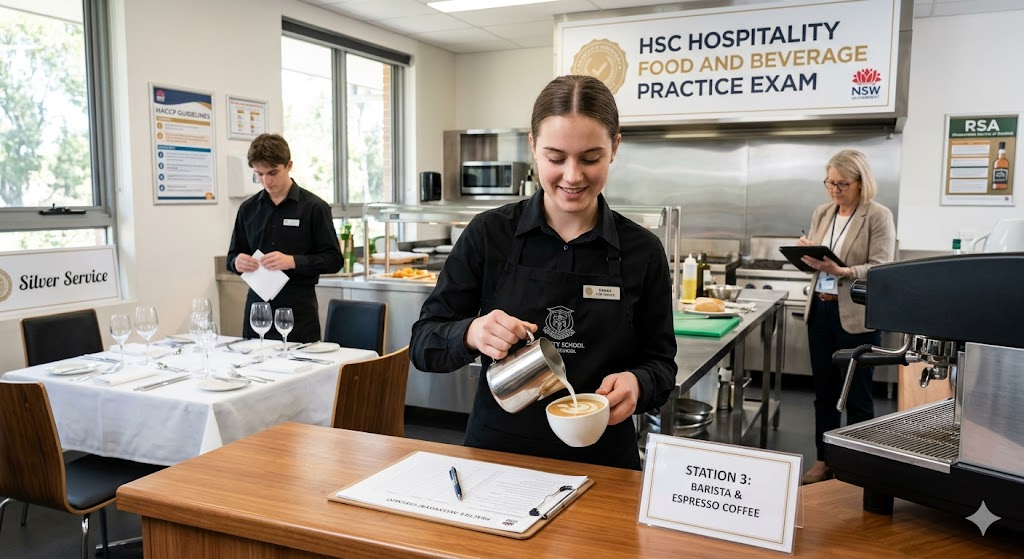
Additional Information
What the Course Entails and Exam Details
This comprehensive course merges practical skill development with essential industry knowledge. Over two years, students master a range of competency units that form the backbone of a successful hospitality career. The core areas covered include:
Workplace Health and Safety (WHS): Understanding and applying safe work practices, including emergency procedures and risk assessment in a kitchen or service environment.
Hygiene and Food Safety: Implementing hygienic practices to prevent food contamination and mastering HACCP (Hazard Analysis and Critical Control Points) principles.
Food and Beverage Service: Developing technical skills in silver service, plate service, and matching food with non-alcoholic and alcoholic beverages.
Espresso Coffee Preparation: Learning to use commercial espresso machines to grind, extract, and texture milk for a range of professional coffees.
Responsible Service of Alcohol (RSA): Acquiring the mandatory certification for serving alcohol responsibly in New South Wales.
Customer Service and Communication: Mastering effective communication with diverse customers and colleagues, managing conflict, and working as part of a cohesive team.
What to Expect in the Final Exam
The final HSC assessment is a two-hour written examination designed to test your knowledge, understanding, and ability to apply hospitality concepts to real-world scenarios. Unlike common certification exams, this is a written, structured paper, not a practical test. The paper is typically divided into three sections:
Section I (Multiple Choice): Approximately 15–20 questions testing broad knowledge of the core units, industry terminology, and WHS practices.
Section II (Short Answer): Multiple-part questions requiring concise answers. These scenarios often ask you to explain how you would apply HACCP principles, handle a specific customer complaint, demonstrate a practical skill via description, or apply RSA regulations. Using correct industry terminology and specific examples from your practical experience is crucial for high marks here.
Section III (Extended Response): An in-depth essay response to a structured question. This section often asks you to synthesize knowledge across multiple units, such as analyzing the impact of an industry trend or designing a comprehensive service plan for a major function.
The final HSC exam score is combined with your continuous internal assessment tasks and practical competency sign-offs to determine your overall grade and qualification outcome.
How to Study and Exam Centers
Effective preparation is the key to unlocking a high mark. Your best study resource is the NESA (NSW Education Standards Authority) website, which provides all past HSC examination papers and, critically, the marking guidelines. Analyze the marking guidelines to understand what constitutes a 'band 6' answer and the level of detail required.
Develop actionable study strategies:
Create a Glossary: Compile a comprehensive list of all key industry terms, acronyms (like WHS, HACCP, PCBU, RSA), and common service equipment. Flashcards are highly effective for memorization.
Use Past Papers: Don't just read past papers—write them. Time yourself under exam conditions to improve your writing speed and allocation of time across sections.
Connect Theory and Practice: When answering a question, visualize yourself in a training café. Think about the physical steps you took during a coffee order or table service and use that sequence to structure your written response.
Master the HACCP Table: Be prepared to fill in a blank HACCP plan for a common food item, identifying hazards, critical control points, and monitoring procedures.
As an official New South Wales Higher School Certificate examination, the final written paper is taken at authorized physical testing locations, typically your own high school or a designated local exam center, under strict supervision. You do not register through online portals like Pearson VUE for this specific exam. Your school’s VET coordinator will handle all administration.
Job Opportunities from the Course
Upon successful completion, this qualification serves as a powerful industry pass, opening doors to various immediate career paths. The Certificate II is recognized across Australia, and the skills you acquire are highly transferable. Potential job roles include:
Food and Beverage Attendant / Waiter
Barista
Bar Attendant (RSA required)
Function and Banquet Attendant
Catering Assistant
Room Service Attendant
Junior Restaurant Supervisor or Team Leader
Gaming Attendant (RCG required)
Frequently Asked Questions
Reviews
5.0
Based on 0 reviews
Leave a Review
No reviews yet. Be the first to review!