
HSC Pompeii and Herculaneum Practice Exam
$69.00
- Buy to unlock unlimited access to all Quiz questions and Answers in this Quiz.
- After purchase you can print a PDF of the whole quiz at any point. The PDF will contain the questions and the correct answers.
About this Exam
The Higher School Certificate (HSC) in Ancient History offers a specific focus on the unique archaeological sites of Pompeii and Herculaneum. This core study area, often examined in depth, provides high school students with an unparalleled opportunity to explore the social, political, and daily life of Roman towns frozen in time by the AD 79 eruption of Mount Vesuvius. This exam is designed for students enrolled in the HSC Ancient History course in New South Wales, Australia, serving as a critical component of their final assessment. It aims to evaluate their understanding of key historical concepts, their ability to analyze and interpret various forms of ancient evidence, and their skills in constructing logical, evidence-based arguments.
Ready to test your knowledge?
Buy Now to Access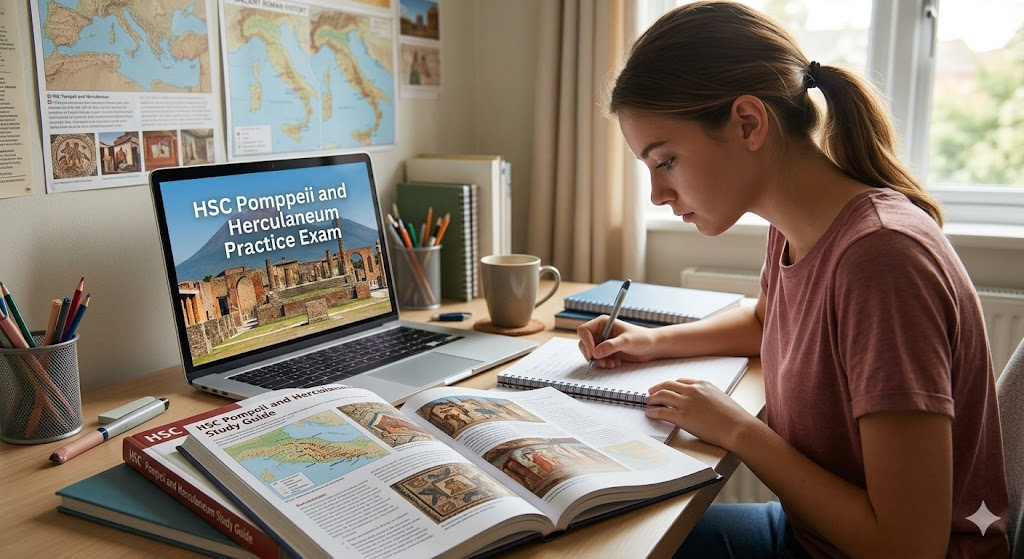
Additional Information
What the Course Entails and Exam Details
This section of the NSW Ancient History syllabus immerses students in the comprehensive study of Pompeii and Herculaneum. The core topics covered include the initial discovery and excavation history of both cities, understanding the physical evidence ranging from houses and public buildings to frescoes and mosaics, and examining the social structure, including the lives of freeborn citizens, freedmen, slaves, and women. It also delves into the religious practices, political organizations, and economic activities that defined these thriving communities. Furthermore, students must understand modern issues related to the conservation, restoration, and ethical management of these globally significant sites, preparing them to critically evaluate how our knowledge is shaped by historical and current practices.
What to Expect in the Final Exam
The actual HSC Ancient History exam, of which Pompeii and Herculaneum is a significant part, typically involves several sections and question formats. The "Core Study: Pompeii and Herculaneum" section is usually a dedicated part of the overall paper. Students should expect a combination of question types. These often include multiple-choice questions designed to test knowledge recall, short-answer questions that require analyzing specific written and archaeological sources, and a long-answer extended response or essay that demands a synthesised argument and broad understanding of the topic. The extended response will focus on key aspects like social life, physical evidence, or conservation, requiring students to use specific evidence to support their statements. The overall three-hour examination period must be divided, with a suitable portion allocated to this core topic, generally aiming for detailed responses within the time constraints.
How to Study and Exam Centers
Effective preparation for this exam requires a multi-faceted approach. First, students must thoroughly review the entire syllabus content, focusing on key terms, figures, and developments. Creating detailed notes and summaries from textbooks, supplementary readings, and class discussions is essential. Utilizing past HSC exam papers and marking guidelines is a highly effective way to understand the exam's structure, question styles, and marking criteria. Practicing source analysis and writing extended essays under timed conditions will significantly improve analytical and writing skills. Creating mind maps and timelines to visualize connections between different historical aspects and the chronological development of the sites is also beneficial. Collaborative study sessions can offer fresh perspectives. For information regarding exam centers, this is managed by NESA (New South Wales Education Standards Authority). The HSC examinations are conducted at authorized schools throughout NSW; students will receive specific location details and schedules directly from their school administration.
Job Opportunities from the Course
While this course is primarily an educational step rather than a direct job certification, it builds critical skills highly valued in numerous fields. Successfully completing the HSC and excelling in Ancient History can pave the way for various rewarding career paths. These opportunities often stem from further tertiary study in related disciplines. The analytical thinking, research proficiency, and complex argumentation developed are directly applicable to careers in education, such as becoming a secondary history teacher or university lecturer. It also supports careers in the heritage sector, including roles as an archaeologist, museum curator, or conservation specialist, particularly with focused university degrees. The skills are equally valuable in journalism, where strong research and communication are crucial. Furthermore, the capacity for critical analysis is essential for roles in law, archival work, and even tourism, especially for those interested in heritage site management or guiding within Italy. Ultimately, this course fosters foundational skills that open doors to diverse careers in research, analysis, and communication.
Frequently Asked Questions
Reviews
5.0
Based on 0 reviews
Leave a Review
No reviews yet. Be the first to review!