
HSC Society and Culture Practice Exam
$69.00
- Buy to unlock unlimited access to all Quiz questions and Answers in this Quiz.
- After purchase you can print a PDF of the whole quiz at any point. The PDF will contain the questions and the correct answers.
About this Exam
This article provides a comprehensive study guide for students preparing for the HSC Society and Culture Practice Exam.
The Higher School Certificate (HSC) Society and Culture course is a unique and dynamic subject designed for senior high school students in New South Wales, Australia.
It develops students’ social and cultural literacy by examining the interactions between persons, societies, cultures, and environments across time.
By engaging with complex social issues and conducting independent research, students gain crucial critical thinking skills and a deeper understanding of the world around them.
This practice exam guide is an essential tool for any student aiming to excel in this rigorous academic challenge and achieve their best possible ATAR results.
Ready to test your knowledge?
Buy Now to Access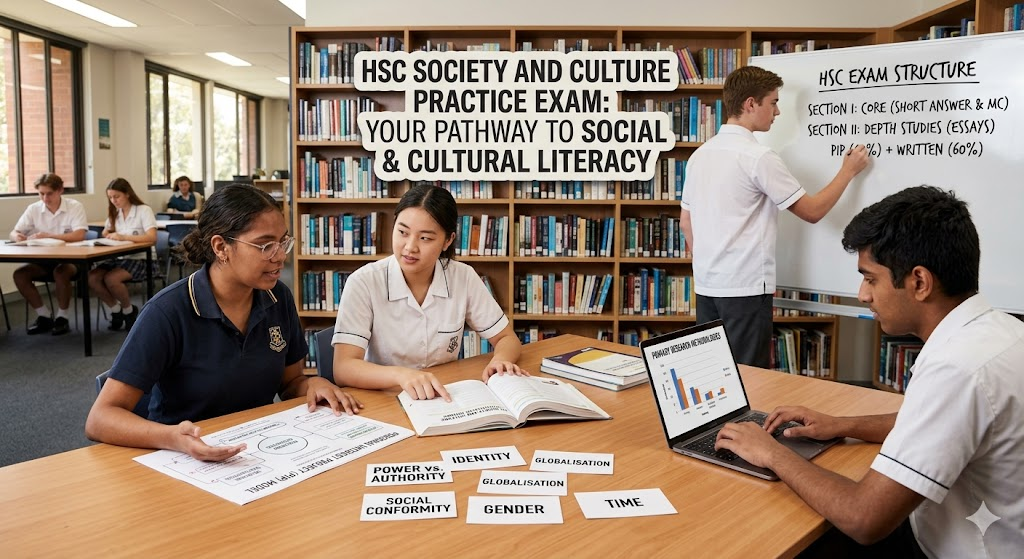
Additional Information
What the Course Entails and Exam Details
The HSC Society and Culture course is divided into Preliminary and HSC components, though this guide focuses on the final HSC year requirements.
The syllabus is structured around a mandatory Core, two Depth Studies, and a major independent research project.
The final course structure for assessment is split into two major parts:
The Personal Interest Project (PIP) (40% of Final Mark)
This is a significant, independent research project of the student's choice.
The PIP requires students to apply social and cultural research methodologies to investigate a specific topic.
It must include both primary and secondary research, a cross-cultural perspective (comparing their own experience with that of a group different from them), and analysis of continuity and change.
The Written Examination (60% of Final Mark)
This formal, timed examination assesses knowledge of the core topics and selected Depth Studies.
Core Topic: Social and Cultural Continuity and Change.
Depth Studies: Students choose two of the following:
Popular Culture
Belief Systems and Ideologies
Social Inclusion and Exclusion
Social Conformity and Nonconformity
What to Expect in the Final Exam
The formal HSC Society and Culture written exam is a 2-hour-and-10-minute (plus 5 minutes reading time) pencil-and-paper test.
It is designed to be challenging, requiring both recall of information and high-level analytical and writing skills.
The exam is typically structured as follows:
Section I: Core – Social and Cultural Continuity and Change (30 Marks)
This section includes a series of multiple-choice questions (often 10 marks).
It is followed by short-answer questions (20 marks) that require students to apply concepts and provide brief, well-structured explanations and analyses.
Section II: Depth Studies (30 Marks)
This section assesses the two Depth Studies chosen by the student (e.g., Popular Culture and Belief Systems).
Students must answer two extended-response (essay) questions, one for each of their chosen topics.
These are worth 15 marks each and require sustained, logical arguments, use of course concepts, and integration of relevant examples.
There is no single "passing score" for this high school exam; rather, student results are categorized into bands and contribute to their overall ATAR ranking.
The final rank depends on the difficulty of that year's paper and the performance of the entire cohort.
How to Study and Exam Centers
Preparation for the HSC Society and Culture exam requires a dual focus on both content knowledge and exam technique.
Here are actionable study strategies and information on taking the exam.
Top Study Strategies
Master the Concepts: Society and Culture is built on precise vocabulary. Create a detailed glossary of fundamental concepts (e.g., person, society, culture, environment, time, power, authority, gender, identity) and depth-specific terms. You must use these accurately in your answers.
Deconstruct PIP Models: Review high-scoring PIP models provided by NESA or the Society and Culture Association. Pay close attention to how they synthesize primary and secondary data, integrate cross-cultural perspectives, and maintain a focus on their hypothesis.
Practice Past Papers: The best way to understand the exam format and time constraints is to complete past exam papers under timed conditions. Pay attention to how marks are allocated.
Analyze Feedback and Marking Guidelines: After practicing, compare your answers with the NESA marking guidelines and general feedback from the examiners. This shows you exactly what they are looking for in top-band responses.
Develop Plan B for Depth Studies: Have a structured plan for how you would approach various potential essay questions for your two Depth Studies. Be prepared with a wide array of contemporary and diverse examples to support your arguments.
Where and How to Take the Exam
The PIP: The finished Personal Interest Project is submitted digitally to NESA (New South Wales Education Standards Authority) for external marking prior to the written exam period.
The Written Exam: This final exam is not taken at private testing centers like Pearson VUE. It is administered by NESA and occurs at the student’s own enrolled high school or a designated government testing location during the official HSC examination period in October/November.
Job Opportunities from the Course
A strong result in HSC Society and Culture develops highly transferable skills—including analytical thinking, advanced research methods, empathy, and excellent written and oral communication—that are valuable in a wide array of tertiary studies and professional careers.
It lays a solid foundation for careers in the social sciences, humanities, and beyond.
Potential job opportunities and career paths this course helps unlock include:
Community Services Manager
Social Researcher / Market Research Analyst
Policy Analyst / Government Adviser
Secondary School Teacher (Humanities, HSIE)
Journalist / Media Correspondent
Public Relations / Communications Specialist
Human Rights Advocate
Non-Profit Program Coordinator
Criminologist / Criminal Justice Professional
Museum Curator / Cultural Heritage Officer
International Aid / Development Worker
By following this guide, students can approach their HSC Society and Culture practice and final exams with confidence, fully prepared to achieve their academic and future career goals.
Frequently Asked Questions
Reviews
5.0
Based on 0 reviews
Leave a Review
No reviews yet. Be the first to review!