
HSC Standard Math Practice Exam
$69.00
- Buy to unlock unlimited access to all Quiz questions and Answers in this Quiz.
- After purchase you can print a PDF of the whole quiz at any point. The PDF will contain the questions and the correct answers.
About this Exam
The HSC Standard Mathematics exam is a critical final milestone for students across New South Wales, Australia, completing their Higher School Certificate (HSC). This certification is expertly designed for Year 12 students who require robust, applied mathematical skills for their future studies, employment, and everyday life. Unlike calculus-intensive mathematics streams, this course focuses on practical applications of mathematical concepts in real-world contexts, equipping individuals with the analytical tools to navigate complex data, finances, and measurements. It is the perfect fit for students planning careers or further education in fields that rely on foundational numeracy, problem-solving, and logical reasoning, preparing you to confidently apply mathematics outside the classroom.
Ready to test your knowledge?
Buy Now to Access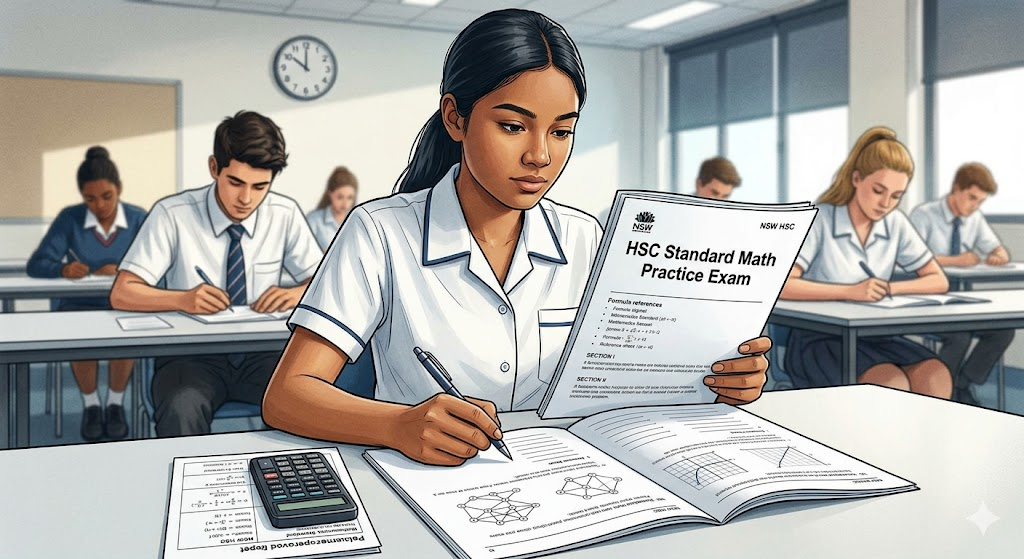
Additional Information
What the Course Entails and Exam Details
The HSC Standard Mathematics syllabus covers a diverse range of foundational and applied topics, emphasizing numerical and graphical literacy. The two streams, Standard 1 (ATAR or non-ATAR) and Standard 2 (ATAR only), both delve into key modules. You will develop competency in Algebra, where you learn to manipulate formulas and model linear relationships to solve practical problems. The Measurement module ensures you can apply numerical knowledge to quantify and solve problems involving length, area, volume, time, and rate. A significant portion of the course, Financial Mathematics, focuses on money matters, including earning, spending, investing, saving, and borrowing, teaching critical financial decision-making skills. Statistical Analysis teaches the essentials of data collection, display, and interpretation, including probability and relative frequency, essential for understanding information in today’s data-driven world. For Standard 2 students, an additional module in Networks provides foundational concepts for understanding and optimizing connections. These areas are not just theoretical; the entire course is structured around practical problem-solving in modern contexts. While specific school-based assessment programs are common, the final, externally assessed examination is the key component and the focus of your preparation.
What to Expect in the Final Exam
Prepare yourself for a comprehensive assessment that values understanding and application over rote learning. The actual HSC Standard Mathematics final exam is typically a structured written paper, lasting approximately 2.5 hours with an additional 10 minutes of reading time, providing a clear window to showcase your skills. It is composed of two primary sections: Section I contains 15 marks' worth of multiple-choice questions, which evaluate your general understanding and quick numerical reasoning. Section II holds the bulk of the assessment, with 85 marks allocated to various question types. This section requires short-answer responses, calculations, and more complex, extended problem-solving where you must demonstrate logical mathematical reasoning and clear working. All questions are designed to test outcomes across the entire syllabus, and you should ensure you are prepared for both the specific topic-based questions and those that integrate multiple concepts. Calculators that are approved by NESA (New South Wales Education Standards Authority) are a compulsory tool, and you will also be provided with a reference sheet containing key formulas and details to assist you. Results are standard-based, with reporting bands that reflect your actual achievement level rather than a simple pass or fail on a practice paper. A high band result is a strong indicator of proficiency in applied mathematics, beneficial for both employment prospects and further studies.
How to Study and Exam Centers
Your primary and most effective study strategy must center on official NESA past exam papers. Consistent practice under simulated exam conditions, focusing on timing and accurately following question instructions, will dramatically improve both your speed and accuracy. Do not just complete the problems – diligently mark your answers against the official marking guidelines, and identify the areas that consistently cause difficulties. Dedicate focused study time to those specific topics, whether it is mastering financial formulas, understanding complex data distributions, or applying geometric principles. Ensure you have an in-depth understanding of your calculator's functions and know the provided reference sheet inside out to optimize your efficiency during the exam. Beyond practice papers, maintain a structured revision schedule and create concise summary notes for each syllabus topic. Your success is within reach, and a proactive, consistent approach to practice is the single best way to unlock your potential. The actual HSC Standard Mathematics final exam is not taken at online portals or Pearson VUE centers. These exams are organized externally by NESA and are strictly held at designated authorized schools or special examination centers across the state. All students take the exam simultaneously under controlled conditions overseen by independent NESA-appointed supervisors, ensuring a fair and equitable process for all candidates.
Job Opportunities from the Course
A strong performance in the HSC Standard Mathematics course is a powerful asset in today’s competitive job market, unlocking a wide array of career paths that require dependable numerical and analytical skills. The applied nature of the course prepares you to step confidently into roles requiring practical problem-solving and financial literacy across many sectors. While not necessarily a requirement for every role, the foundational analytical ability this exam proves is highly desirable for positions such as:
Assistant Manager/Team Leader (Retail, Hospitality)
Administrative Officer or Receptionist
Bookkeeper or Junior Accounts Person
Support Worker or Trainee Care Provider (Health & Community Services)
Trade Qualifications & Apprenticeships (e.g., Electrician, Carpenter, Plumber)
Construction or Infrastructure Roles
Supply Chain or Logistics Coordinator
Data Entry or Data Interpretation Support Role
Sales Consultant or Advisor (especially with commission or financial elements)
Furthermore, achieving a positive final result can provide a critical advantage when applying for numerous tertiary or vocational education programs, many of which appreciate solid applied mathematical skills even if they do not explicitly require calculus-based mathematics. Your investment in preparation is a key that opens doors to a brighter future.
Frequently Asked Questions
Reviews
5.0
Based on 0 reviews
Leave a Review
No reviews yet. Be the first to review!