
Human Growth and Development CLEP Prep Practice Exam
$69.00
- Buy to unlock unlimited access to all Quiz questions and Answers in this Quiz.
- After purchase you can print a PDF of the whole quiz at any point. The PDF will contain the questions and the correct answers.
About this Exam
The College-Level Examination Program (CLEP) Human Growth and Development exam provides students with an opportunity to demonstrate the knowledge typically acquired in a one-semester introductory course in developmental psychology or human growth and development. This test is designed for a broad range of individuals, including high school students aiming to jumpstart their college career, adult learners returning to education, and current college students who want to accelerate their degree progress. It validates your understanding of the major theories, principles, and research related to physical, cognitive, and social development throughout the entire human lifespan.
By successfully passing this exam, you can earn valuable college credit—often three semester hours—at nearly 3,000 cooperating colleges and universities across the United States. It's a professional and efficient way to prove your mastery and advance your academic journey.
Ready to test your knowledge?
Buy Now to Access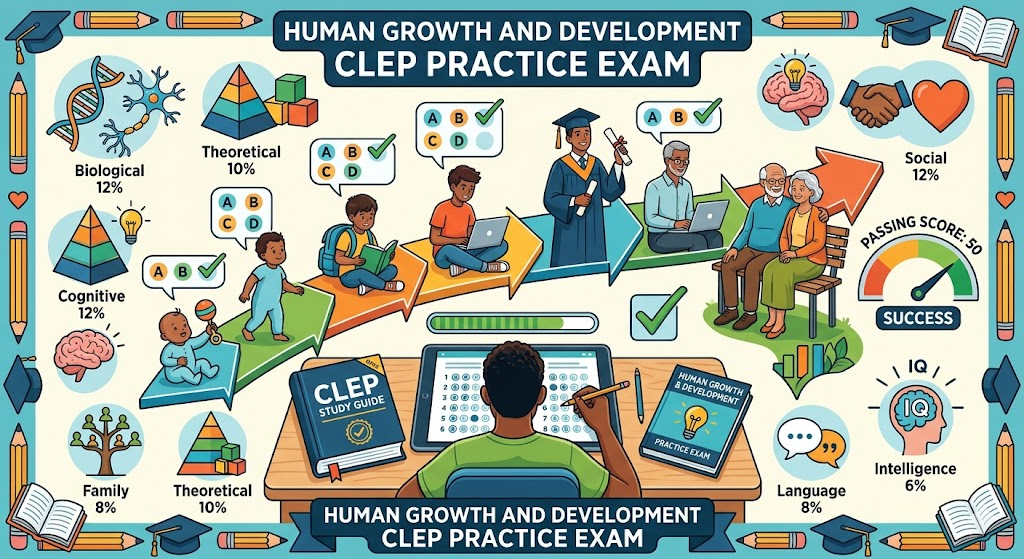
Additional Information
What the Course Entails and Exam Details
Preparing for the Human Growth and Development CLEP exam requires a thorough understanding of the specific content areas covered. The American Council on Education (ACE) provides a detailed content outline that breaks down the percentage of the exam dedicated to twelve key categories. Here is a clear list of what you will be tested on:
Theoretical Perspectives (10%): Includes major theories of development (cognitive, psychodynamic, behavioral, evolutionary, ecological, and sociocultural).
Research Strategies and Methodology (6%): Covers various research designs like longitudinal, cross-sectional, sequential, experimental, correlational, and case studies.
Biological Development Throughout the Life Span (12%): Focuses on genetics, prenatal development, brain and nervous system growth, motor development, health, and aging.
Perceptual Development Throughout the Life Span (6%): Includes habituation, sensitive periods, sensory acuity, and deprivation.
Cognitive Development Throughout the Life Span (12%): Covers theories from Jean Piaget and Lev Vygotsky, information processing, memory, attention, problem-solving, and wisdom.
Language Development (8%): Focuses on bilingualism, development of syntax, vocabulary, pragmatics, and language and thought connection.
Intelligence Throughout the Life Span (6%): Covers concepts of intelligence, IQ testing, creativity, stability and change, and hereditary/environmental influences.
Social Development Throughout the Life Span (12%): Includes attachment, interpersonal relationships, moral development, gender, aggression, self-concept, and wellness.
Family, Home, and Society Throughout the Life Span (8%): Covers family structures, parenting styles, abuse, multicultural perspectives, and social class influences.
Personality and Emotion (8%): Focuses on temperament, emotional expression and regulation, emotional intelligence, and stability and change.
Schooling, Work, and Interventions (6%): Includes applications of developmental principles, learning styles, preschool/day care, occupational development, and retirement.
Developmental Psychopathology (6%): Covers major childhood and life span disorders, including ADHD, autism spectrum, and mood disorders.
The exam content adhering to the criteria referred to in the fifth edition of the Diagnostic and Statistical Manual of Mental Disorders (DSM-5) where applicable.
What to Expect in the Final Exam
Understanding the exam mechanics is crucial for success. The Human Growth and Development CLEP exam is a computer-based, entirely multiple-choice assessment. It does not include short-answer, essay, or practical components. Here are the precise details you need:
Format: Approximately 90 computer-delivered multiple-choice questions.
Time Limit: You will have 90 minutes (1.5 hours) to complete the entire exam. There are no scheduled breaks.
Passing Score: The American Council on Education (ACE) recommends a scaled passing score of 50 for this exam, which typically earns three semester hours of college credit. However, it is essential to check with your specific target institution, as some colleges set their own unique credit-granting scores. You will receive your official score report immediately upon completing the exam.
There are no additional required tools, such as calculators. Some of the questions may be pre-test items that will not count towards your final score. These items are used for research and to build future versions of the exam, but you will not know which questions they are.
How to Study and Exam Centers
Effective preparation is the single biggest predictor of success. A comprehensive, targeted approach will yield the best results.
Actionable Study Strategies and Practice Methods:
First, take a reputable full-length Human Growth and Development CLEP practice exam to establish a baseline of your current knowledge. Use this diagnostic tool to identify your weakest content areas, then dedicate your study time to mastering those topics. Combine the use of the official CLEP study guide, which provides sample questions and a full content breakdown, with a high-quality introductory college textbook on human development or developmental psychology for deep conceptual understanding. Focus on creating flashcards for key vocabulary, names, dates, and seminal theories. Utilize online resources, video lectures, and interactive practice questions to reinforce your learning. Consistent, active study over several weeks is far more effective than cramming.
Exam Centers and Where to Take the Exam:
CLEP exams are administered year-round at over 2,000 official CLEP test centers worldwide, which are often located on college and university campuses. You must search for authorized centers near you and contact them directly to schedule an appointment.
In addition to physical test centers, this exam is also available through an online proctoring option. To take the exam remotely from home, you must register through the CLEP My Account portal, select the remote proctoring option, and pay an additional fee (currently $30). You will then schedule your exam with CLEP's designated remote proctoring vendor, Proctortrack. Remote proctoring requires a computer that meets specific technical standards and a private, quiet room. You must also have a smartphone with a working front-facing camera, which will be used for environment scans and monitoring.
Job Opportunities from the Course
While earning CLEP credit itself does not award a job-specific certification, it significantly accelerates your path toward completing college degrees required for many impactful and essential careers. The profound understanding of human lifespan development you gain from this exam is an invaluable asset in numerous fields focused on human well-being and growth. This course knowledge directly supports career paths such as:
Social Work Assistant
Family Support Specialist
Child Life Specialist
Early Childhood Educator / Preschool Teacher
Youth Mentor / Counselor Aide
Pediatric Nurse Aide / Patient Care Technician
Geriatric Care Aide
Community Health Worker
Rehabilitation Aide
By validating your expertise in human growth and development, you are taking a powerful step toward a career where you can make a meaningful difference. Start practicing, start studying, and unlock your academic and professional potential today.
Frequently Asked Questions
Reviews
5.0
Based on 0 reviews
Leave a Review
No reviews yet. Be the first to review!