
Humanitarian Assistance Response Training (HART) Practice Exam
$69.00
- Buy to unlock unlimited access to all Quiz questions and Answers in this Quiz.
- After purchase you can print a PDF of the whole quiz at any point. The PDF will contain the questions and the correct answers.
About this Exam
The Humanitarian Assistance Response Training (HART) program is an essential educational pathway for individuals dedicated to disaster relief and crisis response.
This certification is meticulously designed for military personnel, civilian government workers, and non-governmental organization (NGO) professionals who plan, support, or execute foreign disaster relief operations.
By passing this exam, candidates prove their readiness to operate effectively within joint task forces and complex international humanitarian systems during critical times of need.
Ready to test your knowledge?
Buy Now to Access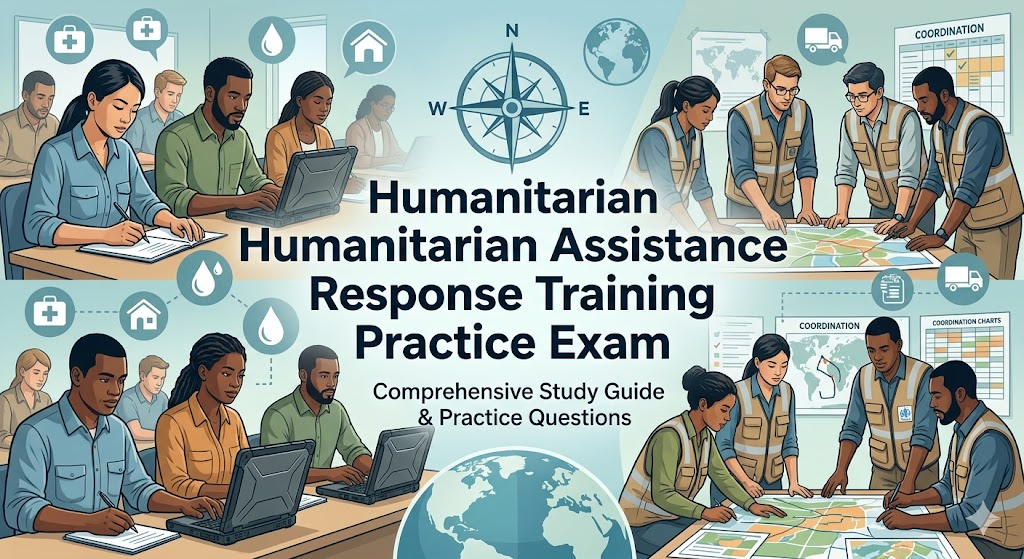
Additional Information
What the Course Entails and Exam Details
The HART course delivers a comprehensive syllabus focused on the intricacies of disaster response and civil-military coordination.
Students dive deep into the fundamental frameworks of the international humanitarian community, including the United Nations cluster approach and Sphere Project humanitarian standards.
Core topics also cover vital legal and policy guidelines, such as government directives on foreign disaster relief, USAID logistics, and the principles of civilian protection.
Ultimately, candidates develop critical skills in rapid needs assessment, cross-cultural communication, and strategic resource allocation in chaotic environments.
What to Expect in the Final Exam
The HART final exam is strategically built to test both your factual knowledge and your situational judgment in high-stakes scenarios.
Typically administered in a multiple-choice format, the test presents complex, scenario-based questions that mimic real-world disaster relief operations and coordination challenges.
Candidates are generally required to achieve a solid passing score of at least 80%, though this can vary slightly depending on the specific administrating body or portal.
While the exam is normally open-book for distance-learning modules, a strict time limit is often enforced to ensure that candidates can recall and apply critical operational information under simulated pressure.
Standard academic integrity rules apply throughout the testing process, meaning test-takers must rely entirely on their own understanding of humanitarian frameworks without unauthorized collaboration.
How to Study and Exam Centers
Succeeding in the HART exam requires a balanced blend of rote memorization and the practical application of civil-military concepts.
The most effective study strategy is to thoroughly review the official course slides, create flashcards for complex humanitarian acronyms, and take multiple practice exams to familiarize yourself with the scenario-based question formats.
You should pay special attention to the distinct operational roles of key organizations, such as USAID's Bureau for Humanitarian Assistance (BHA) and the UN Office for the Coordination of Humanitarian Affairs (UNOCHA).
Regarding exam locations, the HART certification test is primarily taken remotely through official online training portals, such as Joint Knowledge Online (JKO), which caters to military personnel and affiliated government civilians.
Alternatively, instructor-led versions of the course may conclude with an in-person, proctored exam at authorized military installations, specialized defense schools, or specific agency headquarters.
Job Opportunities from the Course
Earning this esteemed certification unlocks a highly rewarding array of career paths in the global aid, emergency management, and defense sectors.
Graduates frequently step into roles as Civil Affairs Officers, bridging the vital gap between military operations and civilian needs during an international crisis.
The training also paves the way for becoming a Humanitarian Relief Coordinator, a leadership position responsible for directing on-the-ground logistics and aid distribution for major NGOs or government bodies.
Other prominent and highly sought-after job titles include Disaster Response Specialist, Emergency Management Planner, International Logistics Manager, and NGO Liaison Officer.
Whether working for international nonprofits, federal agencies, or the armed forces, professionals equipped with HART training are perfectly positioned to lead impactful, life-saving missions across the globe.
Frequently Asked Questions
Reviews
5.0
Based on 0 reviews
Leave a Review
No reviews yet. Be the first to review!