
Humanities CLEP Prep Practice Exam
$69.00
- Buy to unlock unlimited access to all Quiz questions and Answers in this Quiz.
- After purchase you can print a PDF of the whole quiz at any point. The PDF will contain the questions and the correct answers.
About this Exam
The College-Level Examination Program (CLEP) in Humanities is a powerful tool designed for students who wish to accelerate their path to a college degree.
It offers students the opportunity to earn college credit by demonstrating college-level knowledge in a broad range of humanities subjects, including literature, art, and music.
This exam is designed for a diverse group of learners, including high school students wanting to get a head start, adult learners returning to college, military personnel, or anyone looking to save time and tuition money by testing out of general education requirements.
It provides a flexible and efficient way to fulfill essential academic prerequisites.
Ready to test your knowledge?
Buy Now to Access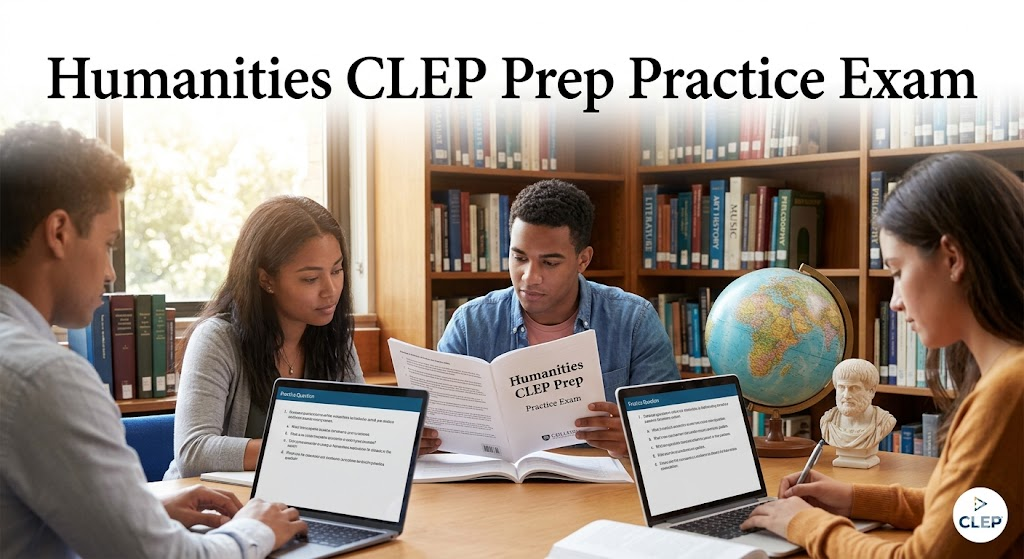
Additional Information
What the Course Entails and Exam Details
Preparing for the Humanities CLEP requires a broad understanding of cultural achievements rather than in-depth knowledge of any single topic.
The course material covers a wide spectrum of topics essential to human culture and expression.
Literature is a major component, including poetry, drama, fiction, and nonfiction, spanning from ancient to contemporary works.
Fine Arts is another critical area, enveloping visual arts (painting, sculpture, architecture) and performing arts (music, film, theater).
You will need to identify major authors, artists, and periods, and understand the formal and stylistic elements of their work, as well as the historical context that shaped them.
While you don't need to be an expert in any one area, a successful candidate will possess a foundational knowledge of the overarching themes and key figures that define Western and some non-Western civilizations.
What to Expect in the Final Exam
The Humanities CLEP exam is a computerized test that requires efficiency and broad recall.
The exam consists of approximately 140 multiple-choice questions that must be answered within 90 minutes.
The questions are divided roughly equally between Literature and Fine Arts.
Some questions will focus on specific information, such as identifying a writer or artist associated with a work, while others will assess your ability to interpret and analyze literary passages, art works, or musical performances.
There is no writing component.
The passing score is determined by individual colleges and universities, although the American Council on Education (ACE) recommends a credit-granting score of 50 (on a scale of 20-80).
It's vital to check the specific policy of your chosen institution before taking the exam.
How to Study and Exam Centers
Effective preparation for the Humanities CLEP requires a varied approach to cover the extensive content.
Start with standard textbooks for introductory college courses in humanities, art history, and literature.
The Official CLEP Study Guide, produced by the College Board, is highly recommended as it includes sample questions and the official exam description.
Online resources such as Modern States (which often offers vouchers for free exams) and practice test platforms provide valuable practice and simulation of the timed environment.
When you are ready to take the test, you must locate an authorized testing center.
CLEP exams are administered throughout the year at over 2,000 collegiate and on-base testing centers across the country.
You can register and schedule your exam through the College Board website, which allows you to find centers near you.
Additionally, remote proctoring options have become available, allowing students to take the exam from home under specific security conditions.
Job Opportunities from the Course
Earning credit through the Humanities CLEP exam does not typically lead directly to a specific job title, as its primary function is to accelerate degree completion.
However, the knowledge acquired and the degree it supports can open numerous career paths.
By fulfilling general education requirements, you move closer to degrees that unlock specialized opportunities.
Potential career paths for graduates who have completed degrees with a strong humanities foundation include:
Secondary School Teacher
Museum Curator or Archivist
Writer or Editor
Communications Specialist
Human Resources Manager
Public Relations Coordinator
Journalist
Librarian
Art Administrator
These roles all benefit significantly from the critical thinking, analytical, and communication skills cultivated through the study of the humanities.
Frequently Asked Questions
Reviews
5.0
Based on 0 reviews
Leave a Review
No reviews yet. Be the first to review!