
HVAC Contractor Practice Exam
$69.00
- Buy to unlock unlimited access to all Quiz questions and Answers in this Quiz.
- After purchase you can print a PDF of the whole quiz at any point. The PDF will contain the questions and the correct answers.
About this Exam
Stepping into the role of a licensed HVAC contractor requires not only practical skill but also a comprehensive understanding of complex codes, safety standards, and business practices. The HVAC Contractor Practice Exam is a critical stepping stone designed for journeymen, technicians, and aspiring business owners who are preparing for their official state or master-level licensing examination. This guide provides a realistic simulation of the challenges you will face, helping you build test-taking confidence and identify specific areas where further study is needed.
Ready to test your knowledge?
Buy Now to Access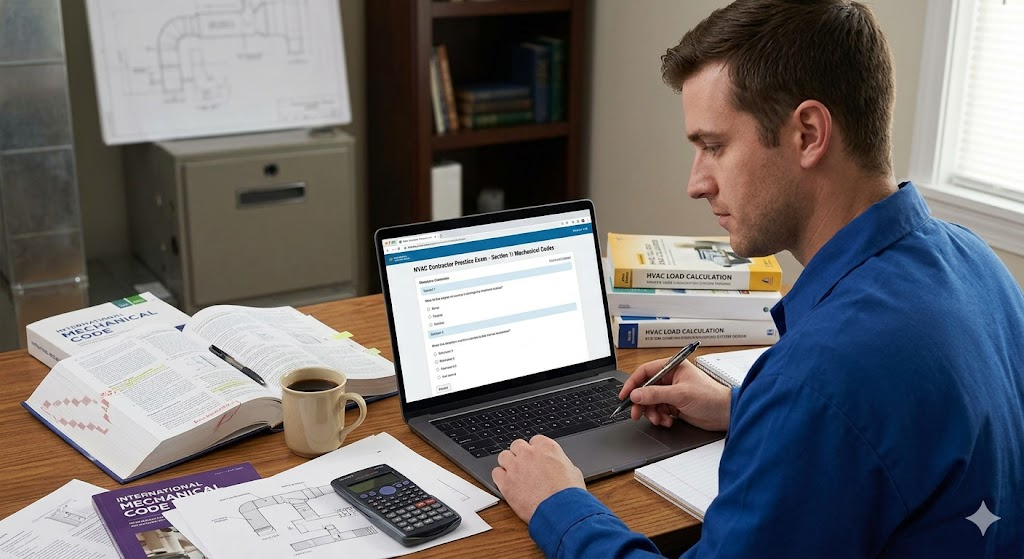
Additional Information
What the Course Entails and Exam Details
Preparing for the HVAC contractor exam involves a deep dive into several distinct areas. This practice exam is structured to reflect the comprehensive nature of the actual licensing test, ensuring you are well-versed in essential concepts.
Key topics covered include:
Systems & Components: Advanced understanding of refrigeration cycles, furnaces, boilers, heat pumps, and air handling units.
Load Calculations: Mastery of Manual J (residential load calculation) and Manual N (commercial load calculation) is often essential.
Duct Design: Familiarity with Manual D principles for proper air distribution.
Codes & Standards: In-depth knowledge of the International Mechanical Code (IMC) or Uniform Mechanical Code (UMC), as well as relevant electrical and fuel gas codes.
Safety & Environmental Regulations: Proper handling of refrigerants (EPA 608), venting safety, and OSHA standards.
Business & Law: Many contractor exams include a separate section on business management, lien laws, contracts, and tax requirements.
What to Expect in the Final Exam
While specific formats vary significantly by state and testing agency (such as PSI or Pearson VUE), most HVAC contractor exams share common characteristics. The final exam is almost always a proctored, timed event, often administered on a computer.
Here is what you should generally expect:
Format: The exam typically consists of multiple-choice questions. It is frequently split into two distinct parts: one focusing on trade knowledge and the other on business and law.
Time Limits: You will be given a specific time window for each portion of the exam, sometimes totaling four hours or more for the complete test.
Open Book Policy: Most contractor exams are "open book," allowing you to use approved references such as specific code books and design manuals. Success depends on knowing how to find information quickly, not just memorizing it.
Passing Score: The required passing score generally ranges from 70% to 75%.
How to Study and Exam Centers
Succeeding on this exam requires a strategic approach to studying.
Focus on Navigation: Since the exam is usually open book, your study time should be heavily focused on learning the layout and tabbing your code books efficiently. You must be able to locate specific tables and sections rapidly.
Take Multiple Practice Tests: Use the HVAC Contractor Practice Exam repeatedly to simulate test-day conditions. This helps improve your pacing and reduces anxiety.
Master the Calculations: Do not neglect the math. Practice load calculations and duct sizing problems until you can solve them without hesitation.
When you are ready for the actual exam, you must register through your state’s licensing board or the designated testing provider, such as PSI, Prometric, or Pearson VUE. These organizations operate numerous physical testing centers throughout the country. In some cases, remotely proctored online exams may be available, but this depends on your specific jurisdiction.
Job Opportunities from the Course
Earning your HVAC contractor license is a transformative career move that transitions you from a technician to a business professional or upper-level manager.
Completing this certification process unlocks various high-level career paths, including:
Independent HVAC Contractor/Business Owner
HVAC Project Manager
Service Manager for Mechanical Contracting Firms
HVAC Systems Designer/Estimator
Facilities Manager for Large Commercial Complexes
Code Compliance Inspector
Achieving licensure demonstrates to clients, employers, and regulatory bodies that you possess the advanced expertise and commitment required to uphold the highest standards of the trade.
Frequently Asked Questions
Reviews
5.0
Based on 0 reviews
Leave a Review
No reviews yet. Be the first to review!