
HVAC Excellence Electrical Certification Practice Exam
$69.00
- Buy to unlock unlimited access to all Quiz questions and Answers in this Quiz.
- After purchase you can print a PDF of the whole quiz at any point. The PDF will contain the questions and the correct answers.
About this Exam
The HVAC Excellence Electrical Certification is a valuable credential designed for students, recent graduates of HVACR programs, and entry-level technicians. This "Employment Ready" exam validates an individual's understanding of foundational electrical concepts as they apply to heating, ventilation, air conditioning, and refrigeration systems. Achieving this certification demonstrates to potential employers that a candidate possesses the essential knowledge needed to safely and effectively work with the electrical components, circuits, and troubleshooting procedures that are integral to all HVACR equipment. It serves as a benchmark of competence, providing a solid foundation for further professional development and advanced certifications in the field.
Ready to test your knowledge?
Buy Now to Access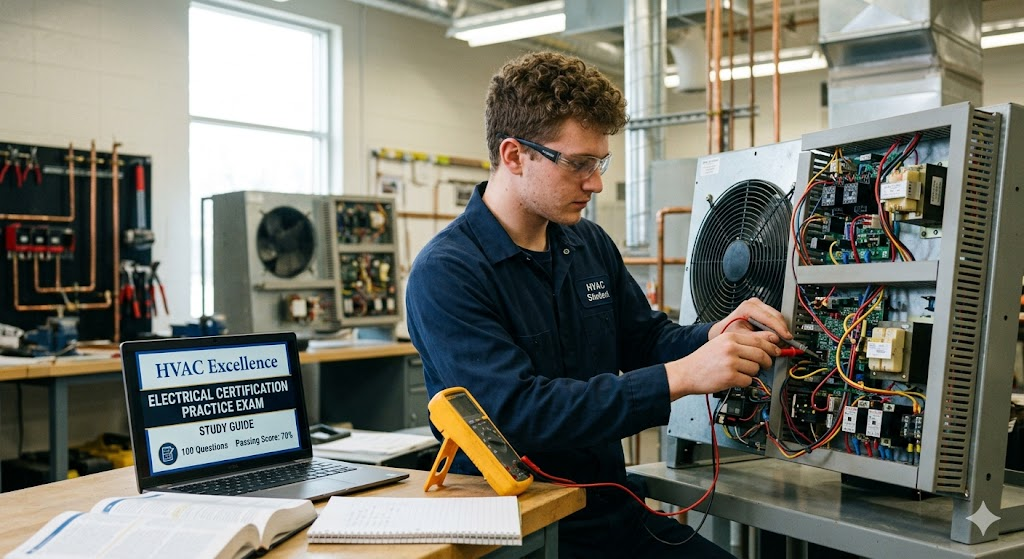
Additional Information
What the Course Entails and Exam Details
The HVAC Excellence Electrical Certification exam is a comprehensive assessment that covers a wide spectrum of critical electrical topics within the HVACR industry. While specific courses may vary by institution, preparing for this exam entails a deep dive into the following core areas:
Electrical Safety: This is the absolute paramount topic. It includes lockout/tagout procedures, understanding the dangers of electricity, personal protective equipment (PPE), and proper safe work practices around live circuits.
Basic Electrical Theory: Candidates must grasp the fundamental principles of electricity, including voltage, current, resistance, power (watts), Ohm's law, and the differences between alternating current (AC) and direct current (DC).
Electrical Components: A thorough understanding of common components is required, such as resistors, capacitors (start and run), inductors, transformers, relays, contactors, solenoids, switches, fuses, and circuit breakers. This includes identifying their symbols and functions within a circuit.
Motors and Capacitors: This section covers various types of motors used in HVACR (single-phase, three-phase, PSC, ECM), their operation, wiring, troubleshooting, and the role of capacitors in motor starting and running.
Interpreting Electrical Diagrams: The ability to read, understand, and use various types of electrical schematics, line diagrams, and wiring diagrams is crucial for installation and troubleshooting. This includes identifying wire colors, component symbols, and tracing circuit paths.
Meter Usage: Candidates must demonstrate proficiency in selecting and using electrical test instruments, such as multimeters, clamp-on ammeters, and voltmeters, to measure voltage, current, and resistance safely and accurately.
Electrical Troubleshooting: This dynamic area tests a candidate's ability to apply their knowledge logically to diagnose and repair electrical faults in HVACR systems. It involves interpreting readings, identifying open and short circuits, and isolating failed components.
What to Expect in the Final Exam
The final HVAC Excellence Electrical Certification exam is a rigorous, standardized test. Here are the key details on what to expect:
Format: The exam consists of 100 multiple-choice questions. These questions are designed to test not only recall of facts but also the application of knowledge to practical scenarios, especially in troubleshooting.
Passing Score: To successfully earn the certification, candidates must achieve a passing score. The general standard for many HVAC Excellence Employment Ready exams is 70%, but always confirm the specific requirement for your testing session.
Time Limit: You will have a defined time limit to complete the exam, which typically ranges from 1.5 to 3 hours. Efficient time management is key, and it's essential to answer every question.
Proctoring and Rules: This is a formal, proctored examination. It must be administered by an approved proctor in a secure testing environment. This means no notes, textbooks, or unauthorized electronic devices are allowed. Scientific calculators are typically permitted.
Focus: A significant portion of the exam, often up to 50%, is dedicated to practical, field-relevant knowledge, including troubleshooting, meter usage, and interpreting diagrams.
How to Study and Exam Centers
Preparation is the cornerstone of success for this exam. Here are actionable study strategies and information on where to take the test:
Actionable Study Strategies:
Utilize Official Resources: Start with any study guides, sample questions, and practice exams provided by your educational program or directly by the ESCO Group (the parent organization of HVAC Excellence). Their official materials are the most direct path to understanding the exam's structure and content.
Master the Fundamentals: Do not underestimate the importance of basic theory. A flawless understanding of Ohm's law, series and parallel circuits, and component function will be your most potent tool, especially when faced with complex troubleshooting questions.
Hands-on Practice is Essential: There is no substitute for physical practice. Spend significant time in the lab environment, practice using your multimeter to measure voltage, current, and resistance on real training equipment. Practice identifying components on actual HVAC systems.
Read and Trace Diagrams Daily: Make it a habit to pick up random HVAC electrical schematics and trace the flow of power and control. Identify every symbol and understand what would happen if a specific component failed. This skill is a guaranteed point-scorer.
Take Full Practice Exams: Mimic the real exam conditions. Set a timer, sit in a quiet room, and take a full 100-question practice exam without any references. This will help you identify weak areas and build stamina.
Focus on Your Weaknesses: Review your practice test results and dedicate extra study time to the topics you found most challenging. Use flashcards for component symbols and key formulas.
Where to Take the Exam:
The HVAC Excellence Electrical Certification exam is not typically taken at general public testing centers like Pearson VUE. Instead, it is administered through a network of authorized testing centers. These include:
Vocational and Technical Schools: Most schools with accredited HVACR programs are authorized testing sites for their students and often for the general public.
High Schools with HVACR Programs: If you are a high school student in a relevant Career and Technical Education (CTE) program, your school will likely be the location for your exam.
HVACR Training Providers: Private training organizations that partner with ESCO Group/HVAC Excellence are often approved to host proctored exams.
Online Portals (with strict proctoring): Some programs may offer a path to take the exam via an online portal, but this still requires a verified, independent proctor to oversee the session, ensuring integrity.
To schedule your exam, your first point of contact should be your instructor or the administration of your HVACR training program. They will guide you through the registration process and confirm the location and time of your testing session.
Job Opportunities from the Course
This certification is a specific "Electrical" credential. It is a key stepping stone that validates core skills required for many entry-level and specialized roles in the HVACR and facilities maintenance industries. Here are the job opportunities and career paths it helps unlock:
HVACR Apprentice
HVACR Installer
Residential HVAC Technician
Light Commercial HVAC Technician
Maintenance Technician (with HVAC focus)
Facility Maintenance Technician
Preventative Maintenance Technician
Appliance Repair Technician (especially for electrically complex appliances)
Controls Technician (as a foundational entry point)
Electrical Helper / Assistant
Achieving the HVAC Excellence Electrical Certification provides an official validation of your electrical proficiency, making you a more competitive candidate for these roles and setting you on a path towards advanced certifications and specialist careers within the industry.
Frequently Asked Questions
Reviews
5.0
Based on 0 reviews
Leave a Review
No reviews yet. Be the first to review!