
HVAC Gas Heat Certification Practice Exam
$69.00
- Buy to unlock unlimited access to all Quiz questions and Answers in this Quiz.
- After purchase you can print a PDF of the whole quiz at any point. The PDF will contain the questions and the correct answers.
About this Exam
Welcome to the comprehensive guide for the HVAC Gas Heat Certification Practice Exam.
This professional certification and the accompanying practice material are designed to validate and enhance the knowledge of current and aspiring HVAC (Heating, Ventilation, and Air Conditioning) technicians.
Earning this certification demonstrates a deep understanding of the principles, safety, installation, maintenance, and troubleshooting of gas-fueled heating systems.
Whether you are a seasoned installer, a dedicated service technician, or an ambitious trade school student looking to stand out in the field, this program provides the essential validation of your expertise.
It ensures that you possess the crucial skills required to work safely and effectively with potentially hazardous gas appliances, reassuring both employers and customers of your capability.
Passing this exam and achieving your certification is a significant milestone in establishing a successful and recognized career in the heating industry.
Ready to test your knowledge?
Buy Now to Access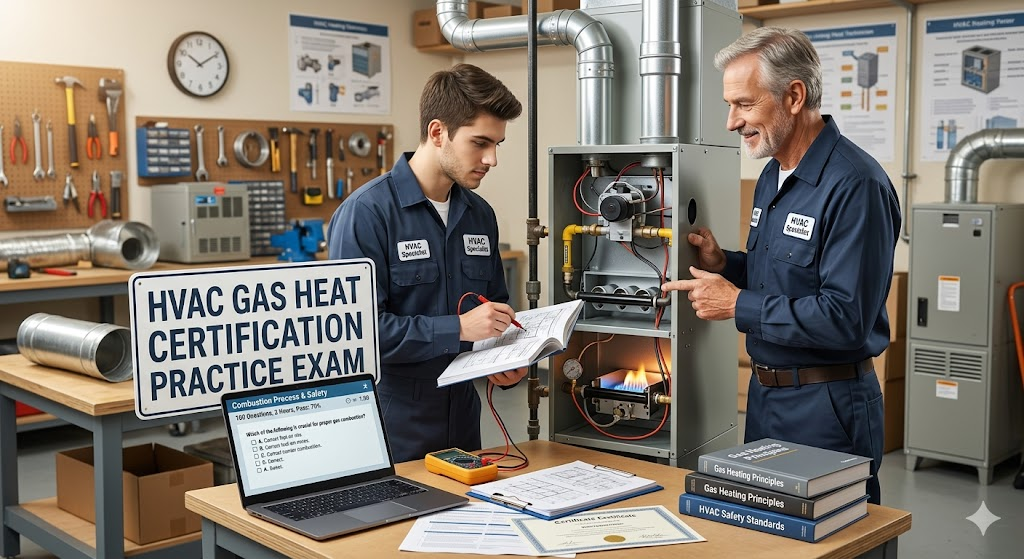
Additional Information
What the Course Entails and Exam Details
The associated course and the certification exam itself cover a broad spectrum of technical and safety-oriented topics crucial for working with gas heating equipment.
This ensures a well-rounded and competent knowledge base for all certified professionals.
Key areas include, but are not limited to:
Combustion Science and Safety: In-depth knowledge of how different gases burn, proper fuel-to-air ratios, the importance of safe operation, and detecting potential combustion problems.
Gas Fuels: Understanding the properties, sources, and safe handling of natural gas and propane (liquefied petroleum/LP gas).
System Components: Identification, function, and safe installation/service of all parts of a gas furnace or boiler, including burners, gas valves, heat exchangers, ignitors, sensors, and blowers.
Electrical Fundamentals & Troubleshooting: Interpreting and diagnosing electrical schematic diagrams, using multimeters, and understanding control systems and common electrical issues.
Venting Systems: Knowledge of proper venting requirements, types, materials, and safety protocols for exhaust gases.
Installation & Service Best Practices: Safe installation techniques, regular maintenance procedures, performance testing, and correct equipment sizing.
Codes and Regulations: Familiarity with national and local codes (like the National Fuel Gas Code) that govern the installation and service of gas heating appliances.
The practice exam serves as a direct mirror to these domains, helping you assess your knowledge and pinpoint areas that require further study.
What to Expect in the Final Exam
The actual final exam for a Gas Heat Certification (depending on the specific certifying body, such as NATE, HVAC Excellence, etc.) typically has specific characteristics.
It is crucial to understand these details to prepare effectively:
Exam Format: The test is almost exclusively multiple-choice, challenging you to select the correct answer among several options for technical and safety questions.
Time Limits: Candidates are usually given a strict time limit, typically around 2 to 2.5 hours, to complete all questions, demanding efficient time management.
Passing Score: A minimum score, often a specific percentage such as 70% or 80%, is required to successfully pass and earn the certification. Be sure to check the exact requirement of your chosen certifying organization.
Number of Questions: The final exam usually comprises a substantial number of questions, commonly between 50 and 100, ensuring comprehensive testing across the different content areas.
Exam Rules: Most final exams are closed-book, meaning no reference materials or notes are allowed. Proper identification and a secure testing environment are mandatory. Some exams might allow simple, non-programmable calculators.
Preparation using targeted practice exams is vital for understanding these constraints and reducing exam-day anxiety.
How to Study and Exam Centers
Effectively preparing for the HVAC Gas Heat Certification requires a combination of structured study and practical experience.
Use these actionable strategies to maximize your success:
Take Practice Exams: Utilize the HVAC Gas Heat Certification Practice Exam as your primary tool. It provides realistic scenarios, highlights your strengths and weaknesses, and acclimates you to the types of questions and time pressures you will face in the actual test.
Utilize Study Guides and Textbooks: Refer to authorized study materials, technical manuals from leading HVAC educational organizations (like ACCA or specific certifying bodies), and textbooks to deepen your understanding.
Hands-on Practice is Key: Real-world experience working on and servicing gas heat equipment in a supervised setting is invaluable. Theory is essential, but practical familiarity is critical.
Review Code Books: Dedicate time to familiarizing yourself with key sections of the applicable National Fuel Gas Code and other relevant regional codes.
Form Study Groups: Collaborating with colleagues or fellow students can provide diverse perspectives, help resolve difficult concepts, and offer shared encouragement.
Attend Specialized Courses: Many trade schools, community colleges, and trade associations offer specific prep courses and hands-on workshops tailored to this certification.
Exam Centers and Testing Methods:
The final, official exam is administered through various professional channels.
Be prepared to explore several options:
Authorized Testing Centers: Many vocational schools, community colleges, and large trade training facilities are authorized test centers.
Online Portals with Proctoring: Some certifying bodies offer the flexibility of taking the exam online from your home or workplace using sophisticated, secure remote proctoring software.
Specialized Testing Providers: Organizations may use third-party testing services like Pearson VUE, which have dedicated, secure testing centers across the country.
Accredited HVAC Schools and Organizations: Trade schools, unions (like UA), and industry groups (like ACCA or HARDI) often host exam sessions.
Always confirm the specific registration and testing procedure required by your chosen certification body.
Job Opportunities from the Course
Achieving your HVAC Gas Heat Certification unlocks numerous specific job opportunities and career advancements within the dynamic and essential heating, ventilation, and air conditioning sector.
A clear list of some of the rewarding paths this certification enables includes:
HVAC Technician: General technicians who install, maintain, and repair various HVAC systems, with a certified specialty in gas heating.
Gas Service Technician: A specialized role focused entirely on servicing, diagnosing, and repairing gas-fueled furnaces, boilers, and related appliances.
Heating System Installer: Professionals who lead the correct and code-compliant installation of new gas-fired heating equipment.
Maintenance Technician: Technicians dedicated to performing essential routine maintenance, safety checks, and performance optimizations on gas heating systems.
HVAC Business Owner/Manager: Long-term career growth, where certification provides the credibility needed to run your own successful HVAC contracting company or manage a team.
Technical Instructor: After gaining sufficient field experience, certified technicians can teach future HVAC students at trade schools and colleges.
Facility Manager: Specialized technical knowledge makes you a valuable candidate for managing the complex climate control systems in large residential, commercial, or industrial buildings.
HVAC Sales/Consulting: A certified technician can transition into consulting or selling advanced heating systems, providing unparalleled expert advice to clients.
Product Development/Support: Technicians can apply their deep understanding of systems in manufacturing roles, contributing to product improvement and technical customer support.
Prepare thoroughly, validate your skills with the HVAC Gas Heat Certification Practice Exam, and open the door to these and other exciting career opportunities!
Frequently Asked Questions
Reviews
5.0
Based on 0 reviews
Leave a Review
No reviews yet. Be the first to review!