
HVAC Level 2 Alternating Current Module (03206) Practice Test
$69.00
- Buy to unlock unlimited access to all Quiz questions and Answers in this Quiz.
- After purchase you can print a PDF of the whole quiz at any point. The PDF will contain the questions and the correct answers.
About this Exam
The HVAC Level 2 Alternating Current Module (03206) is a specialized certification course developed by the National Center for Construction Education and Research (NCCER). It is a vital component of the comprehensive HVAC Level 2 curriculum. This module is specifically designed for serious HVAC apprentices and technicians who have already mastered the fundamentals and are looking to deepen their understanding of electrical systems within the trade.This certification is ideal for individuals currently enrolled in an HVAC apprenticeship program or those with relevant field experience seeking to formalize their knowledge of alternating current (AC). Mastering this module demonstrates proficiency in one of the most critical and potentially dangerous aspects of HVAC service and installation, making you a safer and more competent technician.
Ready to test your knowledge?
Buy Now to Access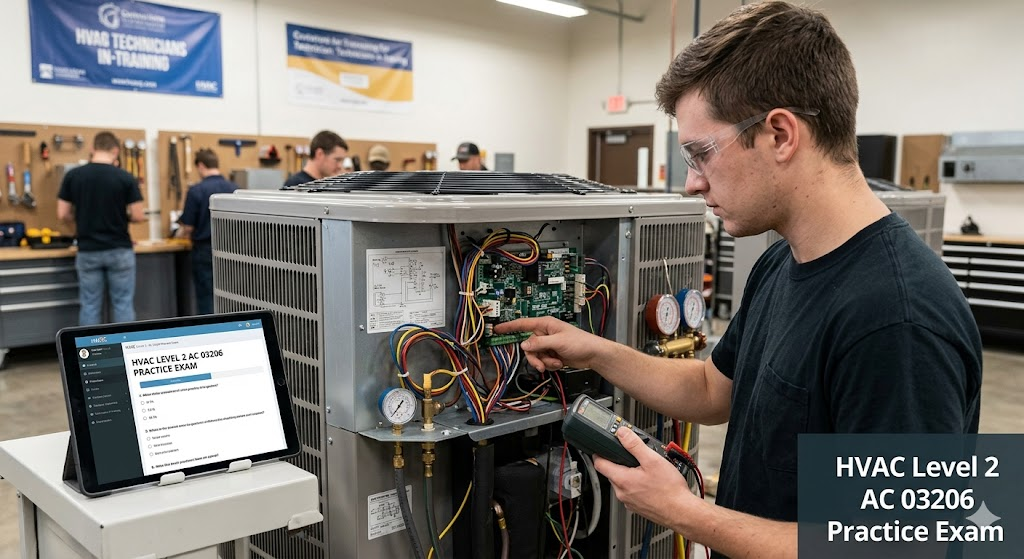
Additional Information
What the Course Entails and Exam Details
The HVAC Level 2 AC 03206 module provides an in-depth exploration of alternating current as it applies to modern residential and commercial HVAC systems. This is not just a theoretical overview; it is a practical, rigorous deep dive into the electrical core of the trade.
The comprehensive syllabus and training for this module cover a wide range of essential topics, ensuring you build a robust foundation in AC principles and applications. Key learning areas include:
AC Theory and Fundamentals: Understanding sine waves, cycles, frequency (Hertz), voltage, current, and impedance in an AC circuit.
Single-Phase and Three-Phase Power: Comprehensive coverage of both power supply types common in the industry, including wiring configurations, balancing loads, and safety considerations.
AC Motors: In-depth study of the types, operation, maintenance, and troubleshooting of single-phase and three-phase motors used in HVAC equipment (e.g., blower motors, condenser fan motors, and compressors).
Generators and Transformers: Principles of power generation and the critical role of transformers in voltage transformation for control and power circuits.
HVAC Control Systems: Mastering the electrical components, switches, relays, contactors, and circuit boards that form the brain of modern HVAC systems.
Schematic and Diagram Reading: Developing expert skills in reading and interpreting complex electrical schematics and ladder diagrams to accurately diagnose and repair HVAC systems.
Electrical Safety: Rigorous emphasis on safety protocols, proper tool usage (e.g., multimeters, clamp meters), Lock-Out/Tag-Out (LOTO) procedures, and understanding Arc Flash hazards.
This course is designed to transition you from simple component-swapping to a diagnostics specialist who truly understands how and why electrical systems function.
What to Expect in the Final Exam
The official NCCER exam for HVAC Level 2 Alternating Current (03206) is a challenging, proctored test that measures your comprehension of the learning objectives. Preparing with a strong understanding of what to expect is key.
The exam typically follows this format:
Question Format: The test is composed of multiple-choice questions. Each question requires you to select the best answer from four options.
Adminstration: The exam is administered in a proctored environment to ensure academic integrity. Candidates must verify their identity.
Passing Score: The typical passing score for an NCCER module exam is 70% or higher. It is essential to aim significantly higher to ensure a margin of safety.
Time Limit: While the specific time limit can vary by institution and administration, expect to have approximately one to two hours to complete the module exam. Efficiency and accuracy are crucial.
Specific Rules: Generally, no outside resources, textbooks, cell phones, or electronic aids are allowed in the testing area. You will be provided with approved reference materials or calculators if necessary. Strict adherence to all testing rules is mandatory.
How to Study and Exam Centers
Preparation is the absolute cornerstone of certification success. While field experience is incredibly valuable, a structured study plan is necessary to master the technical depth required for the 03206 module.
Here are actionable strategies for effective study:
Master the NCCER Textbook: This is your primary resource. Go through the 03206 module textbook thoroughly. Don't just read; take active notes, summarize key concepts, and understand why processes are followed.
Complete All Lab Exercises: NCCER courses blend theory with hands-on labs. If you are in an accredited program, take these lab sessions seriously. Working with actual components, wiring diagrams, and testing tools solidifies your understanding like nothing else.
Utilize Practice Exams: This is a game-changer. Take our dedicated HVAC Level 2 AC 03206 Practice Test multiple times. Our test is designed to mirror the structure, difficulty, and complexity of the actual NCCER exam. Analyze your incorrect answers to identify and strengthen your weak areas.
Use Flashcards for Key Terms: Create flashcards for electrical terms, formulas, motor types, and schematic symbols. Repetition helps commit these essentials to memory.
Seek Mentorship: If you are unsure about a complex concept, such as calculating power in a three-phase system, ask an experienced technician, your instructor, or a mentor for clarification.
Finding Exam Centers
As a standardized NCCER examination, you cannot take this test just anywhere. The exam must be administered by an NCCER-Accredited Training Sponsor (ATS) or an Accredited Assessment Center (AAC). These typically include:
Trade and Technical Colleges
HVAC Apprenticeship Program Facilities
Union or Trade Association Training Centers
Larger HVAC Employers with in-house training programs
You cannot simply register through a general testing portal like Pearson VUE for an individual NCCER module exam unless your accredited organization is using their services for administration. You will take the exam through the learning institution or employer where you are completing your Level 2 course. Check with your training coordinator for specific scheduling.
Job Opportunities from the Course
Earning your certification in NCCER HVAC Level 2 Alternating Current (03206) is a powerful validation of your skills and a significant resume builder. This certification makes you a more valuable asset to any HVAC employer, signaling competency, reliability, and commitment to the trade.
Possessing this specific, high-level skill set unlocks various job titles and career paths, allowing you to move beyond entry-level positions:
HVAC Level 2 Technician: The most direct path, allowing you to operate with less supervision and handle more complex residential and commercial calls.
HVAC/AC System Installer: Focusing specifically on the specialized and vital alternating current aspects of system design, power supply, and control integration during new construction or system change-outs.
Preventative Maintenance Specialist (AC Focus): Utilizing your diagnostic and electrical knowledge to identify and prevent costly failures in sophisticated AC systems before they occur.
Control Systems Technician: Specializing in the logic and electrical controls of HVAC equipment, which is highly sought after in sophisticated commercial and industrial environments.
HVAC/R Service Manager: While this requires further experience and Level 3/4 certification, mastering this complex module is a critical step towards leading teams of technicians.
Investing time and effort in mastering this AC module is an investment in your career trajectory. Good luck with your studies, use our practice exam to its full potential, and we look forward to seeing your success on exam day!
Frequently Asked Questions
Reviews
5.0
Based on 0 reviews
Leave a Review
No reviews yet. Be the first to review!