
HVAC Oil Burner Practice Test
$69.00
- Buy to unlock unlimited access to all Quiz questions and Answers in this Quiz.
- After purchase you can print a PDF of the whole quiz at any point. The PDF will contain the questions and the correct answers.
About this Exam
The HVAC Oil Burner certification is a crucial, specialized credential designed for heating, ventilation, and air conditioning professionals working with oil-fired heating equipment.
It validates a technician's competence in safely installing, servicing, and troubleshooting residential and commercial oil heating systems.
This certification is specifically tailored for aspiring heating mechanics, established HVAC technicians expanding their skill set, and maintenance personnel seeking to meet strict state or local licensing requirements.
Earning this qualification proves to employers and customers alike that you possess the rigorous technical knowledge required to handle combustible fuels and complex combustion machinery safely.
Ready to test your knowledge?
Buy Now to Access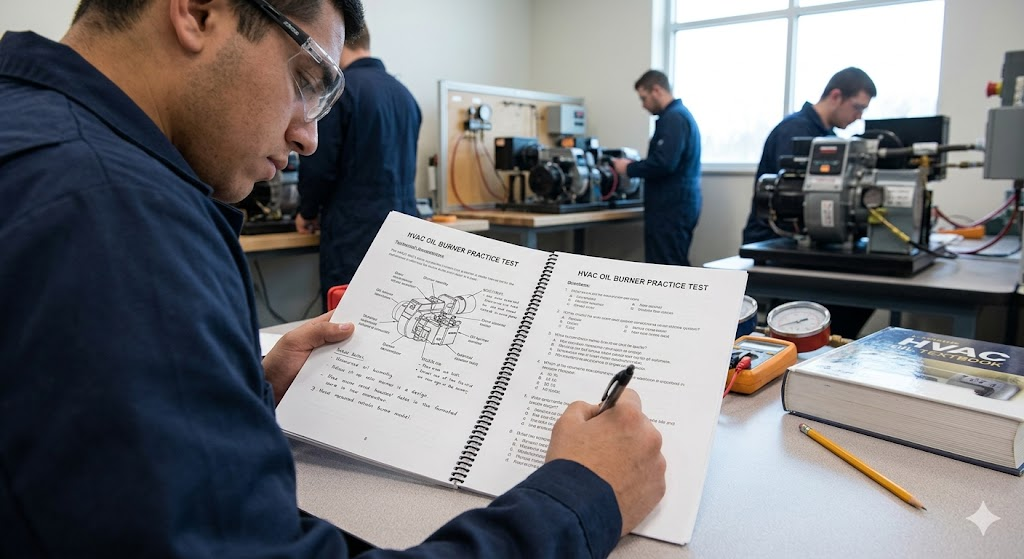
Additional Information
What the Course Entails and Exam Details
Preparing for the HVAC oil burner exam requires a comprehensive understanding of mechanical, electrical, and fluid dynamics principles.
The core syllabus deeply covers combustion theory, focusing on how fuel oil and air must mix under precise conditions for efficient ignition.
You will study the intricate properties of fuel oil, including viscosity, flash points, and proper storage protocols to prevent hazards.
The curriculum also extensively details oil burner components such as fuel pumps, atomizing nozzles, electrodes, primary control relays, and ignition transformers.
Furthermore, you will learn essential safety protocols, including drafting, venting, electrical wiring diagrams, and compliance with national safety codes like NFPA 31.
What to Expect in the Final Exam
The final assessment is typically a rigorous, proctored, multiple-choice examination that tests both theoretical knowledge and practical problem-solving scenarios.
Depending on your specific state licensing board or the certifying organization (such as NORA), the exam generally consists of 50 to 100 questions.
Candidates are usually granted a time limit of two to three hours to complete the test, which requires steady pacing and deep focus.
The standard passing score typically hovers around 70% to 75%, making thorough preparation absolutely essential.
These exams are generally closed-book, meaning you must commit safety codes, wiring logic, and troubleshooting sequences to memory, though some specific jurisdictions may allow an approved code book.
How to Study and Exam Centers
A strategic, multi-faceted study approach is the best way to conquer the oil burner exam.
Start by taking numerous practice exams to familiarize yourself with the question formats and to identify your weak areas in topics like combustion efficiency or electrical troubleshooting.
Flashcards are incredibly highly effective for memorizing nozzle sizes, pump pressures, and code clearances.
When it comes to scheduling your test, exams are typically administered through state-approved testing vendors like Pearson VUE or Prometric.
Additionally, many local trade schools, community colleges, and industry organizations offer authorized physical testing centers, and some regions now provide secure, online proctored testing options for added convenience.
Job Opportunities from the Course
Successfully passing this exam unlocks a highly specialized and lucrative career path within the HVAC industry.
You can pursue a role as a Dedicated Oil Burner Technician, focusing entirely on the maintenance, tuning, and repair of oil heating units during the demanding winter months.
It also qualifies you for the title of Comprehensive HVAC Service Technician, making you a versatile asset capable of servicing both standard air conditioning units and heavy-duty heating equipment.
Other excellent career paths include Heating Equipment Installer, where you will manage the physical setup of new boilers and furnaces in residential and commercial builds.
You can also thrive as a Building Maintenance Engineer or Facilities Mechanic, overseeing the complex heating operations for large-scale properties, schools, or hospitals.
Frequently Asked Questions
Reviews
5.0
Based on 0 reviews
Leave a Review
No reviews yet. Be the first to review!