
HVAC Refrigeration Fundamental Practice Test
$69.00
- Buy to unlock unlimited access to all Quiz questions and Answers in this Quiz.
- After purchase you can print a PDF of the whole quiz at any point. The PDF will contain the questions and the correct answers.
About this Exam
The HVAC Refrigeration Fundamentals Practice is a foundational study guide and preparatory resource designed to assess and reinforce the core knowledge required for entry-level technicians or individuals seeking basic certification in refrigeration systems. It focuses on the primary principles, components, and safety practices essential for working with refrigeration and air conditioning equipment in residential and light commercial settings. This practice material is ideal for students enrolled in HVAC training programs, technicians looking to refresh their knowledge, or anyone aiming to build a strong theoretical base before pursuing advanced, specialized certifications or entry-level positions in the industry.
Ready to test your knowledge?
Buy Now to Access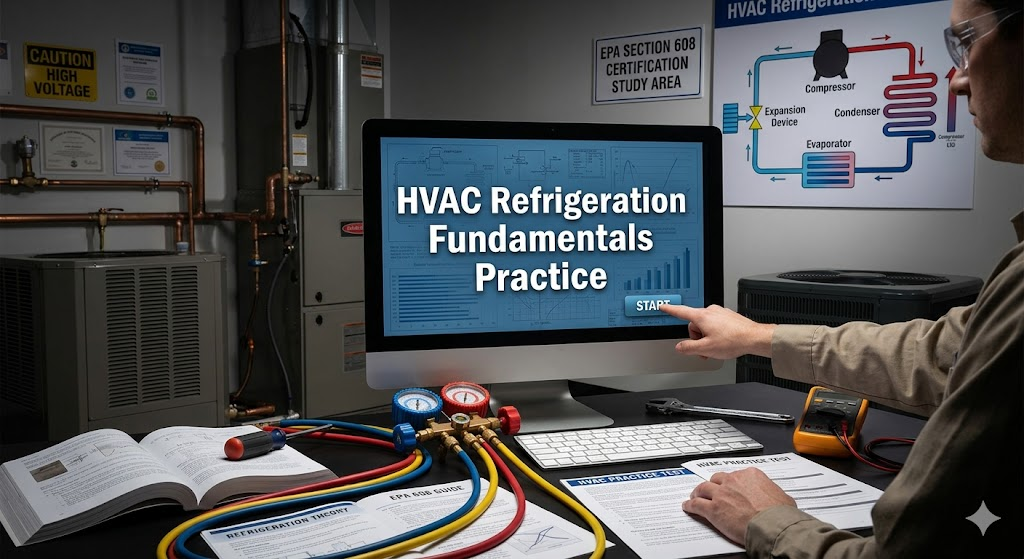
Additional Information
What the Course Entails and Exam Details
While not a formal course, studying the material covered in this HVAC Refrigeration Fundamental Practice Test will equip you with a solid understanding of key refrigeration concepts. Expect to delve deep into topics such as:
Thermodynamics & Refrigeration Cycle: Grasping the fundamental laws of heat transfer, pressure-temperature relationships, and the step-by-step processes within the standard refrigeration cycle (evaporation, compression, condensation, expansion).
Refrigerants: Understanding different types of refrigerants (CFCs, HCFCs, HFCs, and natural refrigerants), their properties, identification, safety handling, and environmental impact regulations.
Refrigeration Components: Detailed exploration of major components: compressors, condensers, evaporators, metering devices (e.g., thermal expansion valves, capillary tubes), and their specific functions and variations.
Piping & System Accessories: Understanding piping types, sizing, installation techniques, and essential system accessories like filter-driers, sight glasses, and accumulators.
Basic Electrical for Refrigeration: Fundamental electrical concepts, reading basic schematics, and understanding safe electrical practices related to HVAC equipment.
System Charging & Basic Service Procedures: Basic procedures for system evacuation, charging methods, leak detection, and common diagnostic techniques.
Safety Practices & Environmental Regulations: Deep focus on industry safety standards (OSHA compliance), proper handling of high pressures, flammable refrigerants, and adherence to environmental regulations regarding refrigerant containment and disposal (e.g., EPA Section 608 regulations, which this practice material can help prepare you for).
The associated HVAC Refrigeration Fundamental Practice Test itself is designed to mirror common exam formats and assess proficiency in these core areas.
What to Expect in the Final Exam
For your actual certification exam, you should anticipate:
Format: Typically a multiple-choice exam, delivered either in a proctored digital environment or sometimes in paper format at approved testing centers. Some foundational exams may occasionally have basic diagram identification or matching questions as well. Practice materials like this one will primarily feature multiple-choice questions to familiarize you with this structure.
Structure: Questions will be distributed across the main content areas (refrigeration cycle, components, safety, etc.) with varying difficulty levels designed to test both comprehension and application of knowledge.
Passing Score: Requirements vary significantly depending on the specific certification body or state/local regulations. Research the exact exam you plan to take, as passing scores can range from 70% to 80% or higher. Your goal with practice tests should be a consistently high score (e.g., over 85%) to build confidence for the real thing.
Time Limit: Most fundamental certification exams have a designated time limit, typically ranging from 1.5 to 3 hours, depending on the number of questions and the specific exam board. Time management is crucial, and practice tests help you gauge how much time to allocate per question.
Rules & Proctoring: Be prepared for strict exam conditions. Mobile phones, electronic devices, study materials, and unauthorized resources are strictly prohibited. In-person exams are supervised by proctors, while online exams use secure browser technology and sometimes live remote proctoring. You will need a valid government-issued ID for verification.
How to Study and Exam Centers
Preparation is key to success on your actual certification exam. Here’s a strategic approach and guidance on where to take your test:
Actionable Study Strategies:
Utilize Practice Material: Take HVAC Refrigeration Fundamental Practice Tests multiple times to identify areas where you consistently struggle. Review the explanations for both correct and incorrect answers to deepen your understanding. This is a critical active learning technique.
Refer to Key Textbooks & Guides: Revisit your HVAC/R course materials, specialized textbooks, and fundamental refrigeration guides (including official EPA 608 study materials if relevant). Don’t just rely on practice questions; understand the underlying principles in detail.
Create Flashcards & Diagrams: Make flashcards for essential formulas, refrigerant types/colors, component functions, and safety symbols. Draw and label the refrigeration cycle repeatedly until you can do it from memory. Visual and active recall are powerful study tools.
Hands-on Practice (If possible): If you are in a training program or working under supervision, apply your theoretical knowledge by observing and safely assisting with basic refrigeration systems. Connect what you are reading with physical components and procedures. Caution: Only perform work you are qualified and supervised for.
Focus on Weak Points: Dedicate more study time to topics you find confusing or consistently get wrong on practice exams. Don't avoid challenging material.
Simulate Exam Conditions: For final practice rounds, set a timer and take a full practice test without any outside resources to build stamina and practice time management.
Finding Exam Centers:
You cannot take the final certification exam on a basic practice portal; you must use an authorized provider. Common avenues include:
Online Proctors: Many prominent certification bodies (e.g., NATE, RSES, various state licensing boards) now partner with secure online proctoring services. This allows you to take the exam from a quiet, prepared space at home or work, often with more scheduling flexibility. You will typically use a specific secure browser and your webcam and microphone will be monitored.
Pearson VUE & Other Testing Services: Large testing network providers like Pearson VUE often administer various professional certifications, including some HVAC exams, at their physical testing centers located in cities and towns globally.
Authorized Schools & Training Facilities: Many accredited HVAC/R trade schools, community colleges with relevant programs, and dedicated HVAC training centers are authorized exam locations, both for their own students and sometimes for external candidates.
Local Professional Organizations: Contact local chapters of industry organizations like the Refrigeration Service Engineers Society (RSES) or your state's licensing division for guidance on local testing centers and approved providers.
Job Opportunities from the Course
Successfully completing fundamental refrigeration training and potentially achieving associated certifications (after practicing with tools like this) significantly boosts your employability and career prospects in the HVAC/R industry. This knowledge unlocks doors to roles such as:
Apprentice Refrigeration Technician
HVAC Service Technician (Entry-Level)
Refrigeration Service Technician
HVAC Helper
Maintenance Technician (with refrigeration systems responsibility)
Refrigeration/HVAC Installer (Entry-Level)
Commercial Refrigeration Technician
Industrial Refrigeration Operator
Refrigerant Recovery Technician (with required EPA 608 Certification)
Refrigeration/HVAC Parts Counter Sales Representative (where fundamental knowledge is valued)
With dedication and experience, fundamental knowledge and associated certifications serve as a stepping stone toward advanced specializations, supervisory roles, and potentially starting your own HVAC/R business. Your career journey in refrigeration begins with a solid understanding of the fundamentals – prepare diligently and take that first important step!
Frequently Asked Questions
Reviews
5.0
Based on 0 reviews
Leave a Review
No reviews yet. Be the first to review!