
HVAC Troubleshooting Practice Test
$69.00
- Buy to unlock unlimited access to all Quiz questions and Answers in this Quiz.
- After purchase you can print a PDF of the whole quiz at any point. The PDF will contain the questions and the correct answers.
About this Exam
The [HVAC Troubleshooting Practice Exam] is designed as a premier study tool for aspiring and current HVAC/R professionals who are preparing for a formal industry certification. Proving your proficiency in system diagnostics is a crucial step in advancing your career, as it validates your ability to resolve complex issues efficiently and safely. This guide helps students, entry-level technicians, and experienced professionals master the specific problem-solving skills tested in leading certifications, such as NATE (North American Technician Excellence), HVAC Excellence, and others focused on service and repair. It is the perfect simulation to build confidence and accuracy before facing the final, career-defining test.
Ready to test your knowledge?
Buy Now to Access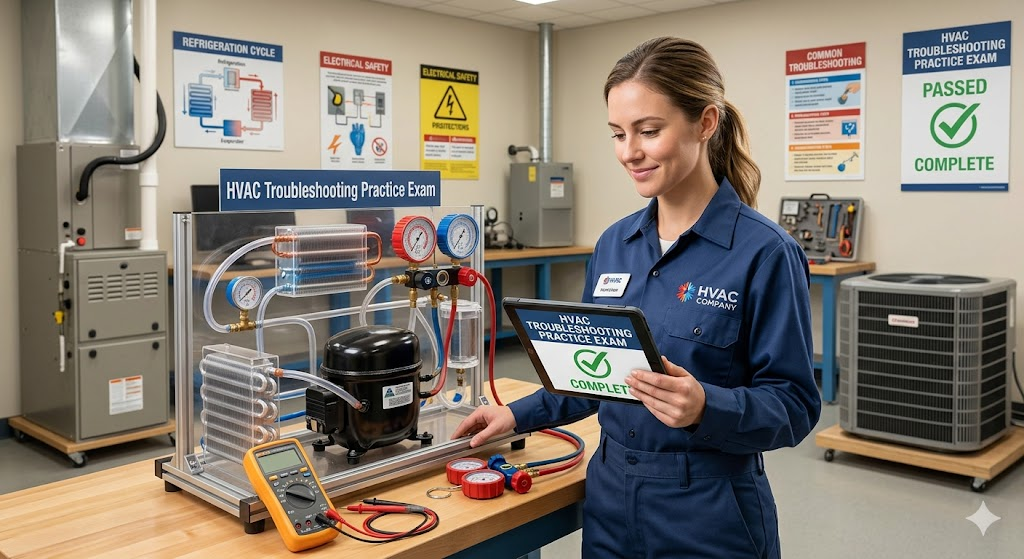
Additional Information
What the Course Entails and Exam Details
While this is a practice test rather than a structured course, it is built to mirror the comprehensive knowledge required to excel in real-world troubleshooting scenarios. The exam content, which this practice test reflects, covers a broad range of critical HVAC/R systems and procedures. You can expect questions that rigorously test your understanding of:
Advanced Electrical Diagnostics: Identifying faults in single-phase and three-phase circuits, testing components like motors, capacitors, relays, contactors, and control boards.
Refrigeration Cycle Troubleshooting: Interpreting pressure and temperature readings to diagnose issues such as overcharge, undercharge, non-condensables, and system restrictions.
Component and System Testing: Evaluating the performance of compressors, metering devices (TXVs, pistons), evaporators, condensers, and fan motors.
Control Systems and Safety Protocols: Troubleshooting thermostat signals, safety switches (high/low pressure, limit), ignition systems, and combustion analysis.
Real-World Scenario Analysis: Solving multi-variable problems, interpreting wiring diagrams, and applying a systematic logical approach to diagnose complex system failures.
What to Expect in the Final Exam
The official HVAC Troubleshooting certification exam is a formal, proctored test designed to ensure technical mastery. While specifics can vary slightly between certification bodies, a typical final exam will consist of approximately 50 to 100 multiple-choice questions. These questions range from fundamental theory to advanced diagnostic case studies.
You will typically have between 1.5 to 3 hours to complete the test. A passing score, often between 70% and 80%, is required to demonstrate your expertise and earn the valuable credential. The final exam environment is structured, requiring valid photo identification and adherence to specific rules, such as prohibiting external resources, notes, or electronics other than approved calculators. Preparation, therefore, is essential to perform well under these conditions.
How to Study and Exam Centers
The most effective way to prepare for this challenging exam is through a multi-faceted study approach. First, utilize this [HVAC Troubleshooting Practice Exam] multiple times. It is designed to identify your knowledge gaps, familiarize you with the question formats, and build essential test-taking speed and endurance.
Complement your practice with deep dives into official study guides and manuals provided by certification organizations. Create flashcards for crucial formulas, electrical symbols, and diagnostic procedures. Whenever possible, pair your theoretical knowledge with hands-on practice in a lab or in the field, as practical application is the foundation of true troubleshooting skill.
Once you are ready, scheduling your official exam is straightforward. Most certifications are offered at a wide network of authorized physical testing centers, including community colleges, vocational schools, or third-party facilities like Pearson VUE. Increasingly, many organizations also provide secure online proctoring, allowing you to take the exam from a private and quiet location. Be sure to check the specific body's website for their current test center and online options.
Job Opportunities from the Course
Successfully passing an HVAC Troubleshooting certification exam significantly enhances your professional credibility and unlocks numerous career paths with excellent growth potential. This credential proves to employers and customers that you possess the advanced diagnostic skills necessary to keep critical systems running. Some of the specific job titles and career paths this certification enables include:
HVAC Service Technician
Residential HVAC Technician
Commercial HVAC/R Technician
Controls Specialist
Facilities Maintenance Manager
HVAC Installer (Higher Tier)
Lead Maintenance Technician
Energy Auditor
HVAC Sales and Project Estimator
Technical Trainer / HVAC Instructor
HVAC Business Owner / Contractor
Earning this certification not only increases your marketability but also directly connects to higher responsibility levels and significantly increased earning potential throughout your HVAC career.
Frequently Asked Questions
Reviews
5.0
Based on 0 reviews
Leave a Review
No reviews yet. Be the first to review!