
IAED Emergency Medical Dispatcher (EMD) Practice Exam
$69.00
- Buy to unlock unlimited access to all Quiz questions and Answers in this Quiz.
- After purchase you can print a PDF of the whole quiz at any point. The PDF will contain the questions and the correct answers.
About this Exam
The IAED Emergency Medical Dispatcher (EMD) certification is the gold standard for public safety telecommunicators specializing in medical emergency response. This comprehensive program, developed by the International Academies of Emergency Dispatch (IAED), validates that a dispatcher possesses the necessary knowledge and critical thinking skills to manage high-stress medical calls effectively. It is designed for both newly hired dispatchers entering the field and experienced professionals seeking official accreditation. By certifying, dispatchers prove their commitment to maintaining the highest standard of care as the critical "first, first responder" on the scene of an emergency.
Sample Questions
Explanation:
Explanation:
Explanation:
Explanation:
Explanation:
Ready to test your knowledge?
Buy Now to Access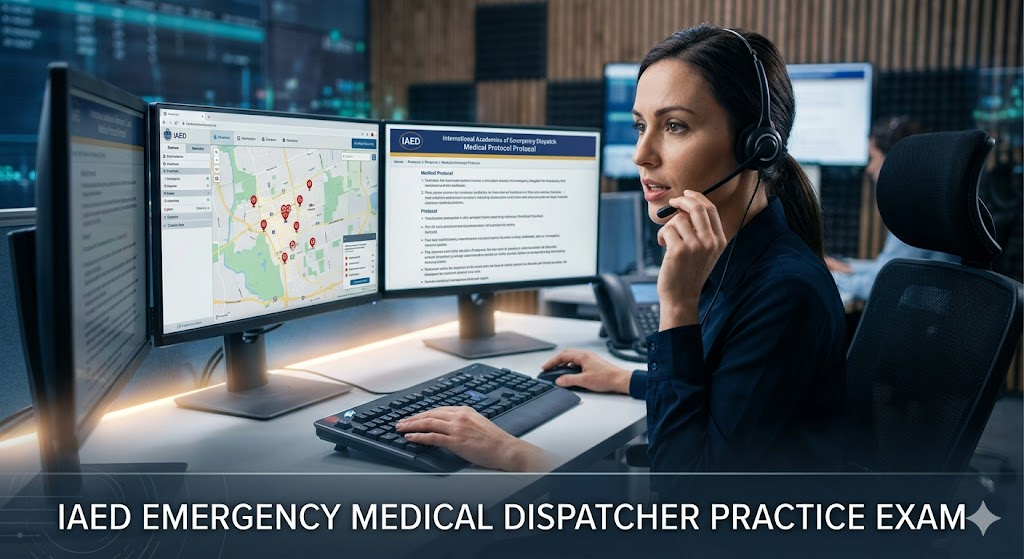
Additional Information
What the Course Entails and Exam Details
This certification is earned through completion of a 24-hour, multi-day instructor-led training course, culminating in a final written exam. The curriculum covers the essential components of effective emergency medical dispatching. Core topics include mastering the Medical Priority Dispatch System (MPDS) protocols, proper caller interrogation techniques, and agonal breathing recognition. Participants learn how to deliver crucial post-dispatch instructions and life-saving pre-arrival instructions (PAIs) to callers. The course also addresses legal aspects of dispatch, stress management, and the principles of the Chain of Survival. Students must also maintain current CPR certification as a prerequisite.
What to Expect in the Final Exam
The final exam is a written assessment designed to test your mastery of the IAED EMD course material. It consists of 50 multiple-choice questions. To achieve certification, applicants must secure a minimum passing score of 80 percent. The test evaluates your ability to apply the specific protocols, prioritization rules, and instruction sequences learned during training to realistic scenarios. While exact time limits can vary by proctor, candidates should be prepared to complete the exam in one sitting. For those who do not pass on their first attempt, official retest options are available for a fee.
How to Study and Exam Centers
Effective preparation is key to passing the IAED EMD exam. Focus your study on repetition: read the mandatory MPDS protocol cards verbatim until the interrogation sequences become second nature. Create flashcards to associate specific chief complaints with their corresponding protocol numbers and priority levels. Utilize mnemonic devices to memorize critical lists and agonal breathing signs. Take timed practice questions to simulate the pressure of the real test environment. As for taking the exam, it is typically administered directly at the authorized IAED training site where you completed the 3-day course, which might be a dedicated police or fire academy, a community college, or an in-house training facility at an Accredited Center of Excellence (ACE).
Job Opportunities from the Course
Obtaining your IAED EMD certification opens numerous pathways in the field of public safety communications. This accreditation is often a mandatory requirement for hiring and promotion within many agencies. Below are specific job titles and career paths this certification unlocks:
Emergency Medical Dispatcher (EMD)
911 Communications Operator
Public Safety Telecommunicator
EMD Quality Assurance Specialist (EMD-Q)
Lead Dispatcher / Shift Supervisor
IAED-Certified EMD Instructor (EMD-I)
Frequently Asked Questions
Reviews
5.0
Based on 0 reviews
Leave a Review
No reviews yet. Be the first to review!