
IAI Crime Scene Analyst Practice Test
$69.00
- Buy to unlock unlimited access to all Quiz questions and Answers in this Quiz.
- After purchase you can print a PDF of the whole quiz at any point. The PDF will contain the questions and the correct answers.
About this Exam
The International Association for Identification (IAI) offers the prestigious Certified Crime Scene Analyst (CCSA) designation to forensic professionals who have demonstrated exceptional knowledge and skill in the field of crime scene investigation.
This certification is not for beginners; it is specifically designed for individuals who are already employed full-time in a crime scene investigation or related forensic capacity and have a minimum number of years of experience, a strong educational background, and relevant training.
Earning your CCSA credential validates your expertise in processing complex crime scenes, identifying and preserving critical evidence, and presenting your findings with unwavering professional integrity. It is a hallmark of commitment to the forensic community and can significantly advance your career.
Ready to test your knowledge?
Buy Now to Access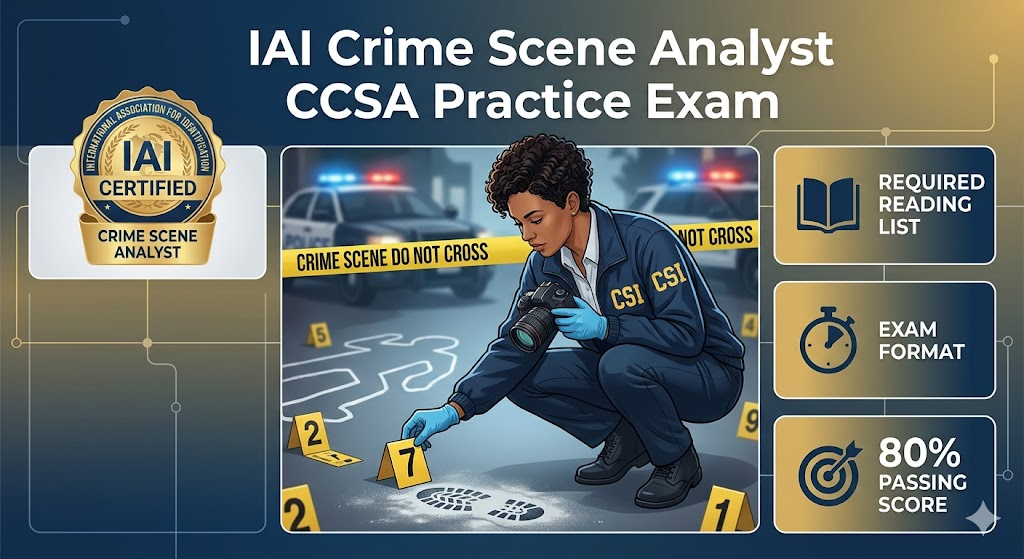
Additional Information
What the Course Entails and Exam Details
Preparing for the IAI Crime Scene Analyst examination requires a dedicated and comprehensive review of several standard, foundational forensic science textbooks, as mandated by the IAI. The core topics covered in the exam, and subsequently the literature, include:
Comprehensive Crime Scene Management (Safety, Security, Search, and Documentation)
Advanced Forensic Photography and Videography
Sketching and Measuring for Crime Scene Reconstruction
Detection, Documentation, and Collection of Biological and Trace Evidence
Latent Impression and Pattern Evidence Processing
Friction Ridge (Fingerprint) Detection and Comparison
Tire, Shoe, Trace, Tool Mark, and Firearms Evidence
Proper Techniques for Evidence Packaging, Preservation, and Chain of Custody
Report Writing for Forensic Investigation
Professional Ethics and Courtroom Testimony
The IAI publishes a specific list of required reading on their official website. Mastery of this material is the key to passing the examination.
What to Expect in the Final Exam
The Certified Crime Scene Analyst examination is a rigorous, proctored test. For this level of certification, it primarily consists of a long, challenging multiple-choice exam derived directly from the required textbooks.
Students should expect hundreds of questions designed to test both factual recall and the application of complex crime scene analysis principles to unique scenarios. The passing score is 80%, meaning you must achieve an 80% correct rate across all questions.
You will be given a set time limit, typically several hours, to complete the exam. While some higher-level IAI certifications might involve practical components or moot court evaluations, the CCSA focuses heavily on verifying a deep, theoretical, and methodological understanding of forensic best practices through the written exam.
How to Study and Exam Centers
The absolute best way to study is to first obtain the current required reading list from the official International Association for Identification website and dedicate your time to thoroughly studying these texts.
Many aspiring CSAs find that taking a formal, intensive IAI Certification Prep Course is highly beneficial. These 5-day courses offer a structured review of the material, highlight key concepts, and often include practice tests with hundreds of questions, which are crucial for identifying areas where you need further study.
The final, official examination is not usually taken at a standard computerized testing center. The IAI facilitates the exam, often administering it at the conclusion of an authorized IAI training or prep course, at official IAI conferences, or by special arrangement where a verified proctor can oversee the test.
Job Opportunities from the Course
A Certified Crime Scene Analyst designation significantly boosts your professional standing and can open doors to leadership positions and advanced career paths. It is a highly respected credential within the criminal justice system. Job opportunities that this certification unlocks or enhances include:
Senior Crime Scene Investigator
Crime Scene Unit Supervisor
Forensic Science Technician
Criminalist
Evidence Technician Manager
Police Detective or Lead Investigator
Forensic Photographer
Forensic Consultant
Forensic Science Educator or Trainer
Sectors seeking CCSAs include local, state, and federal law enforcement agencies, state bureaus of investigation, and private forensic consulting firms.
Frequently Asked Questions
Reviews
5.0
Based on 0 reviews
Leave a Review
No reviews yet. Be the first to review!