
IAI Latent Print Certification Practice Test
$69.00
- Buy to unlock unlimited access to all Quiz questions and Answers in this Quiz.
- After purchase you can print a PDF of the whole quiz at any point. The PDF will contain the questions and the correct answers.
About this Exam
The International Association for Identification (IAI) Latent Print Certification is a premier, voluntary credential designed to recognize and validate the unique skills and comprehensive knowledge of forensic professionals specializing in the examination and comparison of latent fingerprint evidence. Achieving this prestigious senior-level certification demonstrates a commitment to the field and an in-depth understanding of the science, making it a critical asset for those who analyze complex impressions and provide expert testimony in a court of law.
Ready to test your knowledge?
Buy Now to Access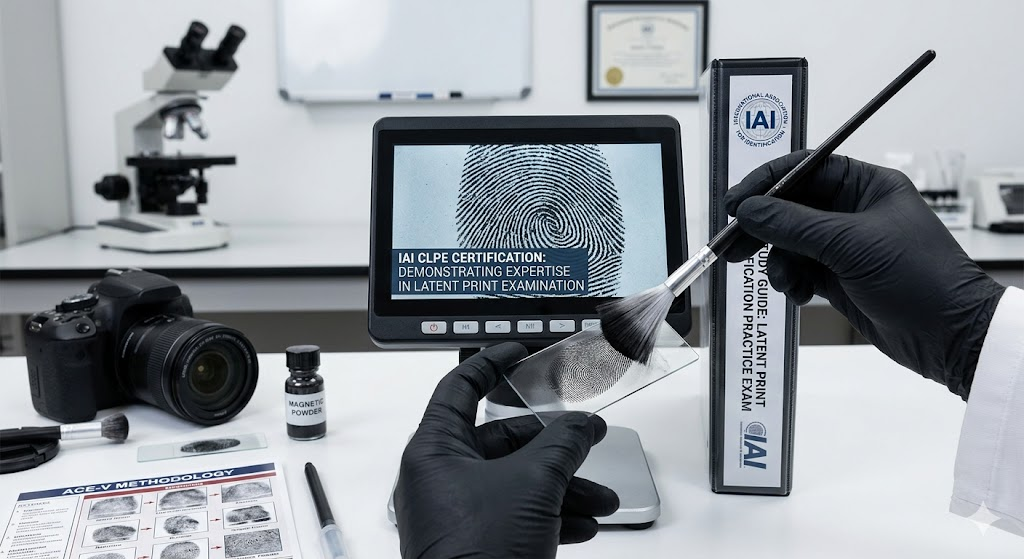
Additional Information
What the Course Entails and Exam Details
This certification is not a single course but rather a professional designation earned by fulfilling rigorous prerequisites and passing a multi-part exam. Candidates are required to have a specific combination of formal education, ranging from a Bachelor’s degree with two years of experience to a high school diploma with four years, alongside a minimum of 160 hours of approved, specialized technical training in friction ridge skin science. Additionally, all initial applicants must complete 16 hours of courtroom testimony training and participate in a moot court exercise. The process ensures that individuals demonstrate expertise in areas such as friction skin physiology and morphology, specialized terminology, latent print detection, recovery, photography, preservation, chemical enhancement, documentation, and the application of the ACE-V (Analysis, Comparison, Evaluation, Verification) methodology.
What to Expect in the Final Exam
The final certification exam is a challenging 8-hour comprehensive assessment divided into three mandatory parts. You must successfully navigate all sections to become certified.
Part 1: The Written Examination This segment consists of a collection of multiple choice questions focusing on the history of fingerprints, development and preservation techniques, friction ridge skin development, and the comparison process. You must achieve a minimum score of 85% to pass this section.
Part 2: The Comparison Examination This critical practical section involves the actual comparison of 15 latent prints with 15 known exemplar prints. To receive a passing grade, you must correctly reach 12 or more conclusions (identification or exclusion) and must not make any erroneous identifications. A single erroneous conclusion results in an immediate failure of this part.
Part 3: The Pattern Interpretation Examination You must interpret the patterns of 35 inked impressions and achieve a passing score of at least 32 correct interpretations.
How to Study and Exam Centers
Preparation is paramount, as the exam has historically been considered one of the most demanding in the forensic sciences, with past pass rates hovering around 50%, though recent improvements have seen this number rise to over 70%. The IAI Latent Print Certification Board (LPCB) strongly recommends that all candidates have an appreciable level of experience in comparing latent prints and suggests having a currently certified examiner assess your readiness before applying. A variety of board-approved training courses—including dozens of online options—and certification preparation workshops are available to help you build the necessary technical expertise. Practice should focus on mastering the ACE-V strategy, especially when working with 1:1 image scales, which are used on the test.
The exam itself is highly technical and logistics are carefully managed. The initial certification’s comparison portion is often delivered digitally via a mini-computer pre-loaded with Adobe Photoshop Elements, which is shipped to a designated proctor at an authorized school, agency, or other professional testing location, along with a hard copy of the written portion. It is essential to familiarize yourself with Photoshop Elements if you choose this digital option. For specific information about localized exam centers and proctoring, you should contact the IAI or your regional division.
Job Opportunities from the Course
A key marker of elite forensic professional status, this certification unlocks a wide range of rewarding career paths. Earning the CLPE (Certified Latent Print Examiner) designation directly qualifies individuals for advanced, senior, and lead positions, and is often an explicit requirement for federal specialist roles.
Latent Print Examiner
Forensic Scientist (with a specialization in fingerprints)
Crime Scene Analyst
Criminalist
Fingerprint Specialist (e.g., for the Drug Enforcement Administration, DEA)
Forensic Technician
Laboratory Supervisor
Forensic Consultant
Digital Forensic Examiner (with specialized experience)
Frequently Asked Questions
Reviews
5.0
Based on 0 reviews
Leave a Review
No reviews yet. Be the first to review!