
IALA Maritime Buoyage System Practice Test
$69.00
- Buy to unlock unlimited access to all Quiz questions and Answers in this Quiz.
- After purchase you can print a PDF of the whole quiz at any point. The PDF will contain the questions and the correct answers.
About this Exam
The IALA Maritime Buoyage System is the international standard for marine aids to navigation, crucial for maintaining safety at sea. It divides the world into two regions (Region A and Region B) with differing lateral marking rules, but standardized cardinal, isolated danger, safe water, and special marks.
This [IALA Maritime Buoyage System Practice Test] is designed for mariners, naval officers, commercial vessel operators, recreational boaters, and anyone seeking professional certification in maritime navigation. Mastering this system is not just about passing an exam; it is a critical skill for preventing groundings, collisions, and navigating safely through complex waterways.
Ready to test your knowledge?
Buy Now to Access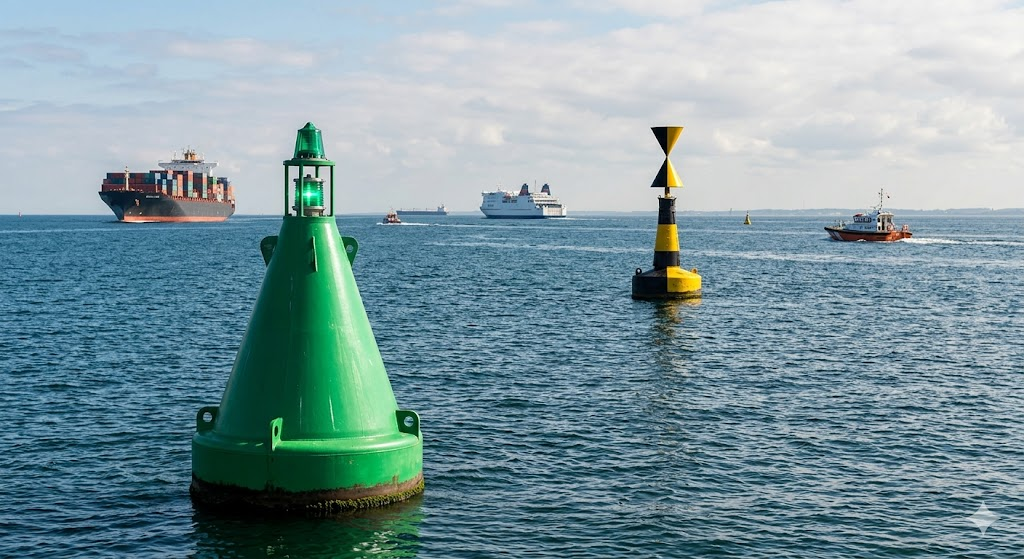
Additional Information
What the Course Entails and Exam Details
This practice test assesses a comprehensive understanding of the International Association of Marine Aids to Navigation and Lighthouse Authorities (IALA) guidelines. Candidates must demonstrate proficiency in recognizing and interpreting the six main types of marks.
The core syllabus covered in the examination includes:
Lateral Marks: Understanding the differences in coloring (red vs. green) for port and starboard hand marks in both Region A and Region B, including preferred channel markers.
Cardinal Marks: Identifying North, East, South, and West marks based on their distinct black and yellow color bands, topmarks (double cones), and specific white light flashing sequences.
Isolated Danger Marks: Recognizing the black and red horizontal bands and the double black sphere topmark that indicate a specific hazard with navigable water all around.
Safe Water Marks: Identifying the red and white vertical stripes and single red sphere that mark the beginning of a channel or land-fall.
Special Marks: Understanding the use of yellow marks to signify specific areas such as spoil grounds, military zones, or pipelines.
Light Characteristics: Memorizing the colors, phase characteristics (flashing, occulting, isophase), and rhythms (e.g., Quick, Very Quick) associated with each type of mark for nighttime identification.
What to Expect in the Final Exam
The actual certification exam following this practice test is rigorous, reflecting the safety-critical nature of maritime navigation. It is designed to test immediate recall and accurate interpretation under time pressure.
Candidates can expect the following structure:
Format: The exam typically utilizes multiple-choice questions. A significant portion of these questions are visual, presenting diagrams or photographs of buoys where the candidate must correctly identify the mark, its light characteristic, or the appropriate navigation action required.
Time Limit: Exams are strictly timed, typically allowing between 45 and 90 minutes.
Passing Score: The required passing score is high, often 80% or 90%, because accurately identifying aids to navigation is essential for safety. A small error can have severe consequences in the real world.
Rules: The exam is closed-book. No reference materials or navigational charts are permitted during the assessment.
How to Study and Exam Centers
The key to success in the [IALA Maritime Buoyage System Practice Test] and the final exam is a combination of theoretical study and visual recognition.
Study Strategies:
Use Visual Flashcards: Create or purchase flashcards that show the buoy on one side and its name, light pattern, and meaning on the other. This is the single most effective way to memorize the shapes and color schemes.
Master the Lights: Do not ignore the light phase characteristics. Dedicate specific study time to memorizing the flashing rhythms of the Cardinal marks.
Utilize Simulations: Interactive online simulation tools that require you to "navigate" a vessel past correct buoys are invaluable.
Understand the 'Conventional Direction of Buoyage': Practice determining which way buoys "run" when entering a harbor or following a coastline.
Take Multiple Practice Tests: Repeatedly taking practice exams helps to identify weak areas and builds speed and confidence.
Exam Centers:
The final official certification exam is generally not proctored independently, but rather delivered through authorized institutions:
Authorized Maritime Training Schools: These are the primary providers, offering approved courses and accompanying exams (often as part of broader STCW certifications).
Naval and Coast Guard Academies: For military personnel.
Select Online Maritime Portals: Some national maritime authorities authorize recognized online platforms to deliver the theoretical components and examinations for certain levels of certification.
Job Opportunities from the Course
Mastering the IALA Maritime Buoyage System is a fundamental prerequisite for virtually all deck-based maritime careers.
Possessing a valid certification that includes this knowledge unlocks numerous professional pathways, including:
Merchant Navy Deck Officer (Third Mate, Second Mate, Chief Mate, Captain)
Harbor Pilot or Sea Pilot
Coast Guard Officer or Petty Officer
Naval Officer (Navigating Officer)
Tugboat Captain or Mate
Offshore Supply Vessel (OSV) Officer
Commercial Fishing Vessel Skipper
Superyacht Captain or Deck Officer
Ferry Captain or Officer
Marine Safety Inspector
Vessel Traffic Service (VTS) Operator
Frequently Asked Questions
Reviews
5.0
Based on 0 reviews
Leave a Review
No reviews yet. Be the first to review!