
IB Chemistry Standard Level (SL) Practice Exam
$69.00
- Buy to unlock unlimited access to all Quiz questions and Answers in this Quiz.
- After purchase you can print a PDF of the whole quiz at any point. The PDF will contain the questions and the correct answers.
About this Exam
The IB Chemistry Standard Level (SL) course is an essential component of the International Baccalaureate Diploma Programme (IBDP), renowned for its rigorous and holistic approach to scientific education. This curriculum is designed specifically for students aged 16 to 19 who seek a foundational yet thorough understanding of chemistry. It caters both to students intending to pursue science further in higher education and to those who require a scientifically literate background for other fields. The course balances crucial theoretical knowledge with practical, hands-on experimental work, ensuring a robust learning experience.
Ready to test your knowledge?
Buy Now to Access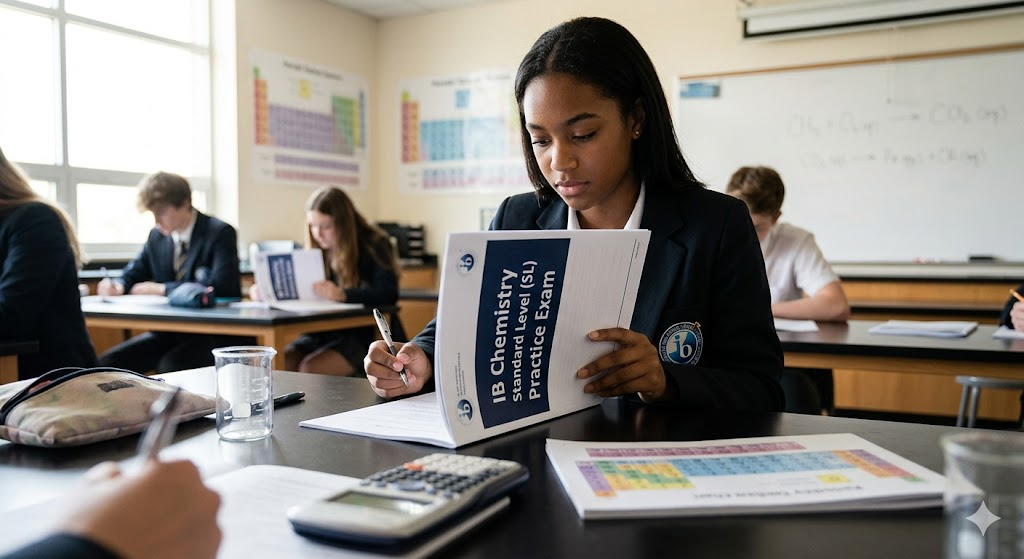
Additional Information
What the Course Entails and Exam Details
The IB Chemistry SL curriculum consists of the same core syllabus as Higher Level (HL) but requires fewer hours and less depth in certain complex topics. Students must cover essential chemical principles including Stoichiometric Relationships, Atomic Structure, Periodicity, Chemical Bonding, and Structure. Further topics include Energetics/Thermochemistry, Chemical Kinetics, Equilibrium, Acids and Bases, Redox Processes, Organic Chemistry, and Measurement and Data Processing. The depth of understanding required is demanding, encouraging students to analyze scientific information critically. A unique aspect is the mandatory group 4 project, which provides an opportunity for collaborative, interdisciplinary scientific investigation.
What to Expect in the Final Exam
The full assessment of IB Chemistry SL is comprised of two external written examinations and an internal assessment (IA). Paper 1 consists of 30 multiple-choice questions designed to test knowledge and understanding of the core material only, to be completed in 45 minutes without the use of a calculator. Paper 2 is a 75-minute examination that includes both short-answer and extended-response questions, allowing students to demonstrate deeper comprehension. In this paper, students are required to use a scientific calculator and the official IB Chemistry Data Booklet. In addition to these papers, the 10-hour Internal Assessment, which involves independent laboratory work or a data-based investigation, contributes significantly to the final grade.
How to Study and Exam Centers
Effective preparation for this challenging exam requires a strategic approach. Utilizing an IB Chemistry Standard Level (SL) Practice Exam is highly recommended as a primary tool to gauge readiness and identify knowledge gaps. When using practice papers, try to simulate real exam conditions and time yourself strictly. Beyond mock testing, consistent revision of class notes, textbooks, and online resources is essential. Focus heavily on understanding fundamental concepts and mastering problem-solving techniques. Regarding exam logistics, students do not take IB exams at public testing centers such as Pearson VUE. Instead, all IB DP examinations are administered internally at authorized IB World Schools where the student is enrolled in the program.
Job Opportunities from the Course
While an IB Chemistry SL qualification does not directly lead to immediate professional placement, it is a vital prerequisite for many prestigious university degrees. A solid foundation in IB Chemistry SL unlocks numerous high-value career paths following further specialized study in higher education. Potential career opportunities that rely heavily on a strong grounding in chemistry include:
Chemical Engineer
Pharmacist
Medical Doctor
Environmental Scientist
Toxicologist
Forensic Scientist
Biochemist
Materials Scientist
Pharmaceutical Sales Representative
Frequently Asked Questions
Reviews
5.0
Based on 0 reviews
Leave a Review
No reviews yet. Be the first to review!