
IB Design Technology Practice Exam
$69.00
- Buy to unlock unlimited access to all Quiz questions and Answers in this Quiz.
- After purchase you can print a PDF of the whole quiz at any point. The PDF will contain the questions and the correct answers.
About this Exam
The International Baccalaureate (IB) Design Technology Diploma Programme (DP) course is a rigorous, practical subject within the Group 4 Sciences. It is uniquely designed for students in the final two years of high school who have a passion for inquiry, creativity, problem-solving, and real-world application. The course moves beyond traditional theoretical studies, challenging students to become critical thinkers and innovators. Students delve into the entire DP design cycle – a structured methodology that involves identifying problems, developing and modelling feasible solutions, and testing/evaluating their outcomes. This comprehensive approach builds a strong foundation in both the practical application of technical knowledge and the strategic, creative thinking crucial in modern industry. Utilizing a practice exam is an essential part of preparing for the actual IB assessments, allowing students to test their understanding and refine their skills in a low-stakes environment.
Ready to test your knowledge?
Buy Now to Access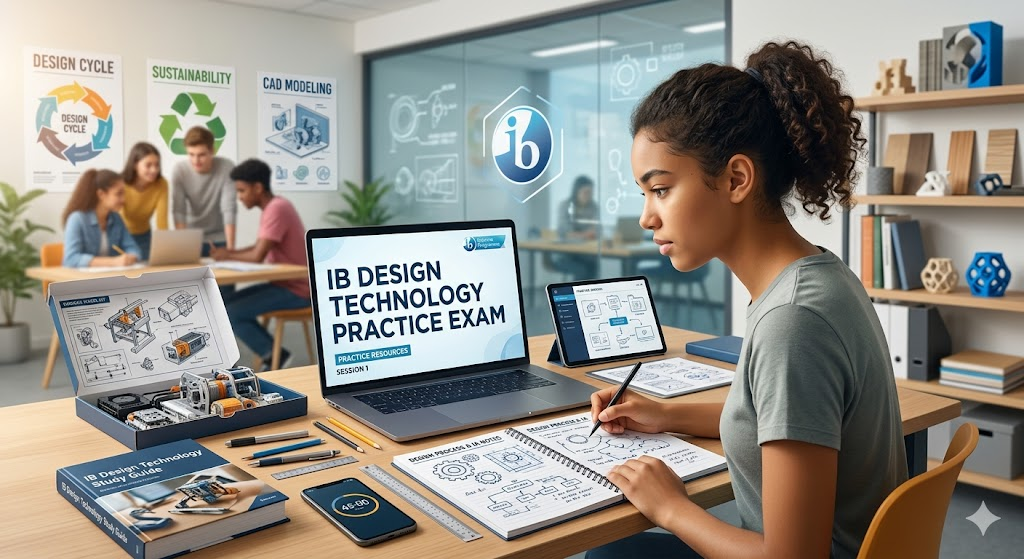
Additional Information
What the Course Entails and Exam Details
This dynamic course is offered at both Standard Level (SL) and Higher Level (HL). At its core, the IB Design Technology syllabus covers fundamental principles of human factors, sustainability, and industrial processes. The curriculum explores various material types (raw to final product) and delves into innovation and classic design. Higher Level students explore these concepts in greater depth and are introduced to additional complex topics including user-centred design (UCD), sustainability on a larger scale, the dynamics of innovation and markets, and commercial production.
Success in IB Design Technology is not determined by a single exam. Instead, students are assessed through a balanced combination of external exams and internal coursework (the Internal Assessment, or IA). The core of the IA is a design project where students demonstrate the practical application of their learned knowledge through inquiry and a thorough design process. The external assessments comprise multiple examination papers which the practice exam is designed to simulate. The practice exam aims to mimic the structure, question types, and time constraints of these high-stakes final papers, enabling students to evaluate their preparedness and gain valuable exam experience.
What to Expect in the Final Exam
The actual IB Design Technology external assessment consists of distinct components that test different skills and levels of understanding. Here is what you can expect in the final papers:
Paper 1 (Multiple Choice): This paper assesses your ability to recall and understand key core concepts and principles from across the syllabus. Time limits are tight, and multiple-choice questions can be challenging, requiring precise knowledge.
Paper 2 (Core Paper): This section consists of short-response and extended-answer questions. These questions require a deeper level of understanding, the ability to apply learned theory to specific contexts or scenarios, and skill in articulating design reasoning clearly. It is based on the common core material for both SL and HL.
Paper 3 (Higher Level Only): HL students must complete an additional paper. Paper 3 contains structured questions based specifically on the HL extension material. It typically includes one question based on a significant case study, testing your ability to analyze complex real-world situations through the lens of design thinking.
Final Grade Composition: The final IB grade for Design Technology is a composite score. The external papers (Papers 1, 2, and 3 for HL) generally contribute a substantial percentage, while the Internal Assessment (design project) makes up a significant remaining portion. The exact weightings can vary slightly between SL and HL and may be updated periodically by the IB, so always consult the latest subject guidelines. The practice exam helps you understand the required style of answer, the time pressure of each paper type, and provides an illustrative score, but it is not the official exam or certification itself.
How to Study and Exam Centers
Effective preparation for both the actual exam and the practice assessment involves several key strategies:
How to Study
Master the Design Cycle: The design cycle is central to the course. Make sure you can explain every stage and understand how knowledge is applied throughout the process.
Create Visual Revision Aids: Use visual tools like mind maps, sketches, flowcharts, and diagrams to help you connect complex concepts and think visually – just like a designer.
Practice, Practice, Practice with Past Papers: Utilizing past official IB exam papers is one of the most effective study methods. Complete these papers under timed conditions to simulate the pressure and gain familiarity with the structure and types of questions. This is also the primary way you should use your practice exam materials!
Focus on Application: The IB rewards the ability to apply theory. When studying concepts, constantly ask yourself, "How could this principle be applied in a real-world design solution?"
Reflect on Mistakes: After completing practice questions or papers, don't just check the answers. Carefully review any errors, understand the reasoning behind the correct response, and reinforce those areas.
Exam Centers and Access
Actual IB Exams: The final, official IB assessments are administered solely through authorised IB World Schools. Students enrolled in the DP program will take their exams at their respective schools or at locations designated by their IB coordinator. You cannot register individually for the official IB DP exams at external testing centres like Pearson VUE.
Practice Exams and Resources: Practice exams and associated revision materials are widely available through a variety of educational platforms, online tutoring services, school resources, and dedicated IB revision websites. While these are invaluable for preparation, they are unofficial resources. Your actual IB coordinator or Design Technology teacher will have access to official past papers and may provide school-specific practice opportunities, but you should also explore reputable third-party revision guides to supplement your studies. Be sure to check the credibility of the sources and look for resources that are updated for the latest syllabus version. Access to these practice resources is usually through online portals, downloads, or sometimes physical textbooks.
Job Opportunities from the Course
A strong performance in IB Design Technology, combined with the skills and mindset it cultivates, opens doors to a wide array of engaging and well-paying career paths. This course is an excellent foundation for further study and professional roles in fields that value creative problem-solving, technological application, and user-centered design:
Engineering Fields: Mechanical, Civil, Electrical, Software, Aerospace, and Automotive Engineering (utilizing the design cycle, prototyping, CAD modeling, and technical knowledge).
Architecture & Urban Planning: Designing structures, environments, and infrastructure with considerations for functionality, aesthetics, and sustainability.
Industrial & Product Design: Creating and refining physical products, from electronics to household goods, focusing on usability, manufacture, and market needs.
User Experience (UX) & Interface (UI) Design: Designing the digital interactions and interfaces for software, apps, and websites, applying user-centered research and evaluation.
Manufacturing & Commercial Production: Managing and optimising production lines, quality control, and the scaling of designs for commercial markets.
Environmental & Sustainable Design Consultancies: Developing solutions and advising on sustainable practices, material selection, and energy-efficient design.
Medical Technology & Healthcare Design: Designing innovative medical devices, assistive technologies, and ergonomic tools for healthcare settings.
Technology & Innovation Management: Leading teams and projects focused on technological development and market innovation.
Pattern Cutting & Fashion Technology: Creating precise patterns and utilizing technology in the design and production of clothing and textiles.
Education & Curriculum Development: Shaping the future of design and technology education as a teacher, curriculum designer, or trainer.
Entrepreneurship: Starting ventures that offer unique design solutions, new products, or innovative technology.
We hope this study guide provides you with a clear roadmap and valuable insights for your IB Design Technology Practice Exam and ultimately, the final IB assessment. Remember, consistent practice, deep understanding, and effective application are the keys to success in this exciting and rewarding course. Best of luck on your journey to becoming a creative, innovative design technology expert!
Frequently Asked Questions
Reviews
5.0
Based on 0 reviews
Leave a Review
No reviews yet. Be the first to review!