
IB International Economics Higher Level (HL) Practice Exam
$69.00
- Buy to unlock unlimited access to all Quiz questions and Answers in this Quiz.
- After purchase you can print a PDF of the whole quiz at any point. The PDF will contain the questions and the correct answers.
About this Exam
The International Baccalaureate (IB) Economics Higher Level (HL) certification is a globally recognized and rigorous academic credential.
It is designed for ambitious high school students enrolled in the IB Diploma Programme who want to master the complex dynamics of the global economy.
This specific practice exam guide targets the International Economics module, an incredibly vital component of the HL syllabus.
By taking this course and passing the exam, students prove their ability to analyze real-world economic issues, evaluate global trade policies, and understand complex financial systems.
It is the perfect stepping stone for future leaders, policymakers, and financial experts who wish to pursue higher education in economics, business, or international relations at top-tier universities.
Ready to test your knowledge?
Buy Now to Access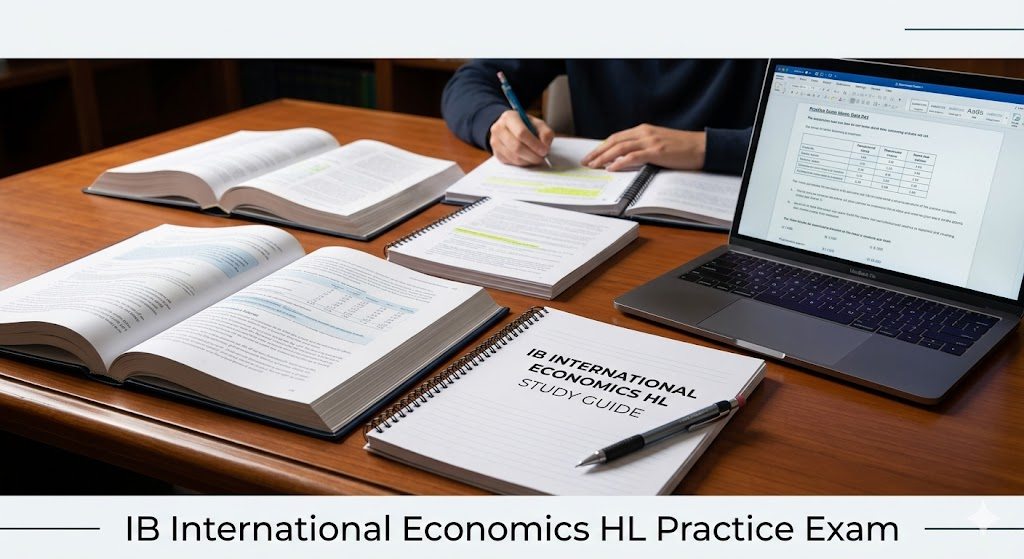
Additional Information
What the Course Entails and Exam Details
The IB Economics HL course provides a deep dive into how resources are allocated on both a micro and macro scale, but the International Economics component is where global perspectives truly shine.
Students will explore the fundamental reasons why countries trade and the benefits of global economic integration.
The syllabus heavily features topics such as free trade, protectionism, trade barriers, and exchange rates.
You will also evaluate the balance of payments, economic integration, and the terms of trade, which are exclusive and crucial topics for Higher Level candidates.
Beyond simply memorizing theories, the course entails developing a sharp analytical mindset to interpret economic data and apply models to real-world scenarios.
What to Expect in the Final Exam
The final assessment for IB Economics HL is comprehensive and split into three distinct papers.
Paper 1 consists of extended response questions where you must rely on your theoretical knowledge and real-world examples to build strong essays. It lasts for 1 hour and 15 minutes.
Paper 2 is a data response paper that lasts for 1 hour and 45 minutes, requiring you to interpret economic data, articles, and charts relating to international and development economics.
Paper 3 is exclusive to HL students and is a policy paper that heavily tests quantitative skills and mathematical economic applications over 1 hour and 45 minutes.
The IB grading system runs on a scale of 1 to 7, with a 4 generally considered a passing grade, though top-tier universities often look for a 6 or 7.
Strict exam rules apply, including the mandatory use of clear, labeled economic diagrams and the restriction of calculators only to Papers 2 and 3.
How to Study and Exam Centers
Mastering this subject requires a strategic blend of theory memorization and practical application.
You should consistently practice drawing and labeling economic diagrams until they become second nature, as these are critical for earning top marks.
Utilizing past papers is one of the most effective study methods; it familiarizes you with the phrasing of the questions and the strict timing required.
Build a "real-world example" portfolio throughout the year, collecting news articles about international trade disputes, currency fluctuations, and tariffs to use in your essays.
The official IB exams are strictly administered and cannot be taken independently online or at general testing centers like Pearson VUE.
Instead, you must be enrolled in an authorized IB World School, and the final exams are conducted physically in supervised classrooms or gymnasiums at your specific educational institution.
Job Opportunities from the Course
Successfully completing this rigorous course opens the door to a wealth of lucrative and impactful career paths.
While it is primarily a foundation for university degrees, the skills learned directly map to several high-level professions.
You can pursue a career as an International Economist, analyzing global market trends and advising governments on trade agreements.
It paves the way to becoming a Financial Analyst, where you will evaluate investment opportunities based on macroeconomic data and exchange rate fluctuations.
Many graduates go on to become Investment Bankers, specializing in global mergers and international capital markets.
You might also consider becoming an International Trade Specialist or a Foreign Policy Advisor, helping corporations or state departments navigate complex geopolitical and economic landscapes.
Finally, the strong quantitative and analytical skills make you a prime candidate for roles as a Management Consultant, solving high-level strategic problems for multinational companies.
Frequently Asked Questions
Reviews
5.0
Based on 0 reviews
Leave a Review
No reviews yet. Be the first to review!