
IBM Introduction to Hardware & Operating Systems Practice Test
$69.00
- Buy to unlock unlimited access to all Quiz questions and Answers in this Quiz.
- After purchase you can print a PDF of the whole quiz at any point. The PDF will contain the questions and the correct answers.
About this Exam
Embarking on a career in information technology begins with a strong foundation.
The IBM Introduction to Hardware & Operating Systems course, and its associated practice test, are designed specifically for individuals looking to gain fundamental knowledge in computing.
This includes entry-level IT professionals, career-switchers, and anyone with a curious mind about the core components that make modern technology work.
The exam validates understanding of both the physical components of a computer and the essential software that manages them.
This practice test serves as a crucial self-assessment tool.
It allows you to gauge your readiness before attempting the official certification.
Ready to test your knowledge?
Buy Now to Access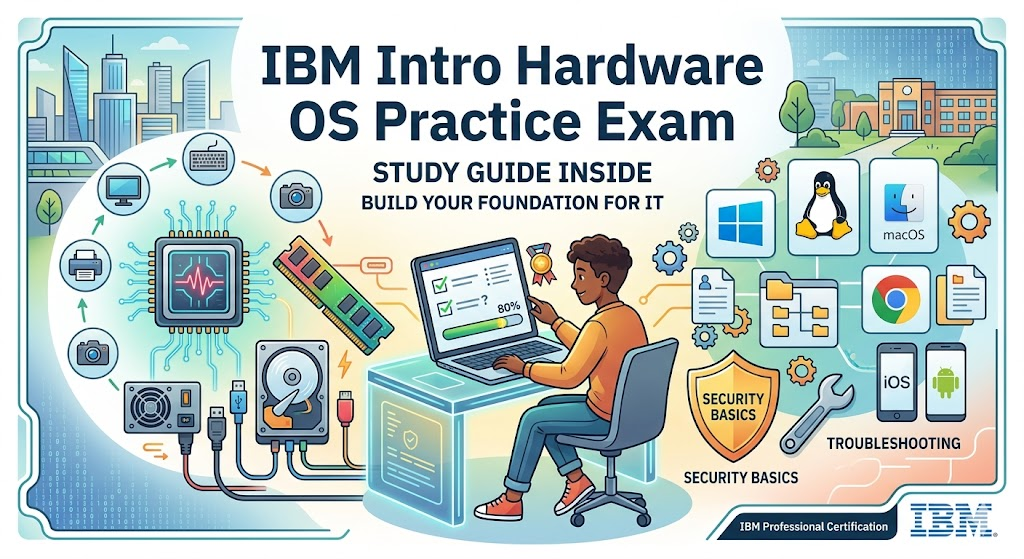
Additional Information
What the Course Entails and Exam Details
This foundational course covers a wide spectrum of essential topics.
You will explore the intricate world of computer hardware, including core components like the Central Processing Unit (CPU), various types of memory (RAM), and storage devices.
You will also understand the crucial role of the motherboard and the various ports and cables that connect different peripheral devices.
The operating systems section delves into the fundamental principles that govern system software.
Key concepts include the purpose and functions of an operating system, the differences between popular platforms like Windows, Linux, macOS, and mobile operating systems.
The course also covers essential aspects of file management, security basics, and foundational troubleshooting techniques for both hardware and system-level issues.
The official exam is designed to comprehensively test this breadth of knowledge.
The specific practice test you are preparing for aims to simulate these exact knowledge areas.
What to Expect in the Final Exam
While the final details of any specific IBM exam can be subject to change, typical foundational exams, and this practice equivalent, adhere to a structured format.
You can anticipate the exam to consist entirely of multiple-choice questions (MCQs).
These questions may test your knowledge through a variety of question styles, including single-answer selection, multiple-answer selection, and scenarios requiring you to identify a correct component or process.
There is a defined time limit for the official exam, which often ranges from 60 to 90 minutes.
A passing score is typically required, often set between 70% and 80%, to demonstrate mastery of the foundational content.
Rules for the actual exam are strict: it is generally closed-book, with no external assistance allowed.
The practice test is designed to mirror this environment, helping you build both knowledge and test-taking speed and confidence.
Remember, the goal of the practice test is to identify weak areas so you can improve before the real challenge.
How to Study and Exam Centers
Effective study begins with a structured approach.
First, thoroughly review all materials provided in the official IBM Introduction to Hardware & Operating Systems course.
Take diligent notes on key terms, definitions, and processes.
Actively participate in any hands-on labs or exercises, as practical application solidifies understanding.
Utilize the practice test repeatedly; not only to check your score but to understand why certain answers are correct and others are not.
Focus your subsequent study time heavily on the topics where you struggled.
Once you feel confident in your mastery, you can register for the official IBM certification exam.
IBM typically delivers its certification exams through established online testing platforms and physical testing centers.
This often includes partnerships with proctoring services like Pearson VUE and IBM’s own professional certification portals.
When registering, you will have the option to take the exam remotely through an online proctored system (like OnVUE) from the comfort of your home, or to visit an authorized Pearson VUE physical testing center, which can be located at specific schools, colleges, or dedicated professional testing facilities.
Ensure you understand the specific requirements for your chosen method, such as a stable internet connection and a clear testing environment for the online option.
Job Opportunities from the Course
A strong understanding of hardware and operating system fundamentals is the first stepping stone to a diverse range of entry-level IT roles.
Successful completion of this course and the official certification can open doors to positions including:
IT Support Specialist
Desktop Support Technician
Help Desk Analyst
Technical Support Representative
Jr. Systems Administrator
Field Service Technician
Customer Support Engineer
These roles are vital across every industry, offering opportunities in large corporations, small businesses, schools, and government organizations.
With a solid grasp of these foundations, you can build your career in various directions, specializing in network administration, system security, or cloud computing.
Good luck with your studies and your journey into the dynamic world of information technology!
Frequently Asked Questions
Reviews
5.0
Based on 0 reviews
Leave a Review
No reviews yet. Be the first to review!