
IBOLC Comprehensive Practice Exam
$69.00
- Buy to unlock unlimited access to all Quiz questions and Answers in this Quiz.
- After purchase you can print a PDF of the whole quiz at any point. The PDF will contain the questions and the correct answers.
About this Exam
The Infantry Basic Officer Leader Course (IBOLC) is a grueling, 19-week foundational training program for newly commissioned Second Lieutenants in the United States Army. Located at Fort Moore, Georgia (formerly Fort Benning), it is designed to forge these new officers into competent, tactical, and physically fit Infantry platoon leaders. This course is the essential first step for any officer aiming to lead American Soldiers in combat, placing a heavy emphasis on leadership, combat skills, and the "Warrior Ethos." The subsequent comprehensive final exam is the ultimate academic hurdle that validates a student's mastery of the intensive curriculum, ensuring they are prepared for the immense responsibilities that await them in the operational force.
Ready to test your knowledge?
Buy Now to Access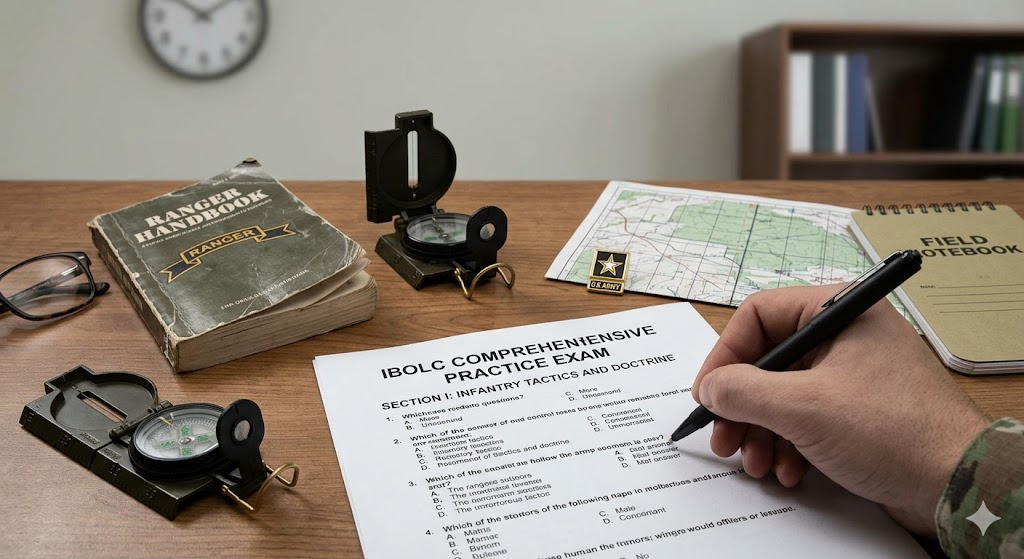
Additional Information
What the Course Entails and Exam Details
IBOLC is not just a classroom-based course; it is an immersive, multi-phased experience, with roughly 15 of its 19 weeks spent enduring rigorous field training. Students undergo a transformation that covers a vast spectrum of infantry operations and leadership principles. Key components of the syllabus and topics evaluated on the comprehensive exam include:
Infantry Tactics and Doctrine: In-depth study and practical application of offensive and defensive operations, stability operations, and the forms of maneuver.
Troop Leading Procedures (TLPs): A rigid and essential eight-step process for planning and executing military missions at the company level and below.
Operation Orders (OPORDs): The format, composition, and effective issuance of mission orders.
Weapons Systems: Mastery of key infantry weapons, including the M4 carbine, M249 squad automatic weapon, M240B machine gun, M2.50 caliber machine gun, and various anti-armor systems. Students must know their capabilities, ranges, and employment.
Navigation and Fieldcraft: Expert proficiency in day and night land navigation, as well as essential field survival and camouflage techniques.
Urban Operations: The unique challenges of planning and conducting operations in a modern urban environment.
Ranger Handbook: Significant portions of the final exam are often derived from the tactics, techniques, and procedures detailed within this foundational text.
What to Expect in the Final Exam
The final IBOLC comprehensive exam is designed to be a comprehensive test of all cognitive learning objectives covered throughout the 19-week course. It is not a test of memory alone, but of tactical scenario-based reasoning and doctrinal application. Students can expect a multi-format written test, likely including multiple-choice, true/false, matching, and short-answer questions. This rigorous assessment will present complex, multi-layered scenarios that require the student to apply the full range of tactics, TLPs, and weapon capabilities they have learned to achieve mission success and ensure the safety of their hypothetical platoon.
There are typically strict time limits for completing the exam, mimicking the time-constrained environment of operational planning. A specific passing score is set by the course cadre and must be achieved for graduation. Failure to meet this standard may result in the student being recycled into a later class to retake the material, or potentially being considered for re-branching. The final exam is a critical gate to proving one’s readiness for the next challenge, often including attendance at the renowned U.S. Army Ranger School.
How to Study and Exam Centers
Preparation for the final IBOLC comprehensive exam is a continuous process that should begin on day one of the course. Effective study strategies involve a blend of individual diligence and group study:
Master the Ranger Handbook: Treat this as your primary textbook. Create flashcards for definitions, TLP steps, and key doctrine numbers.
Develop Personal SOPs: Craft personal standard operating procedures for various aspects of TLPs and operations, based on course instruction. This process reinforces learning.
Participate in Study Groups: Reviewing OPORDs, walking through tactical scenarios, and quizzing each other on weapons capabilities is highly effective.
Practice Scenario-Based Thinking: When given any tactical problem in the field or classroom, walk through it intellectually, considering all METT-TC (Mission, Enemy, Terrain, Troops, Time, and Civil Considerations) factors.
Exam Centers: It is crucial to understand that the IBOLC comprehensive exam is an internal U.S. Army assessment. It is administered exclusively by the course cadre within the secure, controlled environment of the 197th Infantry Brigade at Fort Moore, Georgia. It is not an exam that can be taken at a commercial testing center like Pearson VUE or an online portal. Successful completion is a prerequisite for graduating from the course.
Job Opportunities from the Course
Graduation from IBOLC is the definitive entry point for a career as a commissioned Infantry officer. Successful completion, coupled with a passing score on the final comprehensive exam, unlocks a clear upward path within the U.S. Army:
Infantry Platoon Leader (Second Lieutenant/First Lieutenant): This is the direct and most immediate job opportunity, where a new officer assumes command of an Infantry platoon, typically consisting of approximately 40 Soldiers.
Ranger School Candidate: A primary and highly desired path for IBOLC graduates is immediate attendance at the U.S. Army Ranger School, which further enhances leadership and tactical proficiency.
Special Operations Candidate: Graduates often pursue careers within the Army’s Special Operations forces, including Special Forces (Green Berets) and the 75th Ranger Regiment.
Company Commander (Captain): After gaining experience as a platoon leader and attending the Captain's Career Course, officers move into command of an Infantry company.
Staff Officer: Serving in critical planning and support roles at the battalion, brigade, and higher command levels.
Future Military Leaders: The leadership and tactical foundation built in IBOLC serves as the baseline for all subsequent career progression, from battalion command to potential general officer ranks.
Frequently Asked Questions
Reviews
5.0
Based on 0 reviews
Leave a Review
No reviews yet. Be the first to review!