
ICBC Heavy Trailer Endorsement (Code 20) Practice Test
$69.00
- Buy to unlock unlimited access to all Quiz questions and Answers in this Quiz.
- After purchase you can print a PDF of the whole quiz at any point. The PDF will contain the questions and the correct answers.
About this Exam
The ICBC Heavy Trailer Endorsement (Code 20) is an essential qualification for drivers in British Columbia who need to tow trailers that exceed a specific weight but do not require a full commercial license.
This endorsement allows holders of a valid Class 4 or 5 license to tow a recreational trailer with a gross vehicle weight (GVW) over 4,600 kg, provided neither the truck nor the trailer is equipped with air brakes. For non-recreational (commercial) trailers in this weight range without air brakes, you typically need to look towards upgrading to a higher license class like Class 3. The Code 20 is particularly designed for individuals who own larger recreational vehicles, substantial boat trailers, or fifth-wheel setups for personal or family travel, allowing them to legally and safely operate these significant combinations.
This comprehensive study guide is your ultimate resource, linking directly to the concept of practice tests to empower you with the knowledge and confidence to ace your endorsement exam. Embark on this journey to ensure your personal towing adventures are both compliant and, most importantly, safe for everyone on the road.
Ready to test your knowledge?
Buy Now to Access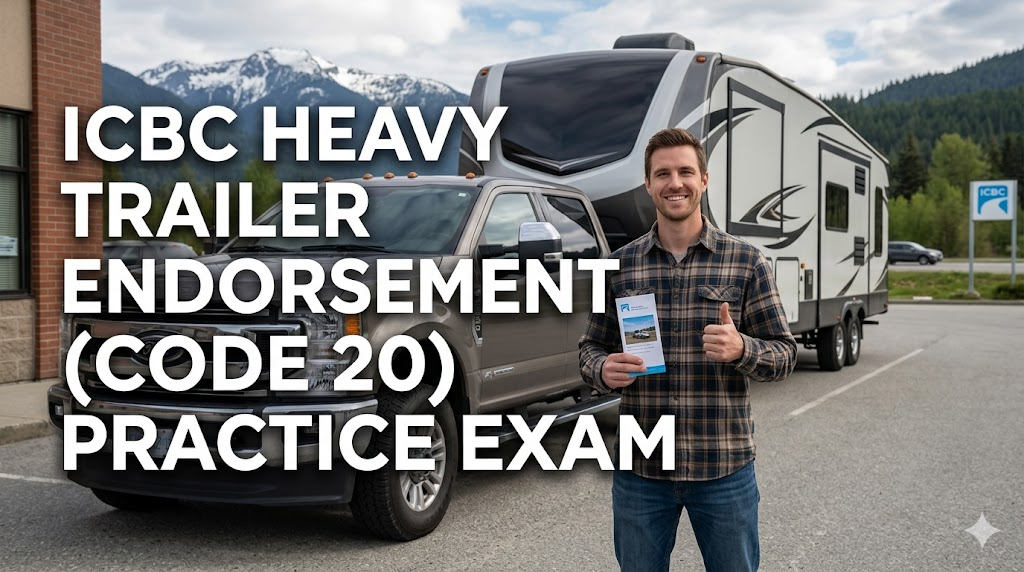
Additional Information
What the Course Entails and Exam Details
While not always structured as a mandatory single course, the pathway to obtaining your Code 20 involves mastering specific knowledge and practical skills related to towing heavy trailers safely.
The process primarily consists of two distinct parts: a comprehensive knowledge test and a practical road test. To prepare, you must become thoroughly familiar with essential areas, including:
Towing Safety and Dynamics: Understanding the unique challenges and handling characteristics of driving with a heavy trailer, such as increased braking distances, wider turns, and susceptibility to sway.
Pre-Trip Inspections (Theory): Mastering the correct procedures for a detailed theoretical pre-trip check, focusing on both your towing vehicle and the specific components of the heavy trailer. This involves understanding how to inspect coupling devices (hitches, fifth wheels, safety chains), electrical connections, lighting systems, tires, brakes, and load securement.
BC Driving Rules for Towing: Reviewing and reinforcing your understanding of British Columbia’s relevant driving laws and regulations as they apply specifically to operating larger combinations of vehicles. This includes speed limits, following distances, maneuvering through various traffic situations, and understanding weight restrictions.
Candidates are typically required to study the official ICBC "Driving Commercial Vehicles" guide, which is the foundational resource for the Class 3 knowledge test needed for this endorsement. The knowledge test ensures you have the necessary theoretical foundation, while the practical road test will assess your ability to apply this knowledge and demonstrate hands-on skill in pre-trip inspections, maneuvers, and safe towing on the road.
What to Expect in the Final Exam
The culmination of your preparation is the official ICBC examination process, designed to rigorously test both your understanding and practical execution. You must be prepared for two critical assessments:
Knowledge Test:
Format: This is a multiple-choice exam, typically administered on a computer or tablet at an official ICBC driver licensing office. Appointments are required.
Questions: You can expect a certain number of questions (e.g., around 30-50, derived from the Class 3 knowledge areas).
Passing Score: To pass, you will need to achieve a high score (usually 80% or higher). Thorough preparation is crucial.
Time Limit: A specific time limit is typically allocated for the knowledge test, encouraging efficient answering.
Road Test:
Format: This is a comprehensive practical examination where an ICBC driver examiner observes you while you drive and maneuver a properly equipped truck and heavy trailer combination on actual roads and in a designated maneuvers area.
Duration: The road test typically lasts around one to two hours, giving the examiner ample time to thoroughly evaluate your competence.
Components: You must successfully demonstrate proficiency in several key areas:
Detailed Pre-Trip Inspection (Practical): You will need to physically and verbally demonstrate a thorough and correct pre-trip check of your truck/trailer combination. This involves physically inspecting and explaining the status of crucial safety components like coupling mechanisms, lighting, tires, brakes, and security. Prepare to follow the examiner’s requests for checking specific exterior and interior components for both units.
Backing Maneuvers: You will be required to execute one or more distinct backing maneuvers, demonstrating precise control and use of mirrors.
On-Road Driving: You will drive your combination on public roads, navigating diverse traffic situations, executing smooth turns, merging safely, and maintaining appropriate speed and positioning.
Coupling/Uncoupling (Potential): Be fully prepared for the possibility of safely demonstrating standard coupling and uncoupling procedures for your truck and trailer, as some examiners may request it. Many training courses cover this comprehensively.
For both portions, it's crucial to be on time, bring your required identification, and for the road test, ensure you bring a safe, roadworthy, properly insured truck and trailer combination that meets all Code 20 requirements.
How to Study and Exam Centers
Preparation is the absolute key to success on both the knowledge and road tests. Implement these actionable strategies:
Study Official ICBC Materials: Immerse yourself in the official "Driving Commercial Vehicles" guide. This is your primary source for Class 3 knowledge, crucial for passing the knowledge test and understanding towing-specific concepts for the practical.
Utilize Practice Tests: Capitalize on the power of practice exams, both official ICBC options (where available for Class 3 knowledge) and reputable third-party sources. Consistently taking mock knowledge tests helps you:
Familiarize yourself with the multiple-choice format and question style.
Identify specific areas where you need to improve your knowledge.
Build confidence and manage test anxiety by simulating the actual exam experience.
Hands-on Practice: There’s no substitute for practical experience. Dedicate significant time to practicing driving and maneuvering your truck and heavy trailer combination. Focus heavily on:
Perfecting your theoretical and practical pre-trip inspection routine, verbally stating each check as you do it.
Mastering smooth backing maneuvers, especially using your mirrors effectively.
Consistently practicing safe towing habits on the road, paying close attention to following distance, turn radii, and braking.
Professional Training: Consider enrolling in specialized one-on-one driver training from a reputable professional driving school that offers instruction for heavy trailer endorsements. Instructors can provide structured, hands-on guidance, focused practice, detailed pre-trip check training, and valuable feedback.
Mental Preparation: On exam days, ensure you are well-rested, eat a proper meal, and arrive early with all required documents. Stay calm and listen attentively.
Exam Centers:
Knowledge Test: Appointments are mandatory for taking the Class 3 knowledge test at an ICBC driver licensing office. You can book these appointments online or by phone.
Road Test: To schedule your practical road test, you must generally call the ICBC driver licensing information line in advance to book at specific ICBC locations that offer testing for heavy trailer endorsements. It is your responsibility to:
Confirm your road test location and that they can test your combination.
Bring your properly equipped, roadworthy, fully insured truck and trailer combination with current registration for both units on the day of the test.
Ensure your vehicle combination meets all BC requirements for safe towing and that neither unit has air brakes.
Bring two forms of valid, accepted government-issued ID.
Pay the required ICBC road test fee.
Job Opportunities from the Course
While the Code 20 is primarily aimed at personal recreation, obtaining this endorsement opens up opportunities to use your skills in various personal and potentially certain specialized career paths. Here is a clear list of potential opportunities and descriptions:
Personal Recreational Travel: Legally and safely tow large recreational trailers (RVs, 5th wheels) across British Columbia and beyond, expanding your potential for vacations and diverse hobbies.
Boating Logistics: Confidently transport large, significant boats to waterways and boat ramps, enabling larger vessel ownership and enjoyable boating experiences.
Vehicle & Equipment Transport: Use large, non-commercial flatbed or enclosed trailers to transport classic cars, race cars, off-road vehicles, motorcycles, or extensive sports and hobby equipment securely.
Small Business Support (Towing-Related): Support specific non-commercial business activities like property maintenance (towing larger lawn care trailers), construction staging (moving non-commercial utility trailers with materials or small equipment), or special event setup (towing trailers for equipment, food service, or general supplies, provided the trailer and vehicle combination meet Code 20 non-commercial criteria).
Specialized Logistics Operator (e.g., Non-CDL Delivery): Explore roles that might require towing larger non-commercial trailers, such as specific delivery services for large personal items (e.g., furniture, appliances using large cargo trailers with a non-commercial setup), provided the combination meets non-air brake and weight limits and doesn’t require a commercial-class license.
Agricultural Support (Specific Tasks): Assist on farms or large properties with non-commercial towing duties, such as transporting substantial loads of hay, farm supplies, or larger livestock in appropriate non-commercial-grade trailers that still require Code 20 endorsement due to weight.
By securing your ICBC Heavy Trailer Endorsement (Code 20), you not only ensure legal compliance and significant safety knowledge for your own towing ventures but also position yourself for these and other similar opportunities. Embark on this critical learning experience, utilize comprehensive practice tests, and invest in thorough preparation to unlock a world of expanded possibilities and confident, compliant heavy trailer operation on British Columbia's roads.
Frequently Asked Questions
Reviews
5.0
Based on 0 reviews
Leave a Review
No reviews yet. Be the first to review!