
ICC General Requirements Practice Exam
$69.00
- Buy to unlock unlimited access to all Quiz questions and Answers in this Quiz.
- After purchase you can print a PDF of the whole quiz at any point. The PDF will contain the questions and the correct answers.
About this Exam
The International Code Council (ICC) General Requirements component is a cornerstone for professionals pursuing certification in building inspection, plans examination, and code enforcement. This exam is designed to validate a candidate's fundamental knowledge of the administrative provisions, legal aspects, and basic sciences that underpin all International Codes (I-Codes). Whether you are an aspiring building inspector, a contractor looking to master code administration, or a design professional, this certification is a critical step in demonstrating your expertise. Passing this exam proves you understand not just what the codes are, but how they are legally applied and enforced within a jurisdiction.
Ready to test your knowledge?
Buy Now to Access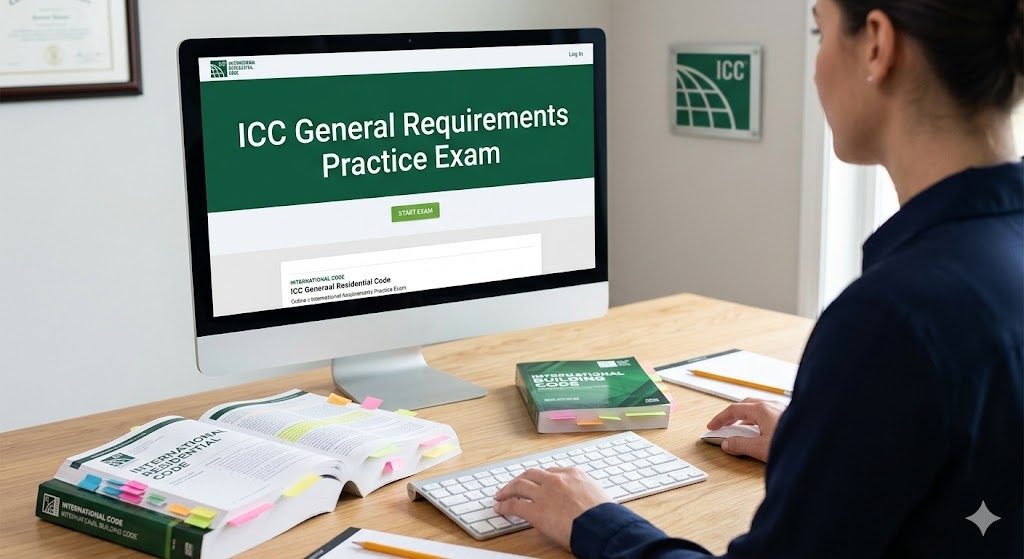
Additional Information
What the Course Entails and Exam Details
This comprehensive guide prepares candidates for the administrative and scientific fundamentals common across ICC technical exams. The study curriculum focuses on the essential principles that govern the built environment and the bureaucratic processes required to manage it.
Key topics covered include:
Code Administration: Understanding the intent and scope of the I-Codes, the duties and powers of the building official, and the permit application process.
Legal Aspects: Navigating the legal chain of authority, right of entry, liability issues, and the appeals process.
Inspections and Enforcement: Mastering the required inspection sequence, stop work orders, and violation notices.
Construction Documents: Interpreting building plans, specifications, and site plans for code compliance.
Basic Sciences and Mathematics: Applying fundamental algebraic and geometric calculations necessary for determining areas, volumes, and basic structural loads.
Definitions and Terminology: Grasping the precise legal and technical definitions used throughout the ICC code family.
What to Expect in the Final Exam
The ICC General Requirements exam is a rigorous test of your ability to quickly find, interpret, and apply administrative code provisions. It is typically administered in a computer-based format.
Here is what you can expect on exam day:
Exam Format: The exam consists entirely of multiple-choice questions. You will be given a set of possible answers for each scenario or administrative question.
Open Book: This is an open-book exam. You are permitted to use the specific references listed by the ICC for your exam (often the administrative chapters of the IBC or IRC). However, you are not permitted to use photocopies or sticky notes containing external information.
Time Limit: The exam is strictly timed, typically ranging from 2 to 3 hours depending on the specific exam code. Efficient navigation of your reference material is essential.
Passing Score: ICC uses a scaled scoring system. A scaled score of 75 or higher is required to pass and achieve certification.
How to Study and Exam Centers
Preparation is the absolute key to success in an ICC open-book exam. The test does not just measure what you know; it measures how effectively you can find the correct answer under time pressure.
Actionable Study Strategies:
Master the Index: Spending hours memorizing the code is less effective than mastering the index and table of contents. You must know exactly where to look for "permits," "right of entry," or "duties of the building official."
Practice Under Time Pressure: Use the ICC General Requirements Practice Exam to simulate real testing conditions. This builds your speed in flipping through the code book and locating specific sections.
Highlight and Tab: If permitted by current ICC rules, use approved tabs to mark major chapters and heavily highlighted key sections. This can save critical seconds on every question.
Focus on 'General' Provisions: Unlike trade-specific exams, this test focuses on Chapter 1 of the I-Codes. Focus your studying on the administrative, rather than technical, requirements.
Exam Centers and Scheduling:
ICC exams are administered through approved testing partners. You have two main options for taking your test:
Online Proctored Testing (PRONTO): This option allows you to take your exam from your own computer at home or in the office. You must have a webcam and a private, quiet room. A live proctor will monitor you remotely throughout the session.
Pearson VUE Testing Centers: You can also schedule your exam at a physical Pearson VUE testing location. These professional test centers provide a secure, quiet environment for computer-based testing.
You can schedule your exam directly through your ICC account on the PRONTO portal or by visiting the Pearson VUE website.
Job Opportunities from the Course
Obtaining your ICC certification in General Requirements is a powerful resume-builder that opens doors to stable, respected careers in both the public and private sectors.
Specific job opportunities this certification supports include:
Permit Technician: The first point of contact for the public, responsible for reviewing permit applications for completeness.
Zoning Inspector: Ensuring that land use and structures comply with local zoning ordinances.
Code Enforcement Officer: A public safety position responsible for enforcing non-emergency municipal codes, including housing and property maintenance standards.
Building Inspector (Residential or Commercial): While this is often a prerequisite for trade-specific inspector roles, the general requirements knowledge is foundational for all inspectors.
Jurisdictional Administrator: Overseeing the administrative operations of a building or planning department.
Plans Examiner (Entry Level): Assisting in the administrative review of blueprints and construction documents.
Third-Party Plan Reviewer/Inspector: Working for private firms that contract with jurisdictions to perform code enforcement services.
Frequently Asked Questions
Reviews
5.0
Based on 0 reviews
Leave a Review
No reviews yet. Be the first to review!