
ICC Residential Building Inspector Certification Practice Exam
$69.00
- Buy to unlock unlimited access to all Quiz questions and Answers in this Quiz.
- After purchase you can print a PDF of the whole quiz at any point. The PDF will contain the questions and the correct answers.
About this Exam
The International Code Council (ICC) Residential Building Inspector Certification, often referred to as the B1 Certification, is a prestigious designation for professionals committed to ensuring the safety and structural integrity of one- and two-family dwellings.
This certification validates an individual's comprehensive knowledge of the International Residential Code (IRC) and is the gold standard for jurisdiction-employed inspectors, independent code consultants, and ambitious construction professionals seeking to pivot into regulatory enforcement.
Achieving this certification demonstrates a masterful understanding of fundamental residential construction principles, life safety requirements, and code compliance standards, serving as a critical stepping stone for career advancement in the building safety industry.
Ready to test your knowledge?
Buy Now to Access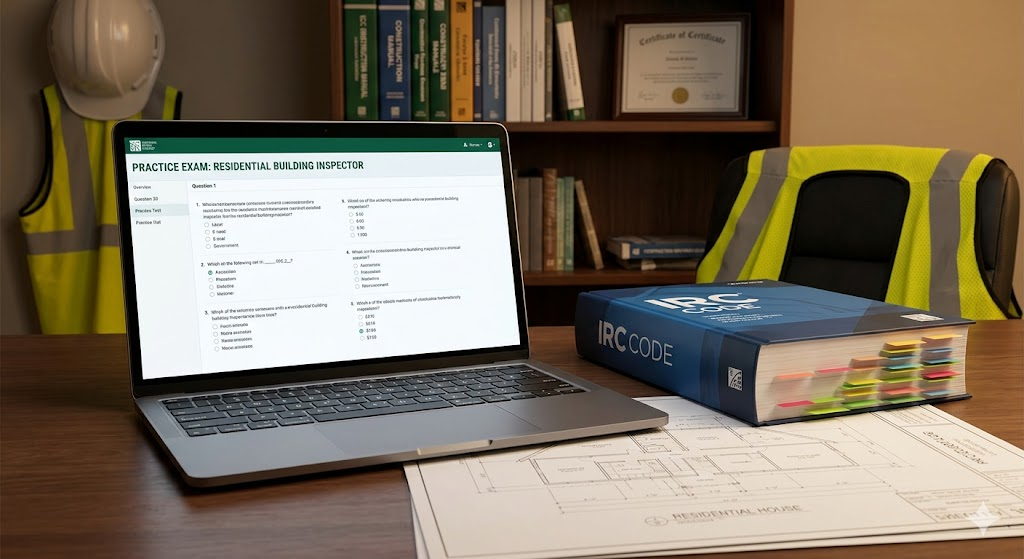
Additional Information
What the Course Entails and Exam Details
This comprehensive study guide and the associated practice exams are meticulously designed to cover the core content areas of the International Residential Code (IRC), which serves as the primary syllabus for the B1 certification.
The primary focus areas include code administration, such as permits, construction documents, and inspection processes. A significant portion of the material delves into legal and safety requirements, including building planning, means of egress, fire-resistant construction, and emergency escape openings.
Additionally, candidates must master structural elements, which include expansive sections on footings and foundations, floor construction, wall construction, and complex roof-ceiling construction designs. Beyond structural concerns, the course covers essential non-structural topics such as interior and exterior finishes, chimney and fireplace requirements, and mechanical, plumbing, and electrical basics required for residential inspector competency.
What to Expect in the Final Exam
The actual ICC Residential Building Inspector Certification exam is a robust, time-limited, and open-book assessment of your knowledge. Candidates should expect a multiple-choice format administered through either high-stakes test centers or online proctoring via the ICC Proctored Remote Online Testing Option (PRONTO).
While specific question counts can update periodically, the exam typically features approximately 60 questions that must be completed within a two-hour time limit. The standard ICC scoring model uses a scaled score range, requiring a minimum scaled score of 75 to pass.
Because this is an open-book exam, questions do not just test rote memorization; they are designed to evaluate a candidate’s proficiency in quickly and accurately locating, interpreting, and applying specific code provisions within the IRC manual.
How to Study and Exam Centers
Preparation for the B1 certification requires a disciplined and highly strategic approach. The most critical step is obtaining the exact edition of the International Residential Code (IRC) specified for your current exam cycle and utilizing a high-quality practice exam platform. Practice exams are invaluable, as they condition you to the time constraints of the real test and teach you essential code-lookup strategies, such as effective tabbing and navigating the IRC index.
Focus heavily on structural requirements and life-safety chapters, as these carry significant weight in the scoring. When you are ready to test, you have flexible options. You can register for an in-person, computer-based testing appointment at an authorized Pearson VUE test center worldwide.
Alternatively, you can utilize the ICC PRONTO online system, which allows you to securely take the exam from your home or office using a webcam and a high-speed internet connection, providing unprecedented convenience for test-takers.
Job Opportunities from the Course
Earning the B1 Residential Building Inspector Certification is a valuable asset that significantly enhances your employability and opens doors to diverse career paths within the construction and regulatory sectors.
This credential is often a prerequisite or a required continuing education milestone for several critical positions. Below is a clear list of specific job titles and career paths this certification unlocks.
Residential Building Inspector
Jurisdictional Code Enforcement Officer
Third-Party/Contract Inspector
Plans Examiner (Residential Focus)
Construction Project Superintendent
Property Development Quality Control Manager
Zoning Inspector
Licensed General Contractor (Verifying Expertise)
Municipal Housing Inspector
Residential Structural Insurance Adjuster
Frequently Asked Questions
Reviews
5.0
Based on 0 reviews
Leave a Review
No reviews yet. Be the first to review!