
ICC Underground Storage Tank (UST) Installation and Retrofitting Certification Practice Exam
$69.00
- Buy to unlock unlimited access to all Quiz questions and Answers in this Quiz.
- After purchase you can print a PDF of the whole quiz at any point. The PDF will contain the questions and the correct answers.
About this Exam
The International Code Council (ICC) Underground Storage Tank (UST) Installation and Retrofitting Certification is a highly respected credential in the environmental safety and petroleum equipment industries.
This certification is specifically designed for contractors, technicians, and environmental compliance professionals who are responsible for installing or modifying underground systems that store hazardous materials and petroleum products.
Earning this credential proves your dedication to environmental protection and your deep understanding of complex regulatory safety codes.
It reassures employers and clients that you possess the technical expertise required to prevent catastrophic leaks, soil contamination, and groundwater pollution.
Ready to test your knowledge?
Buy Now to Access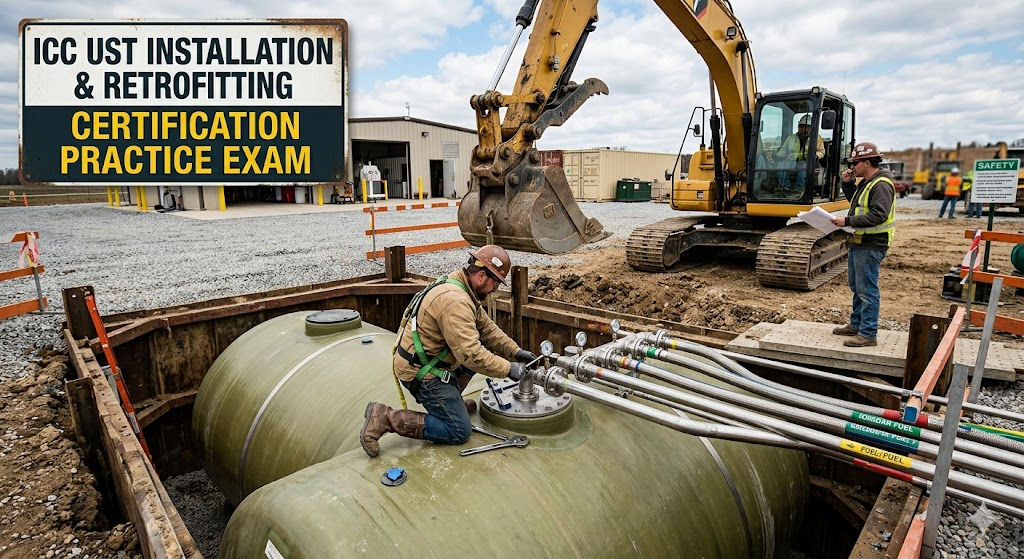
Additional Information
What the Course Entails and Exam Details
Preparing for this exam requires a thorough understanding of industry best practices, federal guidelines, and specific engineering standards.
The core syllabus covers every phase of underground storage tank management, starting from initial site preparation and safe tank handling to the final stages of backfilling and paving.
You will dive deep into critical skills such as proper excavation techniques, secure anchoring to prevent tank flotation, and the meticulous installation of primary and secondary piping systems.
The coursework also heavily emphasizes spill and overfill prevention, state-of-the-art leak detection mechanisms, and cathodic protection to prevent structural corrosion.
Furthermore, you will learn the precise protocols for retrofitting older tanks to meet modern environmental compliance standards, utilizing key reference materials like PEI RP100 and API regulations.
What to Expect in the Final Exam
The ICC UST Installation and Retrofitting (U1) exam is rigorously structured to test your practical knowledge and ability to navigate code manuals.
It is an open-book exam, which means your success depends more on your ability to quickly locate information within approved reference materials than on pure memorization.
Typically, the exam consists of 75 multiple-choice questions that you must complete within a strict two-hour time limit.
To achieve certification, candidates are generally required to score at least a 75 percent or higher.
Be prepared for a fast-paced testing environment where you must adhere to strict rules regarding what specific code books, editions, and standardized calculators are permitted in the testing room.
How to Study and Exam Centers
A strategic approach is essential when preparing for an open-book exam of this magnitude.
Your most effective study method will be purchasing the exact editions of the required reference books, such as the Petroleum Equipment Institute (PEI) Recommended Practices, and meticulously tabbing the chapters for quick navigation.
Take the time to highlight key charts, tables, and safety thresholds, while consistently testing your speed with timed practice exams to simulate the real testing environment.
When you are ready to officially test, you have a few convenient options for exam centers.
You can choose to take the exam online from the comfort of your home or office using the ICC's PRONTO (Proctored Remote Online Testing Option) system, which uses a live remote proctor to monitor your session.
Alternatively, if you prefer a traditional testing environment, you can schedule your exam at any authorized Pearson VUE physical testing center located worldwide.
Job Opportunities from the Course
Achieving this prestigious certification unlocks a wide array of specialized, high-demand career paths in the industrial and environmental sectors.
Certified UST Installer is the most direct role, where you will physically oversee the safe placement and securement of commercial fuel and chemical tanks.
Environmental Compliance Specialist is another excellent path, allowing you to work with government agencies or private firms to audit facilities and ensure they meet strict EPA guidelines.
Petroleum Equipment Contractor positions become readily available, giving you the authority to bid on large-scale gas station construction or commercial fleet fueling projects.
Fuel Systems Technician roles are also abundant, focusing on the ongoing maintenance, troubleshooting, and repair of intricate underground piping and pumping infrastructure.
Finally, you could step into the role of a Retrofit Specialist, upgrading aging tank infrastructure with modern spill prevention and leak detection technologies to keep older facilities legally compliant.
Frequently Asked Questions
Reviews
5.0
Based on 0 reviews
Leave a Review
No reviews yet. Be the first to review!