
ICC Welding Certification Practice Test
$69.00
- Buy to unlock unlimited access to all Quiz questions and Answers in this Quiz.
- After purchase you can print a PDF of the whole quiz at any point. The PDF will contain the questions and the correct answers.
About this Exam
The ICC Welding Certification is a critical credential for professionals wishing to become certified special inspectors responsible for ensuring structural welding meets rigorous code requirements. This certification path, commonly pursued through the Structural Welding Special Inspector (S2) exam, validates an individual’s ability to interpret building codes, verify weld quality, review key documentation, and apply inspection techniques effectively on construction sites. It is designed for welding and construction industry professionals, including inspectors, quality personnel, and aspiring specialists who seek to prove their expertise in structural steel and structural welding codes, like AWS D1.1.
Ready to test your knowledge?
Buy Now to Access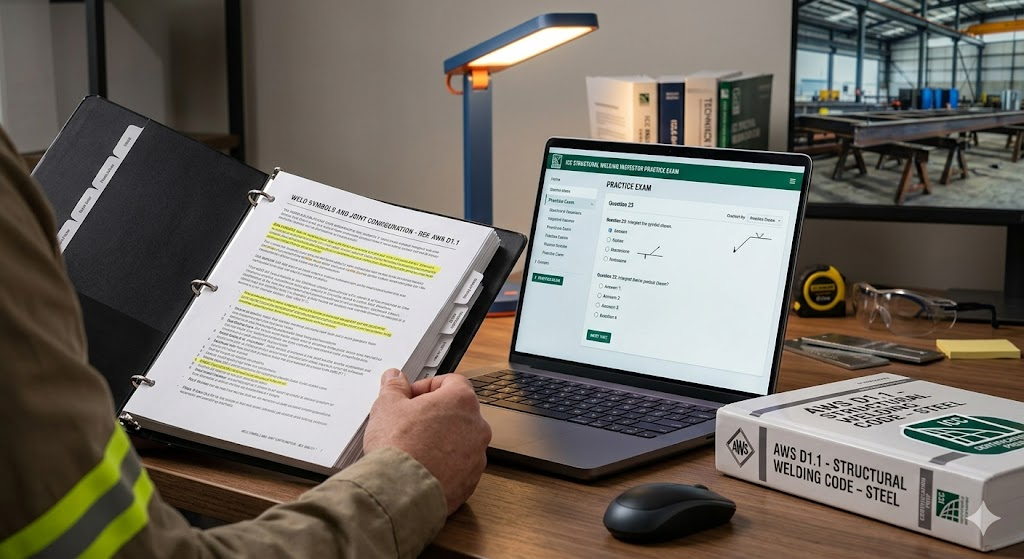
Additional Information
What the Course Entails and Exam Details
Preparing for this exam requires a thorough understanding of the applicable building codes and reference standards. A comprehensive study plan should cover essential core topics. This includes the in-depth application of standards such as the AWS D1.1 Structural Welding Code - Steel, AWS D1.3 Sheet Steel Welding Code, and the International Building Code (IBC). Key concepts involve interpreting complex welding symbols, reviewing and verifying Welding Procedure Specifications (WPS), and assessing Procedure Qualification Records (PQR) to ensure compliance. Candidates must also master visual inspection techniques to identify defects, determine acceptable tolerances, and ensure weld quality, as well as have foundational knowledge of common Non-Destructive Testing (NDT) methods. The exam syllabus directly addresses the skills needed to sample materials, perform verification, and document findings accurately.
What to Expect in the Final Exam
The actual final exam for the ICC Structural Welding Special Inspector certification is typically structured to test both code knowledge and plan application. It usually consists of a two or three-part open-book exam administered via computer. You should expect numerous multiple-choice questions designed to assess your speed and accuracy in referencing and applying code provisions. While the specific format might require modular completion, such as a General Requirements exam and individual modules for Codes and Plans, the typical total number of questions for the code application portion might range around 60 to 80, with a time limit often set to two hours per major module. A minimum passing score of 75% or 80% is generally required, depending on the specific program. Because the exam is often open-book, candidates are permitted and expected to use their designated code references to solve practical, real-world inspection scenarios during the timed session. It is imperative to familiarize yourself with how the modular approach works for special inspector certifications as of recent updates.
How to Study and Exam Centers
Effective preparation for this challenging exam requires strategic study habits. You must obtain the correct, current editions of the mandatory codebooks, like the AWS D1.1 Structural Welding Code, and practice with them extensively. Highlighting and tabbing key sections can significantly reduce search time. We highly recommend starting with a dedicated study resource, such as the [ICC Welding Certification Practice Test] you have identified, to gauge your initial knowledge and mimic the timed conditions. Actionable study strategies include forming study groups, taking online review courses, and focusing on code sections where you identify weaknesses. To take the final exam, you must register through the official ICC website. After completing registration, you will select an exam center through the appropriate portal, with many ICC exams administered via partners like Pearson VUE, offering thousands of physical testing locations worldwide. Additionally, some ICC certifications, including special inspector modules, may be available via remote proctoring options like ProCTORTU or the PRONTO platform, allowing you to take the exam from a secure, authorized home or office environment.
Job Opportunities from the Course
Earning an ICC Welding Certification unlocks diverse career paths across the construction and engineering sectors. It proves your expertise and increases demand for your visual inspection services. Unlocking these opportunities can lead to roles such as:
Structural Welding Inspector
ICC Special Inspector
Quality Assurance Specialist (QA)
Construction Quality Control Inspector (QC)
Welding Superintendent
Third-Party Inspection Professional
Project Manager with Code Compliance Focus
Building Department Inspector
Quality Manager in Steel Fabrication
Risk Management Consultant for Construction Projects
Infrastructure Inspection Technician
Frequently Asked Questions
Reviews
5.0
Based on 0 reviews
Leave a Review
No reviews yet. Be the first to review!