
ICEMA Protocol Practice Test
$69.00
- Buy to unlock unlimited access to all Quiz questions and Answers in this Quiz.
- After purchase you can print a PDF of the whole quiz at any point. The PDF will contain the questions and the correct answers.
About this Exam
The Inland Counties Emergency Medical Agency (ICEMA) Protocol Exam is a mandatory credentialing assessment for all Emergency Medical Services (EMS) professionals who intend to practice within San Bernardino, Inyo, or Mono counties in California. It is designed specifically for Emergency Medical Technicians (EMTs), Advanced EMTs (AEMTs), and Paramedics (EMT-P). Unlike broad national certifications, this exam focuses exclusively on verifying that a provider understands and can apply the unique local policies, standing orders, and clinical protocols established by the ICEMA Medical Director, ensuring standardized and safe patient care throughout the region.
Ready to test your knowledge?
Buy Now to Access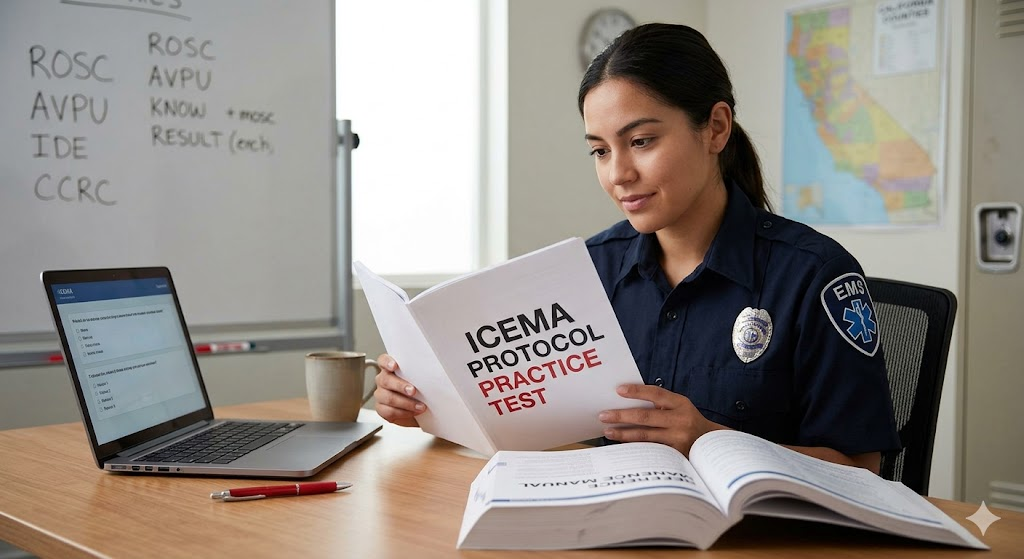
Additional Information
What the Course Entails and Exam Details
This examination does not teach basic medical skills; rather, it tests your proficiency in the application of ICEMA’s specific clinical and administrative rules. The syllabus is effectively the most current version of the ICEMA Reference Documents and Protocol Manual.
Key topics you must master include:
High Performance CPR: Specialized team-based resuscitation protocols.
Medical Emergency Standing Orders: Specific drug dosages and intervention sequences for conditions like acute coronary syndrome, stroke (identification and transport guidelines), seizures (e.g., precise Midazolam administration), and respiratory distress.
Trauma Protocols: Local criteria for trauma center destination and specialized burn care.
Pediatric Protocols: Application of the Pediatric Assessment Triangle and specific pediatric dosage charts (like the Broselow tape application).
Administrative References: Guidelines for Do Not Resuscitate (DNR) orders, Physician on Scene, determination of death, and required documentation (ePCR) procedures.
What to Expect in the Final Exam
While the exact administration parameters can vary by authorized training program, the following characteristics define the ICEMA Protocol written exam experience:
Format: The exam is typically composed entirely of multiple-choice questions designed to test both rapid recall of facts (like drug dosages) and critical thinking based on clinical scenarios.
Time Limit: Students should prepare for a timed session, usually ranging from 60 to 90 minutes, depending on the credential level being tested.
Passing Score: ICEMA typically requires a high degree of proficiency, often demanding a minimum passing score of 80% to achieve credentialing.
Rules: The exam is closed-book. You must rely entirely on your memorization and understanding of the protocol manual. In many initial credentialing scenarios, this written component must be successfully completed alongside a practical skills verification.
How to Study and Exam Centers
Effective preparation for this specialized exam requires focused study strategies rather than general EMS review.
Actionable Study Strategies:
Primary Source Mastery: Your main textbook is the official ICEMA Website’s Reference section. Study every relevant protocol and administrative reference for your level of licensure. Do not rely solely on third-party study guides that may be outdated.
Flashcards for Dosages: Create flashcards for every medication within your scope, focusing on ICEMA’s specific indications, contraindications, and precisely how dosages are calculated or administered locally.
Scenario Application: Practice simulating calls with peers, where one person acts as the Proctor and asks, "Based on ICEMA Reference #XXXX, what is your next intervention?"
High-Yield Focus: Pay extra attention to protocols regarding stroke destination criteria, High Performance CPR roles, and behavioral emergency management, as these are often heavily tested.
Exam Centers and How to Take It:
You will not take the ICEMA Protocol Exam at a standard Pearson VUE or Prometric national testing center. The exam is administered directly through authorized ICEMA-approved training programs, affiliated EMS employers (such as private ambulance providers), or municipal fire departments. If you are seeking initial credentialing, the exam is usually scheduled as the final component of your accreditation course. If you are a recertifying provider, you must coordinate testing through your employer's Clinical Education Department.
Job Opportunities from the Course
Successfully passing this exam and achieving ICEMA credentialing is the prerequisite for employment as an active prehospital provider within the agency's three-county jurisdiction. This unlocks diverse and competitive career paths in both public safety and private healthcare sectors.
Opportunities available to ICEMA-credentialed providers include:
Municipal Firefighter/EMT or Firefighter/Paramedic roles.
Private Ambulance EMT or Paramedic (Primary 911 Response or Interfacility Transport).
Flight Paramedic for regional air ambulance services.
Critical Care Transport (CCT) Paramedic.
Tactical EMS (TEMS) provider with local law enforcement agencies.
Hopsital Emergency Room Technician (often requires active EMT/Paramedic credential).
Search and Rescue EMS provider in high-altitude or wilderness environments within Inyo and Mono counties.
By dedicating yourself to the mastery of these local protocols, you ensure not only exam success but also the delivery of the highest standard of care to the communities you will serve. Good luck with your studies!
Frequently Asked Questions
Reviews
5.0
Based on 0 reviews
Leave a Review
No reviews yet. Be the first to review!