
iCEV Equine Science Certification Practice Test
$69.00
- Buy to unlock unlimited access to all Quiz questions and Answers in this Quiz.
- After purchase you can print a PDF of the whole quiz at any point. The PDF will contain the questions and the correct answers.
About this Exam
The iCEV Equine Science Certification is a prestigious industry-recognized credential designed to validate an individual's comprehensive understanding and practical skills in equine management and science. Developed for students and emerging professionals in the equine industry, this certification confirms mastery of essential topics from equine anatomy and nutrition to facility management and industry business practices. Achieving this certification demonstrates to employers that you have the knowledge and dedication to succeed in a variety of horse-related careers.
Ready to test your knowledge?
Buy Now to Access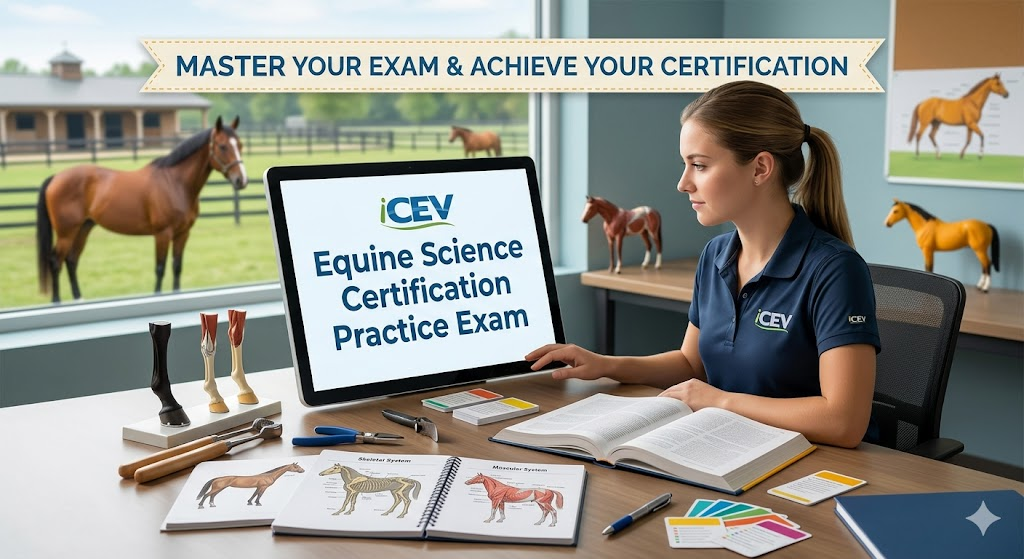
Additional Information
What the Course Entails and Exam Details
This comprehensive course, leading up to the certification, covers a broad spectrum of critical areas. Expect to dive deep into:
Equine Anatomy & Physiology: Detailed study of skeletal, muscular, and other organ systems.
Nutrition and Digestion: Understanding dietary requirements, digestive processes, and feed management.
Equine Health & Diseases: Identifying common illnesses, prevention strategies, and basic veterinary care.
Breed Identification and Conformation: Evaluating horses for structural correctness and desirable traits.
Horsemanship and Training: Fundamental concepts in handling, training methods, and behavior.
Equine Facility Management: Principles of safe, efficient, and healthy horse environments.
Equine Evaluation: Developing the skills to assess and judge equine performance and structure.
The Equine Industry: Gaining an overview of business operations, regulations, and diverse career paths.
What to Expect in the Final Exam
The final iCEV Equine Science Certification exam is a robust assessment of your knowledge.
You can typically expect the following format:
Question Type: A combination of question formats, including multiple-choice, matching, ordering, and potentially labeling or interactive elements, all designed to rigorously test your understanding.
Number of Questions: While the exact number may vary, it is a significant exam, often containing close to 100 questions.
Format: The exam is administered online through the iCEV Testing Platform.
Passing Score: To earn your certification, you will need to achieve a passing score, usually set around 70% or higher.
Time Limit: You will be given a specific time limit to complete the exam, often ranging from 60 to 90 minutes. It's crucial to manage your time effectively during the test.
Proctoring: The exam is usually proctored within a controlled environment, such as a school computer lab or an authorized testing location.
How to Study and Exam Centers
Preparation is key to succeeding on the iCEV Equine Science Certification exam. Here are effective study strategies:
Review iCEV Course Materials: Thoroughly go through all the lesson plans, videos, and worksheets provided in the iCEV curriculum.
Use Practice Tests and Quizzes: Utilize any pre-tests, post-tests, and specific practice questions available on the iCEV platform. These are specifically designed to mirror the actual exam format and content. Create or use online flashcards (like Quizlet) for terms, breeds, anatomy, and health facts.
Study Key Terms & Facts: Focus on important definitions, key health indicators (temperature, heart rate, respiration ranges), nutritional facts, and identifying equine systems.
Gain Practical Experience: Apply your knowledge in real-world settings whenever possible – in the stable, with trainers, or in school programs. This hands-on experience often reinforces key concepts.
Group Study: Collaborate with other students to review difficult topics, quiz each other, and share different understanding perspectives.
Regarding taking the exam:
iCEV Online Portal: The certification exam is accessed and completed entirely online through your student account on the iCEV multimedia platform.
Authorized Schools & Testing Centers: Most often, you will take the exam in a controlled setting within your school, where a teacher or instructor acts as the proctor. For those not currently enrolled in a participating school, search for authorized testing centers or contact iCEV for individual testing options or instructions on finding an approved location.
Job Opportunities from the Course
Earning your iCEV Equine Science Certification can unlock numerous doors in the diverse equine world. Here are some specific career paths and job titles:
Stable Manager / Barn Owner
Equine Trainer / Assistant Trainer
Breeding Manager
Riding Instructor / Riding Program Coordinator
Rodeo Crew / Arena Staff
Exercise Rider
Horse Care Technician
Equine Facility Supervisor
Course Designer
Pharmaceutical or Feed Sales Representative (in the equine sector)
Equine Marketing/Journalism (with further education)
Veterinary Assistant or Technician (often requires additional certification and training)
Academic Instructor (with advanced degree)
Base knowledge for aspiring Veterinarians (requires significant further education)
With proper preparation, this certification will validate your skills and dedication to the equine industry, marking a significant milestone in your professional journey. Use this study guide as your roadmap to success!
Frequently Asked Questions
Reviews
5.0
Based on 0 reviews
Leave a Review
No reviews yet. Be the first to review!