
iCore Operations Practice Exam
$69.00
- Buy to unlock unlimited access to all Quiz questions and Answers in this Quiz.
- After purchase you can print a PDF of the whole quiz at any point. The PDF will contain the questions and the correct answers.
About this Exam
Prepare to excel in the rigorous and rewarding iCore Operations component! This practice exam is specifically designed as the ultimate preparation tool for students enrolled in the prestigious iCore (integrated core) business programs, often a hallmark of top-tier university business schools.
It is tailored for driven students who are looking to solidify their understanding of complex operations management principles, perfect their case analysis skills, and demonstrate critical thinking in a high-stakes academic environment. By engaging with this practice exam, students can confidently gauge their readiness and strategically target areas for improvement before facing the final course assessment.
Ready to test your knowledge?
Buy Now to Access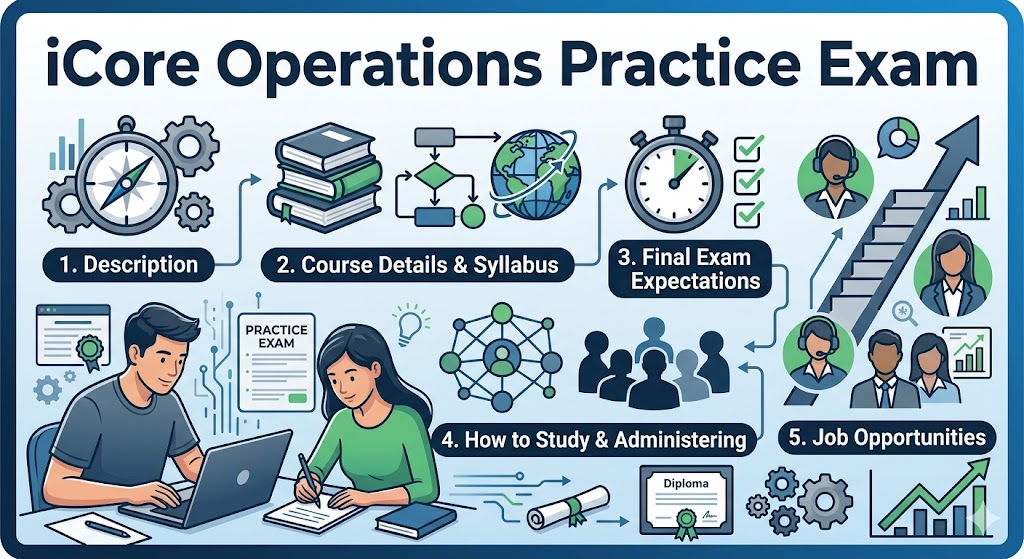
Additional Information
What the Course Entails and Exam Details
The iCore Operations course is a cornerstone of an integrated business curriculum, challenging students to analyze how organizations design, manage, and improve their core operational processes. The content is designed to provide a deep, practical understanding of operations as a strategic function and a critical driver of business success.
Specific topics, while unique to your program’s syllabus, generally include the following core operations management domains, all of which you should expect to see reflected in your practice and final exams:
Process Analysis and Design: Understanding flow, capacity, bottlenecks, and efficiency within varying operational systems.
Supply Chain Management: Strategic sourcing, logistics, inventory control, and navigating global supply networks.
Project Management: Fundamentals of planning, scheduling, resource allocation, and risk assessment for complex initiatives.
Quality Management and Improvement: Philosophies like Six Sigma and Lean Operations, statistical process control, and continuous improvement methodologies.
Operational Strategy: Aligning operational decisions with overall business goals and managing tradeoffs.
Forecasting and Demand Planning: Utilizing historical data and analytical models to predict and prepare for future operational needs.
Operational Data Analytics: Leveraging data to make informed decisions and optimize system performance.
The iCore Operations practice exam and the final exam are highly rigorous, often demanding not only a solid grasp of theoretical concepts but also the ability to apply that knowledge to real-world business scenarios, frequently presented through detailed case studies.
What to Expect in the Final Exam
While specific rules are governed by your academic institution and specific iCore program, you should expect the final iCore Operations exam to be a comprehensive and challenging assessment of your semester’s learning.
Key characteristics to keep in mind:
Format: The exam will likely include a mix of multiple-choice questions testing conceptual clarity, problem-solving calculations, and, crucially, significant case analysis questions or entirely case-based sections requiring written application of operations principles to solve business problems.
Time Limit: Expect a strict time limit, requiring you to manage your time effectively between conceptual questions and in-depth case analysis. The limit is designed to be challenging.
Passing Score: The required score to pass or achieve a specific grade is determined by your university's grading scale and the overall performance of your cohort. It is a competitive academic environment.
Specific Rules: All standard university examination and academic integrity rules apply. This includes specific guidelines on allowed materials (e.g., calculators, formula sheets) and adherence to secure testing procedures.
The practice exam serves to mirror this structure and rigor as closely as possible, helping you build necessary test-taking endurance and refine your time management and case application skills.
How to Study and Exam Centers
Successfully conquering the iCore Operations exam requires a strategic, multifaceted approach. The practice exam is your best asset, but it should be part of a broader study plan. Actionable strategies include:
Practice with the iCore Operations Practice Exam repeatedly: This is your primary resource to understand the question style, time management, and areas of weakness. Analyze every incorrect answer to understand the underlying concept and application.
Engage with Study Materials and Lectures: Thoroughly review all course textbooks, lecture notes, case studies, and instructor-provided resources. Operations management is a practical field; understand the why and how behind each principle.
Simulate Case Analysis: Dedicate significant study time to reading, analyzing, and writing responses for operations case studies. Practice identifying key operational issues and proposing structured, data-supported solutions.
Form Study Groups: The iCore program often emphasizes collaboration. Group discussion, case study debates, and peer teaching are incredibly effective methods for deepening understanding and seeing different operational perspectives.
Focus on Calculation and Formulas: Ensure proficiency in essential operations formulas, such as those for determining cycle time, capacity, utilization, economic order quantity (EOQ), and project critical paths.
Utilize Instructor Resources: Don’t hesitate to attend office hours or review sessions. Clarify complex concepts and seek guidance on case analysis techniques directly from your professors and teaching assistants.
Regarding Exam Centers:
The iCore Operations Practice Exam is likely a digital resource provided directly through your course or university learning management system (LMS) – such as Canvas, Blackboard, or a specific program portal. You can generally access it online from any location at your convenience.
The Final iCore Operations Exam will be administered under secure, standardized conditions as determined by your academic institution. This typically means taking the exam on campus in a designated, proctored computer lab or classroom, using secure testing software or standard university exam procedures. Refer directly to your course syllabus, instructor, and university testing services for specific locations, dates, and mandatory procedures for the final exam.
Job Opportunities from the Course
While the iCore Operations practice exam and the course are part of an academic degree rather than a standalone industry certification, completing the rigorous iCore program – which often carries significant weight and prestige, particularly when linked with top business schools – develops highly sought-after skills.
Specific job titles and career paths this experience and the associated business degree can unlock include:
Operations Manager / Analyst
Supply Chain Manager / Analyst
Logistics Manager / Coordinator
Project Manager
Business Analyst
Operations Consultant
Procurement Specialist
Quality Assurance Manager / Engineer
Inventory Control Manager
Process Improvement Specialist
Operations Strategy Analyst
The analytical, problem-solving, collaborative, and strategic thinking skills honed in the iCore Operations course are versatile and essential for success across a wide range of operational and managerial roles in nearly every industry.
Stay focused, practice diligently with your resources, including this study guide and the practice exam, and approach the final assessment with confidence. Your hard work in the iCore program will not only help you succeed in this exam but also prepare you for a dynamic and impactful career in operations and beyond! Good luck!
Frequently Asked Questions
Reviews
5.0
Based on 0 reviews
Leave a Review
No reviews yet. Be the first to review!