
Idaho Civics Practice Test
$69.00
- Buy to unlock unlimited access to all Quiz questions and Answers in this Quiz.
- After purchase you can print a PDF of the whole quiz at any point. The PDF will contain the questions and the correct answers.
About this Exam
Preparing for the required Idaho Civics Test is a crucial step for high school students aiming for graduation, and understanding its content is vital for active citizenship.
This study guide focuses on the Idaho Civics Practice Test, a powerful tool designed to mirror the structure and content of the actual exam.
It allows students, educators, and anyone interested in testing their civic knowledge, to familiarize themselves with the key concepts of US history, government, and basic geography required by Idaho state law.
The practice test isn't just about passing; it's about building a robust understanding of the principles that govern our nation and state
Ready to test your knowledge?
Buy Now to Access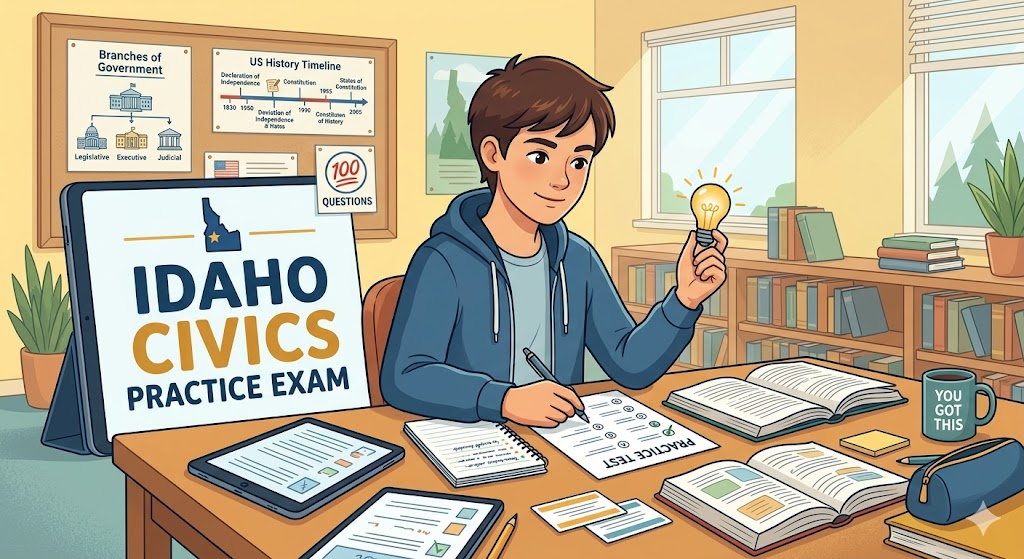
Additional Information
What the Course Entails and Exam Details
The ultimate goal isn't just taking a test, but building deep foundational knowledge of our democratic system.
The core topics, which are reflected directly in both the actual Idaho Civics Test and this comprehensive practice test, encompass several essential domains:
Principles of American Democracy: Includes the foundations, declaration of independence, the U.S. Constitution, and the Bill of Rights.
System of Government: Covering the three branches of government (legislative, executive, judicial), their functions, powers, and the concept of checks and balances.
Also includes federalism and state government structure relevant to Idaho.Rights and Responsibilities: Exploring the rights of U.S. citizens, such as freedom of speech and religion, along with civic responsibilities like voting and jury duty.
American History: Key events and figures, including the colonial period, the Revolutionary War, the Civil War, World War II, and other significant milestones in shaping the nation.
Integrated Civics: Basic U.S. geography (major states, rivers, capitals), national symbols (the flag, the national anthem, the Pledge of Allegiance), and significant U.S. holidays.
The official curriculum generally aligns with the 100 civics questions used for the U.S. naturalization process, so focusing on these areas is a primary learning path.
This practice test ensures you are familiar with the breadth and depth of these topics.
What to Expect in the Final Exam
While the practice test is for preparation, the final Idaho Civics Test itself has specific characteristics.
Typically, students are presented with a multiple-choice exam.
The questions are taken directly or adapted from the official 100 civics (history and government) questions from the U.S. naturalization process.
Format: Primarily multiple choice questions covering the diverse topics listed above.
Number of Questions & Passing Score: The precise number of questions and the minimum required passing score can vary somewhat by school district across Idaho.
However, it's common for students to need to correctly answer at least 60% (or equivalent to a 6/10 ratio on selected questions) to demonstrate proficiency and meet the graduation requirement.
Many schools allow students multiple opportunities to achieve a passing score.Time Limit: Specific time limits are usually determined at the district level and are designed to allow students ample time to complete the multiple-choice section within a standard class period or testing session.
Rules: The exam is typically administered in a supervised, quiet testing environment within the school setting and is generally considered a 'closed-book' assessment, requiring prior knowledge rather than access to study materials during the test itself.
How to Study and Exam Centers
Preparing effectively involves more than just glancing at material; it requires consistent, focused effort.
Here are some actionable study strategies for mastering the civic knowledge required:
Utilize Practice Tests: Engaging frequently with an Idaho Civics Practice Test is one of the most effective ways to understand the types of questions, the scope of topics, and build confidence.
It identifies weak areas for targeted review.Study the 100 Questions: Make the official 100 civics questions (used for U.S. naturalization) your central study resource.
You can find these on the U.S. Citizenship and Immigration Services (USCIS) website or through your school.Create Flashcards: Flashcards are excellent for memorizing facts like names of government officials, key dates, and definitions of terms.
Make cards for both the question and the answer.Group Study & Discussion: Explain concepts like separation of powers or the Bill of Rights to a friend or family member.
Discussing the 'why' behind historical events and governmental structures deepens understanding.Engage with Diverse Resources: Utilize textbooks, reliable online educational platforms, and official government websites (like state of Idaho, USCIS) for additional context and explanation of concepts.
Don't rely solely on one source.
Where and how to take the exam for most high school students:
In-School Administration: The vast majority of Idaho high school students will take the required civics test directly at their high school.
The exam is typically integrated into the curriculum, potentially within a social studies or government class, and administered by teachers or school administrators.
There are generally no specific external testing centers or online portals required for students meeting this high school graduation requirement.
Job Opportunities from the Course
While the Idaho Civics Test itself is a graduation requirement and doesn't function as a professional certification in a specific field, the deep foundational civic and historical knowledge it fosters can be a significant advantage and often serves as a prerequisite or beneficial asset in numerous career paths.
This required proficiency in understanding our democracy and history directly supports and enables students to confidently pursue and excel in roles such as:
Active and informed citizen (the most important 'job'!)
Public Servant (e.g., locally, state, or federal government roles)
Elected Official or Community Leader
Non-Profit Organization Staff or Leader (especially for mission-driven work)
Legislative Aide or Government Relations Specialist
Teacher or Educator (particularly in social studies, history, or civics)
Historian, Archivist, or Researcher
Legal Profession (Paralegal, Lawyer – advanced education required)
Journalist, Public Affairs Broadcaster, or Writer
Member of the Armed Forces
Law Enforcement Officer (local, state, federal)
Urban and Regional Planner
Community Organizer or Advocate
Foreign Service Officer (advanced studies and tests required)
This broad knowledge provides a critical understanding of societal structures, rights, and responsibilities essential for success and contribution in a wide range of civic and public-facing roles.
Understanding how government and history shape our society is a vital skill for anyone aspiring to work for the public good.
Frequently Asked Questions
Reviews
5.0
Based on 0 reviews
Leave a Review
No reviews yet. Be the first to review!