
Idaho Peace Officer Standards and Training (POST) Practice Exam
$69.00
- Buy to unlock unlimited access to all Quiz questions and Answers in this Quiz.
- After purchase you can print a PDF of the whole quiz at any point. The PDF will contain the questions and the correct answers.
About this Exam
The Idaho Peace Officer Standards and Training (POST) certification is the mandatory gold standard for anyone seeking a career in law enforcement within the state of Idaho. This comprehensive certification process ensures that peace officers possess the necessary knowledge, physical abilities, and ethical standards to serve and protect Idaho’s communities effectively. The examination and surrounding academy training are designed for aspiring police officers, sheriff's deputies, detention officers, corrections officers, and other specialized public safety personnel. It serves as the official gateway into the profession, validating that a candidate is fully prepared for the rigors and responsibilities of a career in law enforcement.
Ready to test your knowledge?
Buy Now to Access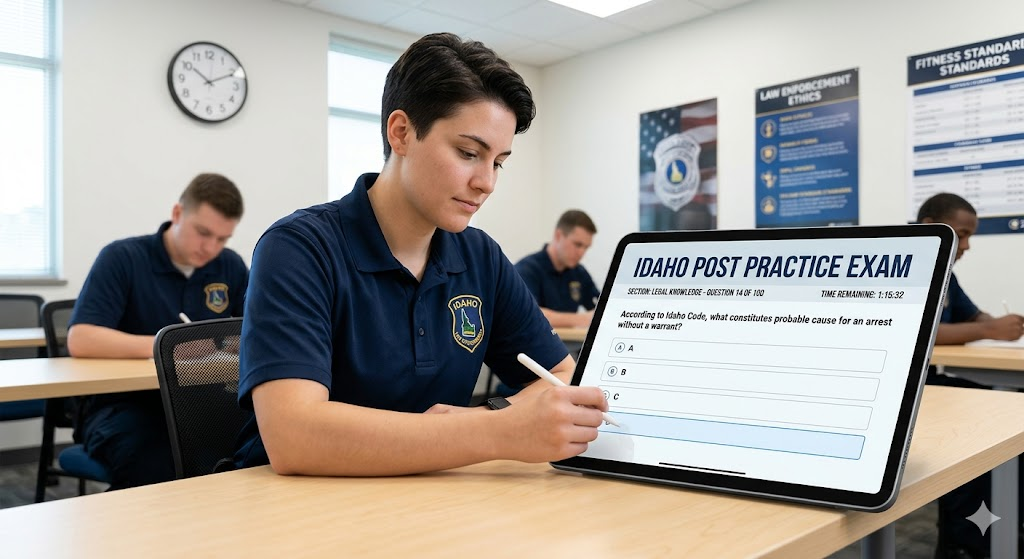
Additional Information
What the Course Entails and Exam Details
Obtaining Idaho POST certification involves successfully completing an accredited basic training academy, which includes rigorous academic coursework, practical skills training, and physical conditioning. The academic curriculum covers a wide array of essential law enforcement topics. Students delve into Idaho criminal and traffic laws, constitutional law, arrest-search-and-seizure procedures, human relations, and ethics. Beyond classroom theory, the course emphasizes high-stakes practical skills. Candidates receive extensive training in firearms proficiency, defensive tactics, emergency vehicle operation (EVOC), basic first aid/CPR, and report writing. The standard Patrol Academy typically spans approximately 16 weeks of intensive full-time training, though lengths vary for other disciplines such as Detention, Corrections, or Juvenile Probation. Throughout the academy, students are expected to maintain high academic standards, often requiring a minimum 75% average on all weekly exams to remain in the program.
What to Expect in the Final Exam
To achieve basic certification, candidates must satisfy several exam components. Primarily, students must pass the comprehensive academic final examination, which is typically a comprehensive written test consisting of multiple-choice questions covering the entire academy curriculum. You must meet the required passing score, which is generally 75% or higher, to demonstrate cognitive mastery of the material. In addition to the written exam, you must successfully pass rigorous practical skills assessments. These are pass/fail evaluations where instructors observe your ability to perform essential tasks such as safely handling a firearm, applying defensive tactics, or navigating an emergency driving course. Furthermore, candidates must pass the Idaho POST Physical Readiness Test (PRT). The PRT consists of five timed events: a vertical jump, one minute of sit-ups, maximum push-ups (no time limit), a 300-meter sprint, and a 1.5-mile run. You must score a minimum of 10 points in each event to pass the PRT overall.
How to Study and Exam Centers
Effective preparation for the Idaho POST examination requires a disciplined, multifaceted study strategy combining academic review and physical training. Academically, you should organize your academy notebooks, create flashcards for key legal terms and standard operating procedures, and participate in peer study groups to quiz each other on scenario-based application of laws. Utilizing an Idaho POST Practice Exam is a critical step; it helps you become familiar with the formatting of multiple-choice questions and identifies specific knowledge gaps you need to address. Physically, you must train specifically for the five PRT events weeks or months before the academy begins, ensuring you can comfortably exceed the minimum 10-point threshold in each category.
Regarding exam centers, it is important to understand that in Idaho, individual citizens cannot "self-sponsor" to take the POST exam or attend the main training academy in Meridian on their own. You must first be hired by an Idaho law enforcement agency. Once hired, your employing agency will handle your application and send you to the Idaho POST Academy in Meridian, where all official certification testing is administered. Alternatively, some regional colleges, such as North Idaho College or Idaho State University, offer accredited law enforcement programs that host POST-certified academies. Students who successfully complete these college-based programs are eligible to take the POST certification exam upon graduation.
Job Opportunities from the Course
Successfully completing the Idaho POST certification unlocks numerous rewarding career paths within the state's public safety sector. Certified individuals are qualified to apply for a variety of sworn positions at the municipal, county, and state levels. The career paths available to POST-certified officers include:
Municipal Police Officer
County Sheriff's Deputy
Idaho State Police Trooper
Detention Officer
Corrections Officer
College or University Police Officer
Probation and Parole Officer
Juvenile Corrections Officer
Fish and Game Warden
Airport Security Officer
Tribal Police Officer
Once employed and experienced, officers can further specialize in roles such as Criminal Investigator/Detective, K9 Handler, SWAT Team Member, Field Training Officer (FTO), or School Resource Officer (SRO).
Frequently Asked Questions
Reviews
5.0
Based on 0 reviews
Leave a Review
No reviews yet. Be the first to review!