
Idaho Public Driver Education Practice Test
$69.00
- Buy to unlock unlimited access to all Quiz questions and Answers in this Quiz.
- After purchase you can print a PDF of the whole quiz at any point. The PDF will contain the questions and the correct answers.
About this Exam
The Idaho Public Driver Education program is a state-approved course designed to equip new drivers, primarily teenagers, with the essential knowledge, skills, and attitudes necessary for safe and responsible vehicle operation.
Successful completion of this course is a mandatory step in Idaho's Graduated Driver Licensing (GDL) program for anyone under the age of 17.
This program focuses not only on passing the state exams but also on developing lifelong defensive driving habits to reduce traffic collisions and fatalities.
This guide and the associated practice test are specifically crafted to assist students in mastering the material covered in the classroom portion of the course and to ensure readiness for the official Idaho Knowledge (Permit) Test.
Ready to test your knowledge?
Buy Now to Access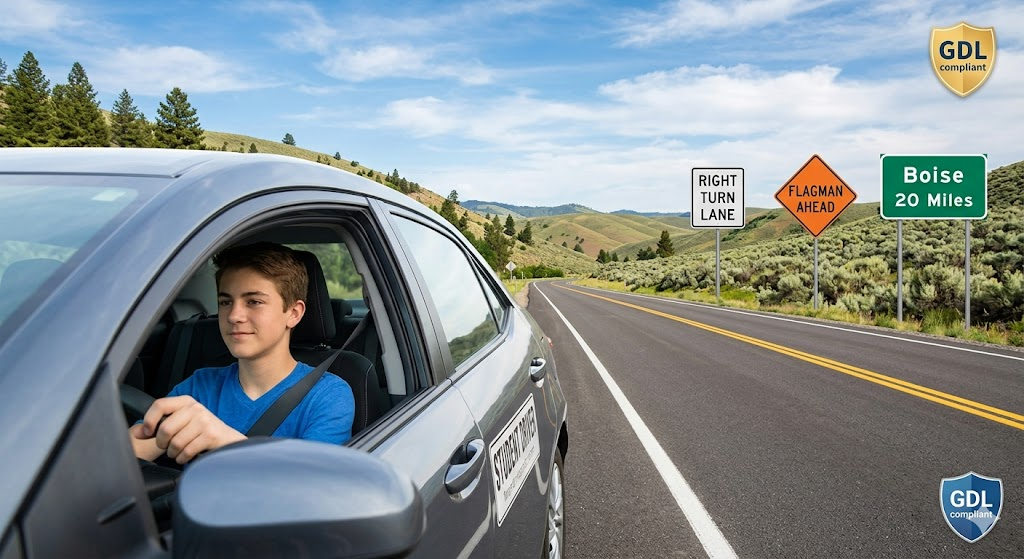
Additional Information
What the Course Entails and Exam Details
A standard Idaho Public Driver Education course consists of three main components totaling at least 42 hours of instruction.
Students must complete 30 hours of classroom instruction, which covers the theory of driving, traffic laws, and safety regulations.
Additionally, students must complete 6 hours of behind-the-wheel training with a certified instructor, actively operating the vehicle.
Finally, students are required to complete 6 hours of in-car observation, watching another student driver and learning from their interactions with the instructor.
The core syllabus covers critical topics, including:
Understanding vehicle control and maintenance.
Idaho traffic laws, right-of-way rules, and speed limits.
Interpreting road signs, signals, and pavement markings.
Defensive driving techniques and risk management.
The dangers of impaired and distracted driving.
Navigating different driving environments, such as city streets, highways, and rural roads.
What to Expect in the Final Exam
When we refer to the "Final Exam" in the context of driver education, there are actually two distinct hurdles to clear to become fully licensed.
The first is the state's Written Knowledge (Permit) Test, which is a computer-based, multiple-choice exam taken at a County Driver’s License office.
This test consists of 40 questions derived directly from the Idaho Driver’s Manual.
To pass the Knowledge Test, you must score at least 85%, which means you need to get 34 out of 40 questions correct.
The test is typically timed, with a common limit of 25 minutes, and focuses on state-specific laws and sign recognition.
The second "final" is the Skills (Road) Test, which you take after completing your driving practice with a permit.
This is a practical exam where an examiner observes your ability to safely operate a vehicle in real traffic situations, evaluating skills like turning, braking, parking, and lane changes.
How to Study and Exam Centers
Effective preparation requires a combination of reviewing official material and active practice.
Study Strategies:
Master the Handbook: The primary source for all Knowledge Test questions is the official Idaho Driver’s Manual. Read it thoroughly and focus on numbers (distance limits, speed limits, age requirements).
Take Practice Tests: Regularly taking the Idaho Public Driver Ed Practice Exam is the most effective way to gauge your readiness, identify weak areas, and become familiar with the multiple-choice format.
Use Visual Aids: Create flashcards for all road signs and signals to ensure instant recognition.
Discuss Driving Scenarios: Talk to parents or experienced drivers about real-world scenarios you observe, applying the rules you’ve learned.
Exam Centers and Locations:
Classroom/Coursework: The Driver Education course itself is taken through authorized public schools or licensed private driving schools throughout Idaho.
Knowledge and Skills Tests: These official state exams are administered by the Idaho Transportation Department (ITD) at County Driver’s License offices. You can find your nearest location on the official ITD website.
Job Opportunities from the Course
Successfully completing driver education and earning your Idaho driver's license unlocks a variety of career paths where safe driving is a primary requirement.
While this course provides the standard Class D license, it is the foundational prerequisite for jobs such as:
Local Delivery Driver (e.g., parcel services, auto parts, local vendors)
Food and Beverage Delivery Driver
Rideshare Driver (e.g., Uber, Lyft)
Medical Courier or Non-Emergency Medical Transportation Driver
Sales Representative (requiring travel within a designated territory)
Property Manager (requiring travel between sites)
Field Service Technician (e.g., cable/internet installation, light repair services)
Home Health Aide (requiring transportation for clients)
Frequently Asked Questions
Reviews
5.0
Based on 0 reviews
Leave a Review
No reviews yet. Be the first to review!