
IDOT Mixture Aggregate Technician Practice Exam
$69.00
- Buy to unlock unlimited access to all Quiz questions and Answers in this Quiz.
- After purchase you can print a PDF of the whole quiz at any point. The PDF will contain the questions and the correct answers.
About this Exam
The Illinois Department of Transportation (IDOT) Mixture Aggregate Technician certification is a specialized credential designed for individuals responsible for the sampling and testing of aggregates used in IDOT construction projects. This certification ensures that technicians have the necessary technical proficiency to accurately perform critical quality control and quality assurance tests. It is primarily designed for personnel working for aggregate producers, commercial testing laboratories, contractors, and agency employees who must administer the Aggregate Gradation Control System (AGCS) or verify material compliance. Possessing this certification confirms a technician’s ability to ensure that the foundational materials of Illinois infrastructure meet stringent state specifications.
Ready to test your knowledge?
Buy Now to Access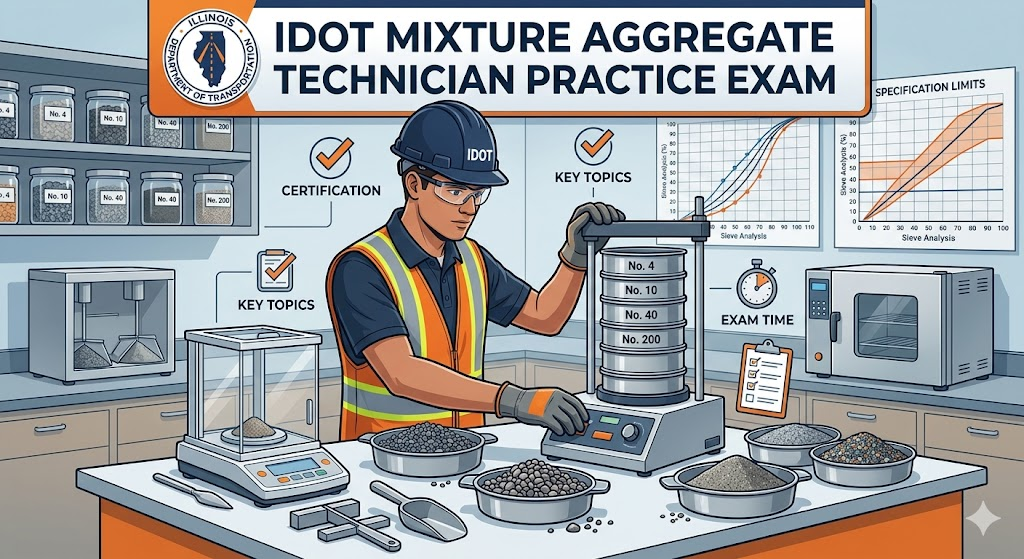
Additional Information
What the Course Entails and Exam Details
The corresponding training course provides comprehensive instruction on the properties, handling, and testing of aggregates. Participants will delve into the standard procedures required by IDOT for the official control of aggregate gradation. Key topics covered in the syllabus include:
Standard methods for sampling aggregates from various sources (stockpiles, bins, conveyor belts).
Procedures for reducing field samples of aggregate to testing size to ensure representativeness.
Determining the total evaporable moisture content of aggregate by drying.
Performing sieve analysis of fine and coarse aggregates to determine size distribution.
Conducting tests to determine the amount of material finer than the No. 200 (75-µm) sieve by washing.
Understanding the Aggregate Gradation Control System (AGCS) and technician responsibilities within it.
The preparation typically involves a dynamic mix of classroom lectures, demonstrations, and hands-on laboratory practice, preparing students for both the theoretical and practical demands of the final examination.
What to Expect in the Final Exam
To earn the IDOT Mixture Aggregate Technician certification, candidates must successfully navigate a rigorous final examination. This exam is divided into two distinct parts: a written component and a performance-based component.
Written Exam: The written test generally consists of multiple-choice questions that assess knowledge of the theoretical principles, IDOT specifications, and test procedures. While rules can vary, this is often a closed-book exam. Candidates must typically achieve a minimum passing score of 70% to move forward.
Performance Exam: The performance (or practical) exam is a hands-on demonstration of proficiency. Examinees are required to correctly perform the specified test methods (such as a full sieve analysis and sample reduction) under the observation of an evaluator. This portion is strictly graded on a pass/fail basis for each standard method.
Time Limits and Regulations: Both portions of the exam are timed, and candidates must adhere to all examination rules, which typically prohibit the use of personal electronic devices during the test. Retesting opportunities may be available for candidates who do not pass on their first attempt, subject to IDOT’s current policies.
How to Study and Exam Centers
Effective preparation is the key to success. Start by thoroughly reviewing the official IDOT course manual and related standard specifications. Pay close attention to definitions, step-by-step testing procedures, and the mathematical formulas used to calculate results.
Actionable Study Strategies:
Practice the math: Ensure you can quickly and accurately calculate moisture contents and percent passing/retained for sieve analysis.
Simulate laboratory conditions: If possible, perform the hands-on tests multiple times before the exam, ensuring you follow every step perfectly.
Take practice exams: Utilizing a structured "IDOT Mixture Aggregate Technician Practice Exam" can help identify your strengths and weaknesses in the theoretical material and familiarize you with the types of questions you will face.
Exam Centers: The IDOT Mixture Aggregate Technician exam is administered at authorized training locations throughout Illinois. These are often organized through partnerships with local colleges and specialized testing facilities. Key centers include:
Lake Land College (Mattoon, IL), which often serves as the primary administrator for IDOT Materials Testing Certifications.
IDOT District Materials Laboratories.
Authorized third-party facilities, such as the Chicago Testing Laboratory. Candidates must typically register for the training course to be eligible to sit for the final exam.
Job Opportunities from the Course
Achieving this certification unlocks a clear career path in the civil construction and materials testing industries. It is frequently a mandatory requirement for key roles involving IDOT projects. The certification unlocks opportunities for positions such as:
IDOT Mixture Aggregate Technician (at aggregate production plants)
Quality Control (QC) Technician
Quality Assurance (QA) Technician
Materials Inspector (for engineering firms or government agencies)
Construction Materials Testing Technician
Laboratory Technician (at commercial testing labs)
Mixtures Support Technician
This credential provides a strong foundation for advancing to more senior certifications, including Hot-Mix Asphalt (HMA) Level I or Portland Cement Concrete (PCC) Level II, further expanding your career potential within transportation engineering.
Frequently Asked Questions
Reviews
5.0
Based on 0 reviews
Leave a Review
No reviews yet. Be the first to review!