
IEA Tie Breaker Practice Test
$69.00
- Buy to unlock unlimited access to all Quiz questions and Answers in this Quiz.
- After purchase you can print a PDF of the whole quiz at any point. The PDF will contain the questions and the correct answers.
About this Exam
The IEA Tie Breaker Practice Test is a crucial educational tool designed specifically for young equestrians competing within the Interscholastic Equestrian Association (IEA). This unique component of the IEA’s broader Horsemanship Program tests a student’s rapid-recall of essential equine knowledge, veterinary science, and competition rules. It is designed to prepare riders in grades 4 through 12 for the intense horsemanship knowledge quizzes that are used to decide ties at IEA horse shows. By offering a comprehensive practice platform, the IEA aims to foster well-rounded horsemen and women who understand not only how to ride, but also the detailed anatomy, care, and management of the horse, ensuring they are prepared for the theoretical challenges of a competition day.
Ready to test your knowledge?
Buy Now to Access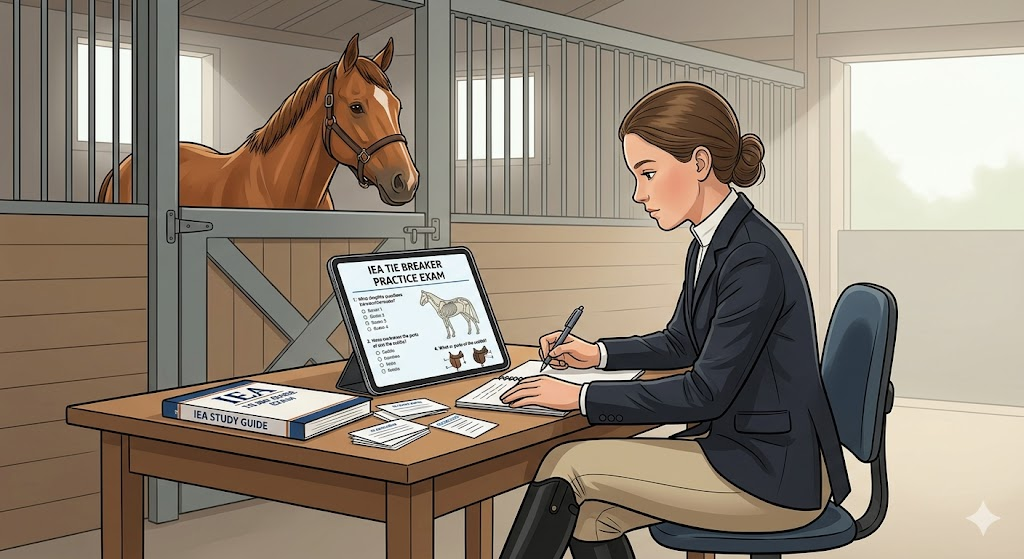
Additional Information
What the Course Entails and Exam Details
This practice exam serves as a comprehensive study tool for the academic and horsemanship knowledge required in IEA competition. It covers a vast range of topics critical for any young equestrian aiming for a competitive edge. The course entails understanding fundamental concepts like equine anatomy (knowing that a horse has 205 bones), a horse’s unique nearly 360-degree field of vision, and essential veterinary information, such as the average body temperature for a horse (99°F to 101°F). The practice exam tests on proper names for horses of different ages and genders, common tack identification (all parts of the saddle and bridle), and specific training aids like natural vs. artificial aids, and martingales. It further drills into competition rules, understanding the phases of a jump (approach, takeoff, flight, landing, recovery), and differentiating between various hunt seat disciplines like hunters, jumpers, and equitation, and what a judge is specifically looking for in each.
What to Expect in the Final Exam
While a "Practice Test," the ultimate "Tie Breaker" at an official IEA event is often a rapidly administered, multi-question quiz or a single, challenging open-ended question designed to produce a clear winner. The practice format mirrors this intensity. Students can expect a timed, multiple-choice or short-answer test where speed and absolute precision are paramount. The "Final Exam" in this context is the high-stakes knowledge assessment used in competition. It may require the rapid identification of a knot or piece of equipment, or a diagram of a horse's skeletal structure where a single error makes the difference. It isn't a long-form exam, but a targeted sprint to test the student's mastery of horsemanship details. A perfect score is often needed, or the fastest accurate completion, to break the tie and claim the win.
How to Study and Exam Centers
Actionable preparation for the IEA Tie Breaker Practice Test requires both focused theoretical study and practical experience. Students are strongly encouraged to utilize the official IEA Horsemanship Quiz Challenge (HQC) study guide and other recommended equestrian textbooks as their foundation. To master the content, use flashcards for anatomical terms, veterinary facts, and age/gender names. Regularly study diagrams of saddles and bridles until all parts can be identified instantly. The most effective strategy is integration with real-world barn time; ask a coach or knowledgeable rider to quiz you on parts of the tack while you groom, or discuss a horse's health. The practice exam itself is typically accessib online through the IEA website or an authorized program portal, allowing students to train from home or a barn. For the official Tie Breaker, the "exam center" is the horse show facility itself during an actual IEA competition event.
Job Opportunities from the Course
While the IEA Tie Breaker Practice Test is not a formal job certification on its own, it is a key element of the IEA Horsemanship Program, which builds foundational expertise for any student considering a career path in the massive equine industry. Mastering this level of detailed horse knowledge is the first step toward numerous professional opportunities:
Barn or Stable Manager
Riding Instructor or Assistant Trainer
Equestrian Show Groom or Manager
Equine Product Development or Sales Representative
Veterinary Assistant or Technician
Equine Nutritionist or Exercise Physiologist
Horse Show Judge or Steward
Breeding Manager
Frequently Asked Questions
Reviews
5.0
Based on 0 reviews
Leave a Review
No reviews yet. Be the first to review!